
Stories, Legends, Myths

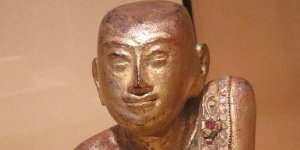
Sāriputta (Śāriputra) is one of the most important figures in the Theravāda tradition and is regarded as the Buddha’s "Chief Disciple" (alongside Moggallana). He was often referred to as the Dhammasenapati, or the "General of the Dhamma."
»
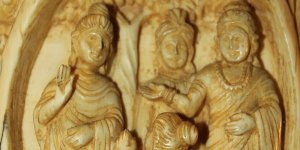
Mahā Moggallāna (Maudgalyāyana) was one of the Buddha's two chief disciples, alongside Sāriputta. While Sāriputta was renowned for wisdom, Mahā Moggallāna was regarded as 'foremost in psychic powers' (iddhi). »
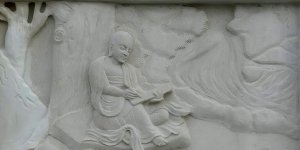
Legend says Nagarjuna was born to a Brahmin family in South India. At his birth, an astrologer predicted the boy would die at the age of seven. To prevent his parents from witnessing his death, they sent him to the great Buddhist university of Nalanda. »
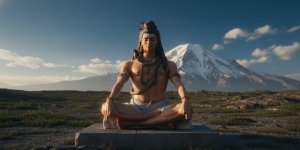
To tell the story of Shiva is not to tell a linear biography, for Shiva is Anadi (without beginning) and Ananta (without end). His story is the story of consciousness itself—the silent observer of the cosmic play.
In the vast pantheon of Sanatana Dharma no figure is as paradoxical as Shiva. He is the Mahadeva—the Great God. He is the supreme ascetic, sitting in frozen silence on the peaks of Mount Kailash, yet he is the cosmic dancer whose rhythm shatters the universe. He is the terrifying Bhairava who haunts cremation grounds, yet he is Bholenath, the innocent one, easily pleased by the simplest prayer. »
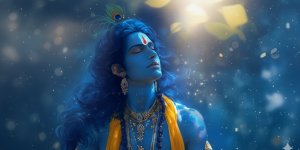
Krishna is the complete incarnation of God, because he experienced every aspect of the human condition: birth, play, love, loss, politics, war, and death
The story of Krishna is not merely a biography; it is a cosmic drama that spans the realms of the earthly and the divine. To understand Krishna is to understand the heartbeat of ancient India—a blend of mischievous childhood, romantic yearning, royal duty, and profound spiritual philosophy. »
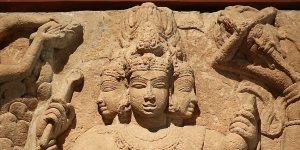
To understand Brahma is to understand the Hindu concept of time, the nature of the mind, and the eternal cycle of the universe.
In the Hindu Trinity (Trimurti), Brahma is the Creator, Vishnu is the Preserver, and Shiva is the Destroyer. While Vishnu and Shiva are worshipped in millions of temples worldwide, Brahma is a deity of the mind and the past, often left out of ritual worship due to ancient curses and philosophical shifts. »
To understand Vishnu is to understand the heartbeat of time itself. What follows is a comprehensive exploration of his essence, his iconography, and the ten primary incarnations—the Dashavatara—that define his legend across the eons.
The legend of Vishnu is not a single story, but an infinite tapestry of cosmic cycles, divine interventions, and the eternal struggle to maintain Dharma. As the "Preserver" in the Hindu Trinity, Vishnu is the force that sustains the universe between the creation by Brahma and the eventual dissolution by Shiva. »
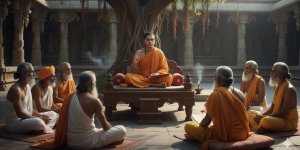
In the quaint village of Kalady, nestled on the banks of the Periyar River in present-day Kerala, India, a child was born to a Nambudiri Brahmin couple, Shivaguru and Aryamba. This child, named Shankara, was destined to become one of India's greatest thinkers and spiritual leaders. »
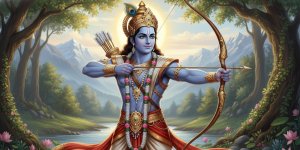
To hear the story of Rama, as the tradition says, is to be reminded that even in the darkest forest, the light of Dharma never truly goes out.
The story of Rama is a blueprint for human conduct. Rama is the Maryada Purushottama—the perfect man who never deviates from the law, even at the cost of his own heart. »
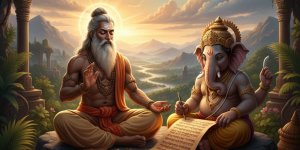
Vyasa is the quintessential sage-scholar of Hinduism. His life story, from his miraculous birth to his monumental literary achievements and his pivotal role in the Mahabharata's narrative, is a saga of divine purpose, intellectual prowess, and unwavering commitment to dharma. »
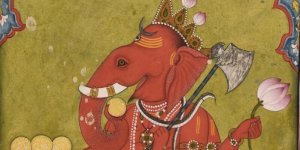
Known as the Remover of Obstacles (Vighnaharta), the Lord of Beginnings, and the Patron of Arts and Sciences, Ganesha occupies a unique position in the Hindu pantheon. He is the first to be worshipped in any ritual, the bridge between the mundane and the divine. »
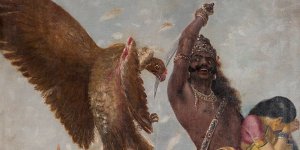
To understand Ravana is to understand the terrifying duality of existence, where the highest spiritual knowledge can coexist with the darkest earthly desires.
The story of Ravana is not merely about a villain who gets defeated. It is a profound philosophical epic that teaches a chilling truth: no amount of wealth, no degree of intelligence, and no intensity of religious devotion can save a soul if it abandons morality and surrenders to the ego. Ravana was a being capable of touching the stars, but his own shadow dragged him back to the dust. »
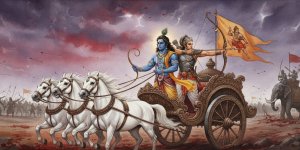
The Mahabharata is one of the two major Sanskrit epics of ancient India. Traditionally ascribed to the sage Vyasa, it is an epic narrative of the Kurukshetra War and the fates of the Kaurava and Pandava princes. More than just a story of a dynastic struggle, it is a vast repository of Hindu philosophy, ethics, statecraft, cosmology, and theology, famously containing the Bhagavad Gita. »
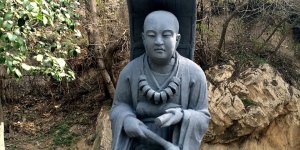
The story of Xuanzang is one of the greatest real-life adventure tales in human history. He was a Chinese Buddhist monk, scholar, traveler, and translator who walked thousands of miles from China to India and back. »

The legend of Kapila is one of the most significant in Hindu mythology and Vedic philosophy. He is revered as an incarnation of Lord Vishnu and is credited as the founder of the Samkhya school of philosophy, one of the oldest systematic thought systems in India. »
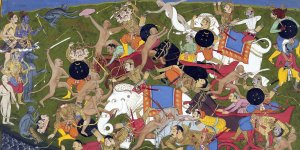
The Ramayana is not merely a story of ancient kings and demons; it is a profound sociological, psychological, and spiritual text. It explores the extreme sacrifices required by Dharma.
The Ramayana is one of the foundational epics of India and world literature. Attributed to the ancient sage Valmiki, it is far more than a simple tale of good triumphing over evil. It is a profound philosophical exploration of Dharma—duty, righteousness, and cosmic order. »
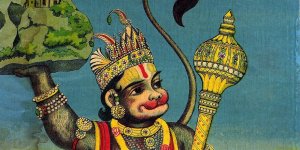
The epic story of Hanuman, the supreme devotee, the embodiment of strength, intellect, and unconditional love
In the vast and colorful tapestry of Hindu mythology, few figures shine as brightly or are as universally revered as Hanuman. He is the monkey god, the ultimate symbol of Bhakti and Shakti. He is a scholar of the Vedas, a peerless warrior, an accomplished musician, and, most importantly, the greatest devotee of Rama. »
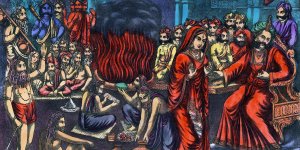
The story of Shiva and Sati is one of the most powerful and emotional tales in Hindu mythology — a story of love, pride, sacrifice, and cosmic transformation.
The love between Shiva and Sati (and later Parvati) is considered one of the most sacred unions in Hindu tradition — representing the inseparable nature of divine masculine and feminine forces. »