| / Stories, Legends, Myths |
The Story of Hanuman
In the vast and colorful tapestry of Hindu mythology, few figures shine as brightly or are as universally revered as Hanuman. He is the monkey god, the ultimate symbol of Bhakti (devotion) and Shakti (power). He is a scholar of the Vedas, a peerless warrior, an accomplished musician, and, most importantly, the greatest devotee of Rama.
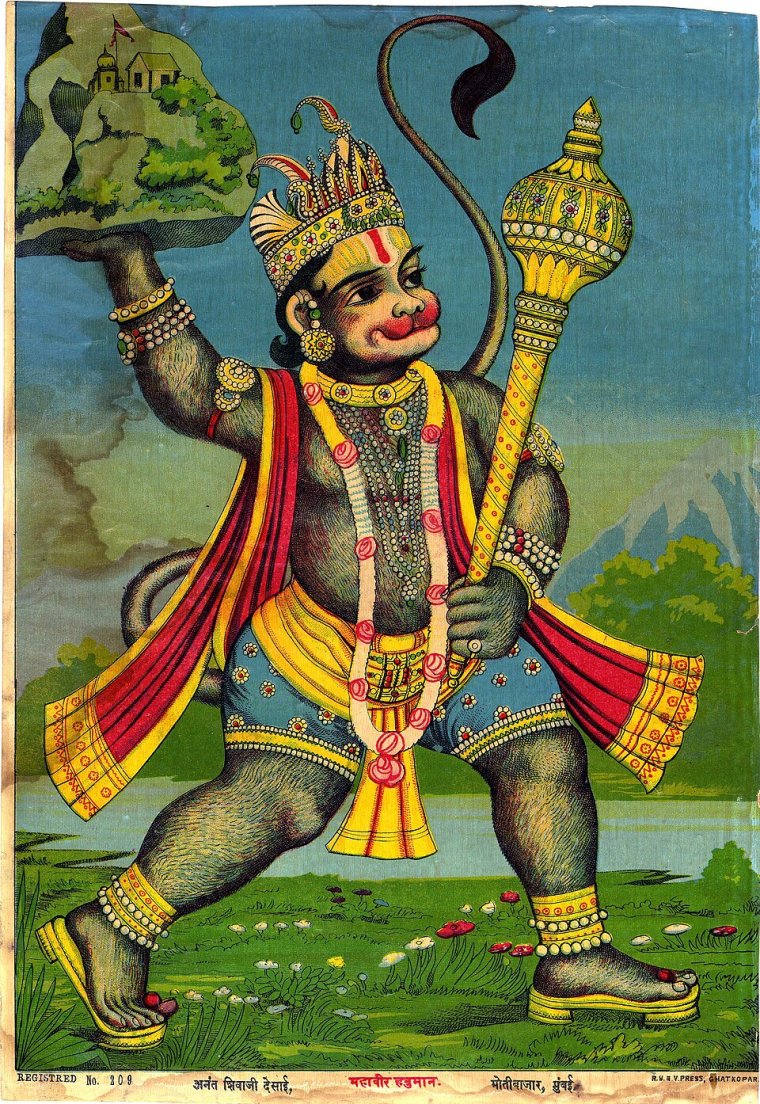
Hanuman fetches the herb-bearing mountain. Photo: A print from the Ravi Varma Press, 1910s /British Museum/Wikipedia
Hanuman’s story is not just a tale of superhuman feats; it is a profound philosophical journey illustrating how infinite power, when coupled with absolute surrender to the divine, achieves the impossible.
Known by many names—Maruti, Anjaneya, Bajrangbali, Mahavira, and Pavanputra—Hanuman is a central figure in the Indian epic, the Ramayana. However, his presence transcends this single epic, weaving through the Mahabharata and various Puranas, cementing his status as a Chiranjeevi—an immortal who walks the earth to this day, listening wherever the name of Rama is chanted.
1. A Divine Birth
The origins of Hanuman are deeply rooted in divine providence. His mother, Anjana, was originally a celestial maiden (an apsara) named Punjikasthala. Due to a curse by a sage, she was born on earth as a Vanara (a monkey-like humanoid race).
She could only be freed from this curse if she gave birth to an incarnation of Shiva. Anjana married Kesari, a powerful Vanara chieftain. Together, they performed intense penance for years, praying to Shiva for a child.
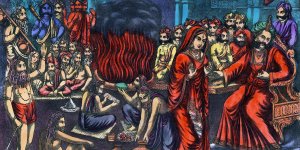
Simultaneously, in the kingdom of Ayodhya, King Dasharatha was performing the Putrakameshti Yagna (a fire sacrifice) to obtain heirs. The god of fire, Agni, emerged from the flames and handed Dasharatha a bowl of sacred sweet pudding (payasam), instructing him to share it among his wives. As Dasharatha did so, a kite swooped down, snatched a portion of the divine pudding, and flew away.
Guided by the divine will of Shiva, Vayu, the God of Wind, created a powerful gust that blew the pudding from the bird's talons, dropping it directly into the hands of Anjana, who was deep in prayer. Believing it to be a blessing from Shiva, she consumed it. Thus, Hanuman was conceived. Because Vayu delivered the divine essence, Hanuman is known as Pavanputra or Vayuputra (Son of the Wind). He is also considered the eleventh Rudra avatar of Shiva.
2. The Sun-Eater and the Bestowal of Boons
Hanuman was a child of boundless energy and unparalleled strength. One morning, the young Hanuman awoke with a ravenous appetite. Looking up at the sky, he saw the rising sun. To the divine toddler, the glowing red orb looked like a giant, luscious, ripe mango. With the power of the wind in his blood, Hanuman leapt into the cosmos to eat it.
His ascent was terrifyingly swift. As he neared the sun, the solar deity Surya was alarmed, but even more alarmed was Rahu, a shadow demon who was scheduled to eclipse the sun that day. Hanuman easily brushed Rahu aside. Humiliated, Rahu fled to Indra, the King of the Gods, complaining that a monstrous child was trying to swallow the sun.
Indra mounted his celestial elephant, Airavata, and rode out to stop the child. Seeing Hanuman approaching the sun, Indra hurled his ultimate weapon, the Vajra (thunderbolt). The weapon struck Hanuman squarely on the jaw, sending the child plummeting back to earth, lifeless. The impact disfigured his jaw, which is how he received the name "Hanuman" (from the Sanskrit words Hanu, meaning jaw, and Man, meaning prominent or disfigured).
Witnessing the death of his son, Vayu, the Wind God, was consumed by grief and rage. He withdrew from the universe, taking all the air with him. Instantly, all life across the cosmos began to suffocate. The gods, realizing their catastrophic error, rushed to Vayu. Brahma, the creator, revived the young monkey.
To appease Vayu, the gods showered the infant with extraordinary boons: Brahma blessed him with immunity from any curse and the ability to change his form at will, Shiva granted him the boon of longevity, immense wisdom, and invincibility against his weapons, Indra declared that the Vajra would never again harm him, Surya granted him a fraction of his brilliance, Yama (God of Death) granted him immunity from death, and Vishwakarma (the divine architect) made him immune to all celestial weapons.
Hanuman was now essentially immortal, invincible, and possessed of unimaginable power.
3: The Curse of Forgetfulness and Education
Power without discipline is dangerous. The young Hanuman, brimming with his new boons, became a menace to the sages living in the forests. He would playfully uproot their trees, disrupt their sacrifices, and steal their sacred implements. Knowing he was a child, the sages initially tolerated him, but his mischief soon crossed all bounds.
Finally, a group of sages placed a mild but highly consequential curse upon him: Hanuman would forget all his divine powers. He would live as an ordinary Vanara. He would only remember his god-like strength and abilities when someone reminded him of his true nature and his divine purpose. This curse humbled the young deity, transforming his boons into dormant potential.
As he grew older, Hanuman desired an education. He chose Surya, the Sun God, as his guru. Surya hesitated, stating that he was constantly moving across the sky in his chariot, making it impossible to teach. Hanuman, undeterred, simply enlarged his body, placed one foot on the eastern horizon and the other on the western horizon, and flew backward across the sky, keeping pace with Surya's chariot. Impressed by his dedication, Surya taught him the Vedas, the Shastras, and all forms of knowledge.
When it was time to pay Gurudakshina (the teacher's fee), Surya asked Hanuman to serve and protect his son, Sugriva, a Vanara prince in the kingdom of Kishkindha. Hanuman gladly accepted, becoming Sugriva's most trusted minister, friend, and protector.
4: The Turning Point - Meeting Rama
Years later, a fierce rivalry broke out in Kishkindha between Sugriva and his immensely powerful older brother, Vali. Due to a misunderstanding, Vali exiled Sugriva and kept Sugriva’s wife captive. Sugriva, alongside Hanuman and a few loyal ministers, took refuge on the Rishyamukha mountain, a place Vali could not enter due to a curse.
One day, two handsome, armed ascetics approached the mountain. Fearing they were assassins sent by Vali, Sugriva asked Hanuman to investigate. Hanuman disguised himself as a humble Brahmin priest and approached the strangers.
These strangers were Rama, an avatar of Vishnu, and his brother Lakshmana. They were searching for Rama’s wife, Sita, who had been abducted by the demon king, Ravana.
As the "Brahmin" spoke to Rama, Rama was mesmerized. He turned to Lakshmana and noted that the priest's speech was perfect; he had not mispronounced a single syllable, nor used a single improper gesture. Hearing Rama's gentle and divine voice, a profound awakening stirred within Hanuman.
The illusion of his disguise melted away. He fell at Rama's feet, weeping tears of pure joy. At that exact moment, the supreme soul (Rama) and the supreme devotee (Hanuman) recognized each other. Hanuman realized that the sole purpose of his existence was to serve Rama.
Hanuman carried Rama and Lakshmana on his shoulders up the mountain to meet Sugriva. In front of a sacred fire kindled by Hanuman, Rama and Sugriva formed an alliance. Rama promised to kill Vali and restore Sugriva’s throne, while Sugriva promised to use his Vanara army to search all corners of the earth for Sita.
True to his word, Rama slew Vali. Sugriva was crowned king, but soon became lost in the pleasures of royalty, forgetting his promise. It was Hanuman who sternly reminded Sugriva of his duty. Roused to action, Sugriva dispatched search parties to the four corners of the world. The southern party, the most crucial one, was led by Angada (Vali's son) and guided by the wisdom of Hanuman and the bear-king Jambavan. Before they left, Rama handed Hanuman his signet ring, knowing in his heart that if anyone could find Sita, it was Hanuman.
5: The Sundara Kanda - The Search for Sita
The southern search party reached the edge of the Indian subcontinent. Before them lay the vast, roaring ocean. They learned from a vulture named Sampati that Ravana had taken Sita to the island kingdom of Lanka, located a hundred yojanas (roughly 800 miles) across the sea.
Despair set in among the Vanaras. None of them could leap that far. Hanuman, bound by his childhood curse, sat silently apart from the group, unaware of his own capacity.
It was here that Jambavan, the wise old bear, stepped forward. He began to sing praises of Hanuman’s birth, his attempt to eat the sun, and the boons granted by the gods. As Jambavan spoke, the curse broke. Hanuman began to grow in size. The earth trembled beneath his feet as his dormant powers surged through his veins. Standing tall like a mountain, Hanuman roared, declaring he would leap across the ocean, destroy Lanka, and bring Sita back.
The Great Leap
Hanuman scaled the Mahendra Mountain. Pressing his feet against the rock—with such force that the mountain sank slightly into the earth—he launched himself into the sky. His leap is one of the most celebrated events in Hindu mythology.
During his flight, the gods decided to test his strength and intellect.
Mainaka: The mountain of gold rose from the sea, offering Hanuman a place to rest. Hanuman respectfully touched the mountain but declined, stating he could not rest until Rama's work was done.
Surasa: The mother of serpents was sent by the gods to test his wit. She blocked his path, saying she had a boon that anyone passing must enter her mouth. Hanuman agreed. As she opened her mouth wide, Hanuman expanded his body. Surasa opened her mouth wider. This continued until Surasa's mouth was massive. Suddenly, Hanuman shrank to the size of a thumb, darted into her mouth, and flew out through her ear before she could snap her jaws shut. Having fulfilled the condition of her boon, Surasa blessed him.
Simhika: A terrifying demoness who caught her prey by gripping their shadow from the water below. She caught Hanuman's shadow, dragging him down. Hanuman simply flew into her gaping maw, ripped her apart from the inside, and continued his journey.
Finding Sita
Arriving at the shores of Lanka, Hanuman shrank to the size of a cat to avoid detection. He wandered through the opulent, gold-laden streets of Ravana’s capital. He searched palaces, mansions, and even Ravana’s chambers, but Sita was nowhere to be found.
Finally, he stumbled upon the Ashoka Vatika, a beautiful grove of trees. There, sitting under a tree, surrounded by hideous demonesses, was a frail, weeping woman. Her brilliance was faded, but her divine aura confirmed her identity. It was Sita.
Hanuman hid in the branches above and softly began to recite the story of Rama. Hearing her husband's name, Sita looked up. Hanuman climbed down, folding his hands in reverence, and introduced himself as Rama's messenger. To prove his identity, he handed her Rama’s signet ring.
Sita wept with joy. Hanuman offered to carry her back to Rama on his shoulders. However, Sita, a paragon of virtue and dignity, refused. She stated that she would not willingly touch another man, and that it was Rama's duty—and his honor—to defeat Ravana and rescue her himself. She then gave Hanuman her Choodamani (a divine hair ornament) to take back to Rama as proof that she was alive.
The Burning of Lanka
His primary mission accomplished, Hanuman decided to assess the enemy's strength. He began to uproot the trees of the Ashoka grove, destroying the beautiful garden. When Ravana’s guards attacked, Hanuman slaughtered them. Ravana sent his youngest son, Akshayakumara, whom Hanuman also killed.
Finally, Ravana sent his mightiest son, Indrajit. Indrajit fired the Brahmastra, the ultimate weapon of Brahma. Though Hanuman was immune to it due to Brahma's boon, he chose to surrender out of respect for the weapon's creator, and to secure an audience with Ravana.
Bound in ropes, Hanuman was brought into Ravana’s grand court. Unintimidated, Hanuman expanded his tail, coiled it to create a seat higher than Ravana’s throne, and sat on it. He advised Ravana to return Sita and beg for Rama's forgiveness.
Enraged by the monkey's insolence, Ravana ordered his execution. However, Ravana’s brother, the righteous Vibhishana, intervened, stating it was against the rules of statecraft to kill an envoy. Instead, Ravana ordered that Hanuman’s tail—the pride of a monkey—be set on fire.
The demons wrapped rags around Hanuman's tail, poured oil over it, and set it ablaze. But Hanuman used his shape-shifting powers to lengthen his tail, requiring more and more cloth and oil, exhausting Lanka's supplies. Once his tail was burning fiercely, Hanuman shrank, slipped out of his bonds, and leapt from roof to roof. With a sweep of his flaming tail, he set the magnificent city of Lanka on fire. Leaving the city in ruins, he dipped his tail in the ocean to extinguish the flame and leapt back to the northern shore.
Upon reuniting with the Vanara army, Hanuman uttered two simple but profound words: "Seen Sita." He did not boast of his leap or his destruction of Lanka; his only focus was delivering the good news to Rama.
6. The Yuddha Kanda - The Great War
When Hanuman presented the Choodamani to Rama, Rama embraced him tightly, declaring that he could never repay the debt he owed Hanuman.
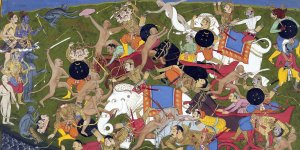
The Vanara army marched to the sea, built a miraculous bridge of floating stones (Ram Setu), and crossed into Lanka. The great war began. Throughout the battle, Hanuman was Rama's greatest general and protector. He fought fiercely, destroying battalions of demons.
The Sanjeevani Mountain
The most critical moment of Hanuman’s participation in the war occurred when Indrajit, using dark magic, struck Lakshmana with a deadly weapon. Lakshmana fell unconscious, hovering near death. The royal physician stated that the only cure was the Sanjeevani (life-restoring) herb, which grew exclusively on the Dronagiri mountain in the Himalayas. The herb had to be brought before sunrise, or Lakshmana would die.
Hanuman immediately launched himself into the sky, flying north at the speed of thought. Ravana, knowing of this mission, sent a sorcerer named Kalanemi to intercept him. Kalanemi created a magical hermitage and disguised himself as a sage, inviting Hanuman to bathe in a lake. In the lake, a crocodile attacked Hanuman. Hanuman killed it, freeing an apsara from a curse, who then warned him of Kalanemi’s deceit. Hanuman swiftly dispatched Kalanemi and reached the Himalayas.
However, upon reaching the Dronagiri mountain, Hanuman found that the magical herbs were hiding themselves from him. With time running out and unable to identify the specific Sanjeevani herb, Hanuman’s colossal intellect provided a simple solution. He grew to a massive size, uprooted the entire Dronagiri mountain, balanced it on the palm of his hand, and flew back to Lanka.
Seeing him fly across the night sky with a glowing mountain, the Vanara army roared in triumph. The physician extracted the Sanjeevani, and Lakshmana was revived. Once again, Hanuman had saved the day.
The Rescue from Patala (The Underworld)
In another less-known but vital episode, Ravana enlisted the help of Ahiravana, the king of Patala (the underworld). Ahiravana used dark magic to kidnap the sleeping Rama and Lakshmana, intending to sacrifice them to the goddess Kali.
Hanuman dove into the underworld. To rescue his lords, he had to defeat Ahiravana, whose life force was hidden in five lamps facing different directions. The lamps had to be extinguished simultaneously. To achieve this, Hanuman manifested his spectacular Panchamukhi (five-faced) form.
The faces were: Hanuman (Monkey) facing East, Narasimha (Lion) facing South, Garuda (Eagle) facing West, Varaha (Boar) facing North, and Hayagriva (Horse) facing upward.
With these five mouths, he blew out the five lamps simultaneously, killed Ahiravana, and carried Rama and Lakshmana back to the battlefield on his shoulders.
Ultimately, Rama killed Ravana, fulfilling his avataric purpose. Sita was rescued, and the period of their exile came to an end.
7. The Return to Ayodhya and Immortality
The triumphant return of Rama to Ayodhya was celebrated with unprecedented joy. Rama was crowned King, and the era of Ram Rajya (a period of perfect peace and righteousness) began.
During the coronation ceremonies, Rama gave gifts to all his allies. Sita took a magnificent necklace of pearls, a gift from the God of the Sea, and looked at Rama. Rama nodded, telling her to give it to the one she valued most. Sita handed the necklace to Hanuman.
Hanuman accepted it with deep reverence. However, the court watched in shock as he took the necklace apart, cracking each priceless pearl between his teeth, peering inside, and throwing the pieces away.
Vibhishana, appalled, asked Hanuman why he was destroying such a priceless gift. Hanuman simply replied, "I am looking for my Lord Rama and Mother Sita in these pearls. Anything that does not contain them is of no value to me."
A courtier mocked him, asking, "If Rama and Sita must be in everything of value, are they inside you?"
Without a moment's hesitation, Hanuman used his sharp claws to rip open his own chest. The court gasped in awe. There, beating within his physical heart, was a glowing, living image of Lord Rama and Goddess Sita. Hanuman had proven that he did not just serve Rama; Rama resided at the very core of his being.
When it was time for Rama to leave his earthly body and return to his cosmic form as Vishnu in Vaikuntha, he invited all his loyal followers to accompany him. However, Hanuman declined the offer. He asked for a single boon: as long as the story of Rama is told and the name of Rama is chanted on earth, Hanuman wished to remain alive to hear it.
Deeply moved, Rama granted this boon, making Hanuman a Chiranjeevi (an immortal).
8. Hanuman in the Mahabharata
Because of his immortality, Hanuman makes notable appearances in the Mahabharata, which takes place in the next Yuga (epoch), thousands of years after the Ramayana.
Hanuman is considered the spiritual brother of Bhima, the physically strongest of the Pandava princes, as both are sons of Vayu, the Wind God. In one famous episode, Bhima was wandering the forest, full of arrogance about his immense strength. He found his path blocked by an old, frail monkey whose tail lay across the trail.
Bhima arrogantly ordered the monkey to move its tail. The monkey weakly replied that he was too old, and suggested Bhima move it himself. Bhima laughed and tried to kick the tail aside. It didn't budge. He used his hands, straining with all his mighty strength, but he could not lift the tail even a fraction of an inch.
Humbled and exhausted, Bhima realized this was no ordinary monkey. He folded his hands and asked for the monkey's true identity. Hanuman revealed his magnificent form, embraced his brother, and taught him that physical strength is meaningless without humility.
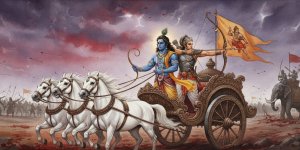
Later, during the great Kurukshetra War, Hanuman granted a boon to Arjuna, another of the Pandava brothers. He promised to reside on the flag of Arjuna's chariot. Throughout the catastrophic eighteen-day war, the terrifying roars of Hanuman emanating from the flag struck terror into the hearts of the enemy army and protected Arjuna's chariot from celestial weapons.
The Eternal Resonance of Bajrangbali
The story of Hanuman is not merely a mythological record; it is a spiritual blueprint. He represents the highest potential of the human soul. Hanuman possesses physical prowess that rivals the gods, an intellect that mastered the Vedas, and magical abilities that defy the laws of nature.
Yet, he never uses these powers for self-aggrandizement. He possesses no ego. Every ounce of his energy is sublimated into Seva (selfless service) to the divine.
In Hinduism, chanting the Hanuman Chalisa—a forty-verse hymn dedicated to him, written by the poet Tulsidas—is believed to invoke his protection, dispel fear, and cure ailments.
He is the patron deity of wrestlers, martial artists, and students, representing the perfect balance of physical discipline and intellectual pursuit.
Today, thousands of years after the epic was first written, the legacy of Hanuman remains vibrantly alive. Statues of him, painted in bright saffron or vermillion, stand watch over villages, crossroads, and mountain peaks across India and beyond.
True to the boon granted by Rama, it is believed that wherever the Ramayana is recited, Hanuman sits quietly in the audience, hands folded, tears of devotion in his eyes, listening eternally to the glories of his beloved Lord.
YOU MAY ALSO LIKE