| / Stories, Legends, Myths |
Story of Shiva and Sati
The story of Shiva and Sati in brief
The story of Shiva and Sati is one of the most powerful and emotional tales in Hindu mythology — a story of love, pride, sacrifice, and cosmic transformation.
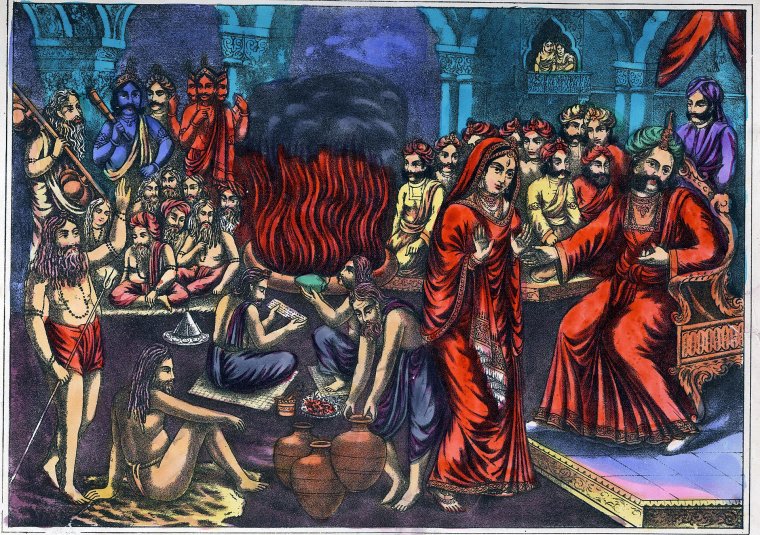
Sati, the first wife of Shiva, stands facing her father Daksha, seated on a throne. They argue after Daksha defiled a statue of the god and refused to invite Shiva to the sacrifice. Sati commits suicide in grief for her beloved. A sadhu, symbolising Shiva, is seated in the foreground. Photo: Album of popular prints mounted on cloth pages,1895, Calcutta / British Museum.
Sati was the daughter of Daksha, a powerful king and one of the sons of Brahma. Though born into royalty, Sati was deeply devoted to Shiva, the ascetic god who lived in the Himalayas, covered in ash, with matted hair and serpents as ornaments.
Daksha despised Shiva. He saw him as wild, improper, and unworthy of his daughter.
But Sati loved Shiva with unwavering devotion. She performed intense penance to win him as her husband, and eventually Shiva accepted her love. They married and lived in deep spiritual union on Mount Kailash.
Daksha organized a grand yajna (sacred fire ritual), inviting all the gods and celestial beings — except Shiva and Sati. It was a deliberate insult.
When Sati learned about the ceremony, she wished to attend. Shiva gently warned her that she had not been invited and would not be welcomed. Still, Sati believed that as a daughter she had the right to attend her father’s gathering. She went alone.
At the yajna, Daksha publicly insulted Shiva, mocking him in front of everyone. Sati was devastated. She realized that she could not bear the humiliation directed at her beloved husband.
In intense sorrow and righteous anger, Sati declared that she could no longer maintain a body born of Daksha. She entered deep meditation and immolated herself in the sacrificial fire.
When Shiva learned of Sati’s death, his sorrow turned to cosmic fury.
From a lock of his hair, he created Virabhadra, a fierce warrior, who stormed the yajna and destroyed it. Daksha was killed (in some versions, later revived with a goat’s head).
Shiva, heartbroken, carried Sati’s lifeless body and wandered across the universe in grief. His sorrow threatened cosmic balance.
To restore order, Vishnu used his Sudarshana Chakra to gently cut Sati’s body into pieces. Wherever a piece fell became a sacred site known as a Shakti Peetha — holy temples dedicated to the Divine Mother.
Sati was later reborn as Parvati, daughter of Himavan, the king of the Himalayas. Once again, she performed great austerities to win Shiva’s love.
Eventually, Shiva accepted her, and their union symbolized the eternal balance between consciousness (Shiva) and energy (Shakti).
The love between Shiva and Sati (and later Parvati) is considered one of the most sacred unions in Hindu tradition — representing the inseparable nature of divine masculine and feminine forces.
The story of Shiva and Sati as told by various puranas
Sati was the daughter of Daksha, a Prajapati (agent of creation) and the son of the creator god Brahma and Prasuti, the daughter of Manu.
In some alternate accounts found in the Shiva Purana, Matsya Purana and Kalika Purana, her mother is mentioned to be Asikni.
Sati is often mentioned as the youngest and the most beloved daughter of Daksha.
According to the Shakta (goddess-oriented) texts including Devi Bhagavata and the Mahabhagavata Purana, before her birth, Brahma advised Daksha to meditate upon the Great goddess and convince her to take an avatar as their daughter (Sati).
The goddess agreed but warned that if he mistreated her, she would abandon her body.
Even as a child, Sati adored the tales of Shiva and grew up an ardent devotee.
As she grew to womanhood, the idea of marrying anyone else, as intended by her father, became unfair to her. It is believed that Brahma intended to get Sati married to Shiva and bring him into worldly affairs.
Sati is described to be very beautiful but the legends emphasize her penance and devotion, which won the heart of the ascetic Shiva.
According to the legend, Sati left the luxuries of her father's palace and retired to a forest to devote herself to austerities of a hermetic life and the worship of Shiva.
She was often tested by him or his attendants. Finally, Shiva acceded to her wishes and consented to marry. Despite Daksha's unwillingness, the wedding was held in due course with Brahma serving as the priest. Sati moved with Shiva in Kailash.
Tension between Shiva and Daksha further arises when Daksha starts to dislike Shiva because of Shiva's odd appearance and behaviour.
According to the Bhagavata Purana, Daksha arranged Sati's svayamvara (self-choice ceremony), where all except Shiva were invited.
When Sati did not find Shiva, she threw a garland in the air to choose her husband. Shiva manifested there and it fell on him, thus they were married.
In the 18th century Svathani Katha, when Shiva asked Sati's hand in marriage, Daksha refused, claiming him unsuitable.
Vishnu aided Shiva by disguising him as a sannyasi and had him marry her.
While many versions of the tale mention Daksha's objections to the marriage, the Shiva Purana does not mention any harsh opposition, though he starts to develop a deep hatred after the wedding.
The most prominent legend associated with Sati is her self-immolation to protest against her father.
The first text to mention Daksha Yajna is the Taittiriya Samhita and it later appears in the Ramayana and the Mahabharata. The narrative of Sati's self immolation appears in the Puranas, Tantra literature, and in Kalidasa's lyrical Kumarasambhava.
According to the most popular narrative, Daksha organized a yajna (sacrifice) to which all the deities, except Sati and Shiva, were invited.
Wanting to visit her relatives, Sati sought to rationalize this omission and reasoned that as family, such formality was unnecessary.
Shiva tried to stop her as he knew that Daksha would humiliate her, but when she was not convinced, he sent her with his gana attendants.
Sati was received by her mother and her sisters, but Daksha was furious by her uninvited arrival and humiliated her and mocked Shiva. Wanting to break all ties with her father and uphold the honour of her husband, Sati self-immolated.
Deeply hurt by the death of his wife, Shiva performed the destructive Tandava dance.
He created two ferocious deities — Virabhadra and Bhadrakali, who wreaked mayhem at the sacrificial place. Nearly all those present were felled overnight; Daksha was decapitated by Virabhadra.
After that night, Shiva, who is considered the all-forgiving, restored the slain to life and granted them his blessings. Daksha was restored both to life and to kingship. His severed head was substituted with that of a goat.
There are varying accounts of this event. The Devi-Bhagavata Purana adds the reason behind Daksha's harsh behaviour.
Shortly after Sati's marriage, Daksha polluted a sacred flower garland and as a result, he was cursed to hate his beloved daughter.
At the sacrificial place, after Daksha discarded Sati's gifts and humiliated her, she used her cosmic powers and burnt her body.
Some texts suggest that before Sati's death, Shakti promised that she will be reborn to a father who merits her respect and remarry Shiva.
The Mahabhagavata Purana presents Sati as a fierce warrior.
When Shiva prevented Sati from visiting the event, she transformed into the ten fearsome Mahavidya goddesses led by Kali, and surrounded him from the ten cardinal directions.
Seeing his wife's powers, Shiva allowed her. Sati, transformed as Kali, went to the sacrifice and split herself into two entities — one real but invisible and another just chhaya (shadow or clone).
Chhaya Sati destroyed the sacred event by jumping into the sacrificial fire, while the "real" Sati is reborn as Parvati.
The Brihaddharma Purana (c. 13th century) narrates the creation of the Mahavidyas but there is no mention of Sati splitting into two. She retains her calming nature after Shiva allowed her.
The most drastic change in this text is the absence of the self-immolation of Sati. Instead, the text mentions that she cursed her father and quit her body in a Himalayan cave.
The Kalika Purana does not mention Sati going to the event, instead it is found that Sati left her body using a yogic process, after her niece, Vijaya informed her about the yajna.
Another important legend associated with Sati is the formation of the Shakta pithas.
Shakta pithas are shrines of the Mother Goddess, believed to have enshrined with the presence of Shakti due to the falling of body parts of the corpse of Sati.
It is believed that an enraged Shiva performed the Tandava dance with Sati's charred body, which led her body to come apart and the pieces fell at different places on earth.
In a more detailed narration found in some texts, Shiva, crazed with grief, roamed with Sati's corpse throughout the universe, causing universal imbalance.
The divinities called upon the god Vishnu to restore Shiva to normalcy and calm. Vishnu used his Sudarshana Chakra (discus weapon) to dismember Sati's cadaver, following which Shiva regained his equanimity.
The legend ends with Sati's body being dismembered into many pieces which fell on earth at various places.
Several different listings of these holy places, known as Shakta pithas, are available; some of these places have become major centres of pilgrimage as they are held by the Goddess-oriented Shakta sect to be particularly holy.
Besides main Shakta pithas, some small peethas like Bindudham came into existence which are due to Sati's fallen blood drops.
A depressed Shiva returned to his ascetic world while Sati was reborn as Parvati, daughter of Himavat, king of the mountains and personification of the Himalayas, and his wife, Mena.
Himavat appreciated Shiva ardently. Consequently, Parvati like Sati, won Shiva over by her penance and married him. (Wikipedia)
YOU MAY ALSO LIKE