| / Stories, Legends, Myths |
The Life of Krishna
The story of Krishna is not merely a biography; it is a cosmic drama that spans the realms of the earthly and the divine. To understand Krishna is to understand the heartbeat of ancient India—a blend of mischievous childhood, romantic yearning, royal duty, and profound spiritual philosophy.
I. The Prophecy and the Prison
The story begins in the city of Mathura, under the iron grip of King Kansa. Kansa was a tyrant who had usurped the throne from his own father, Ugrasena. Though he was cruel, he loved his sister, Devaki.
On the day of her wedding to the noble Vasudeva, Kansa drove their chariot himself. Suddenly, a voice thundered from the heavens: “O Kansa, the eighth son of this sister you love so dearly shall be your slayer!”
Paralyzed by fear, Kansa drew his sword to kill Devaki on the spot. Vasudeva pleaded for her life, promising to hand over every child born to them if only she were spared. Kansa agreed but threw the couple into a lightless dungeon, shackled in heavy chains.
Year after year, Devaki gave birth. And year after year, Kansa entered the cell and murdered the infants. When the seventh child, Balarama, was conceived, he was miraculously transferred to the womb of Rohini (another wife of Vasudeva) to save him. Then came the eighth child.
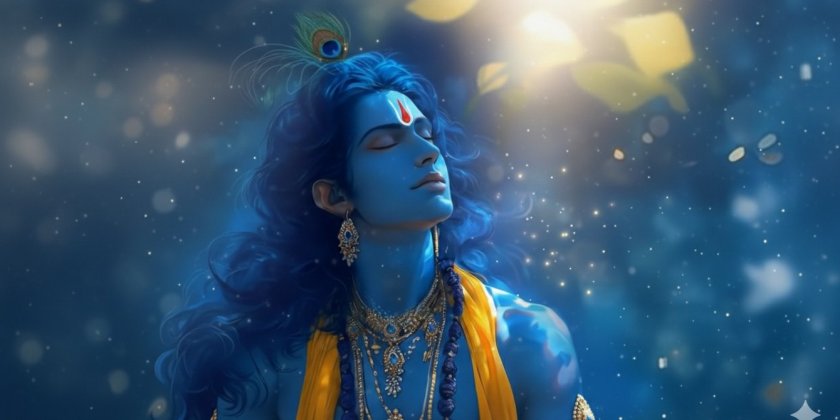
On a stormy midnight in the month of Bhadrapada, as the rain lashed against the stone walls of the prison, the universe held its breath. Suddenly, the cell was flooded with a celestial light. Vishnu appeared in his four-armed form before Vasudeva and Devaki, revealing that he was taking birth to restore Dharma (righteousness) to the world. He transformed into a beautiful infant with skin the color of a dark rain cloud.
The chains fell away. The prison guards fell into a deep, magical sleep. The massive iron doors swung open. Following divine instruction, Vasudeva placed the baby in a wicker basket and stepped out into the storm.
When he reached the Yamuna River, the waters were raging, but as the infant's toe touched the surface, the river parted, creating a path. A great serpent, Shesha, rose behind them, spreading its many hoods like an umbrella to keep the rain off the child.
Vasudeva reached the village of Gokul, entered the house of the cowherd chief Nanda and his wife Yashoda, and swapped the babies. Yashoda had given birth to a girl (an incarnation of Maya). Vasudeva returned to the prison with the girl. When Kansa arrived to kill the eighth child, the baby girl flew into the air, transforming into the goddess Durga. She laughed and told Kansa, "The one who will kill you has already been born. He is elsewhere!"
II. The Blossoming of the Blue God
Krishna grew up in the pastoral beauty of Gokul and later Vrindavan. This period of his life is known as the Lila—the divine play. Though he was the Lord of the Universe, he chose to live as a simple cowherd.
To his mother Yashoda, he was a handful. He was the Makhan Chor, the butter thief. He and his friends would form human pyramids to reach pots of butter hung high from the rafters. When Yashoda would catch him, he would look at her with wide, innocent eyes, his mouth still smeared with white cream, and claim he hadn't touched a drop.
Once, when he was accused of eating dirt, Yashoda forced his mouth open. Instead of mud, she saw the entire universe—the sun, the stars, the galaxies, and the mountains—revolving inside his tiny mouth. For a moment, she realized his divinity, but Krishna quickly cast his veil of Maya (illusion) over her, and she went back to seeing him only as her beloved son.
But danger was never far away. Kansa sent a parade of demons to find and kill the boy. There was Putana, the nurse-demon with poisoned milk; Trinavarta, the whirlwind demon; and Bakasura, the crane demon. Krishna dispatched them all with an ease that suggested he was merely playing a game.
As he grew into adolescence, Krishna’s beauty and the music of his flute became legendary. When he played, the cows stopped grazing, the birds ceased their chirping, and the Yamuna slowed its flow. Most affected were the Gopis, the cowherd women of Vrindavan.
Their love for Krishna was not worldly; it was the symbolic longing of the human soul for the Divine. Among them was Radha, whose soul was so intertwined with Krishna’s that they are often worshipped as a single entity: Radha-Krishna.
The most famous of his youthful miracles was the lifting of Govardhan Hill. The villagers used to worship Indra, the god of rain, out of fear. Krishna told them to worship the land and the mountain that actually sustained them.
Furious, Indra sent a devastating storm to drown the village. Krishna simply picked up the massive Govardhan mountain on his little finger, holding it aloft for seven days and nights like a giant umbrella, sheltering all the people and animals until Indra humbled himself and apologized.
III. The End of Tyranny and the Golden City
The time eventually came for the "play" of Vrindavan to end. Krishna was no longer a child; the world required a savior. When Kansa invited Krishna and Balarama to Mathura for a wrestling tournament—a trap intended to kill them—Krishna accepted.
The parting from Vrindavan was heartbreaking. The Gopis wept, and Radha stood in silent agony as the chariot pulled away. Krishna promised to return, but in truth, he never did. The playful cowherd was gone; the prince and the strategist had emerged.
In Mathura, Krishna and Balarama defeated Kansa’s strongest wrestlers. Finally, Krishna dragged Kansa from his throne and ended his life, fulfilling the prophecy. He freed his parents and reinstated Ugrasena as king. However, Kansa’s father-in-law, the powerful King Jarasandha, began a series of 17 relentless invasions of Mathura to avenge Kansa.
To protect his people, Krishna performed a feat of divine engineering. He led the Yadava clan hundreds of miles away to the western coast of India. There, he commanded the sea to recede and built Dwarka, a city of gold and emeralds rising out of the ocean.
In Dwarka, Krishna ruled as a king and a statesman. He married several queens, most notably Rukmini, who had sent him a secret letter pleading for him to rescue her from an unwanted marriage, and Satyabhama, a fierce woman who even accompanied him into battle.
IV. The Great War of Dharma
The later half of Krishna’s life was dominated by his relationship with his cousins, the Pandavas. The five Pandava brothers were the rightful heirs to the throne of Hastinapur, but their cousins, the Kauravas, led by the envious Duryodhana, had cheated them out of their kingdom.
Krishna became the Pandavas' greatest ally, friend, and mentor. He was particularly close to Arjuna, the peerless archer. Krishna tried every possible diplomatic avenue to avoid a war. He even went to the Kaurava court as a peace messenger, asking for only five villages for the five brothers. Duryodhana, blinded by ego, replied that he would not give them enough land to cover the point of a needle.
War was inevitable. Both sides sought Krishna’s help. Krishna offered a choice: one side could have his entire vast army (the Narayani Sena), and the other could have him alone—and he promised he would not pick up a weapon. Arjuna chose Krishna.
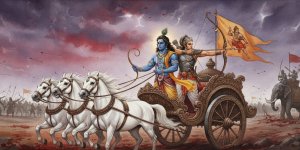
The two armies gathered on the field of Kurukshetra. As the conchs blew to signal the start of the carnage, Arjuna looked across the field and saw his grandfathers, teachers, and cousins. His bow, Gandiva, slipped from his trembling hands. He sat down on his chariot, paralyzed by grief and moral confusion. "I will not fight," he whispered.
It was then, in the center of the battlefield, that Krishna spoke the Bhagavad Gita. He explained that the soul is eternal and cannot be killed. He taught the importance of Nishkama Karma—acting according to one's duty without attachment to the results. He revealed his Vishwarupa, his Universal Form, showing Arjuna that all of creation, time, and death were contained within him. Strengthened by this divine knowledge, Arjuna stood up and fought.
For eighteen days, Krishna served as Arjuna's charioteer. He did not fight, but he directed the war with his mind. He used his divine intelligence to help the Pandavas overcome seemingly invincible warriors like Bhishma and Drona. When the sun was hidden or when a weapon of mass destruction was unleashed, Krishna’s presence was the shield that protected the Pandavas.
V. The Curse and the Final Departure
The Pandavas won the war, but the cost was staggering. Millions were dead. When the Pandavas went to the Kaurava queen-mother, Gandhari, to offer condolences, she was mad with grief over the loss of her 100 sons.
She blamed Krishna, believing that as a god, he could have stopped the war but chose not to. She cursed him: just as her family had destroyed itself, Krishna’s own Yadava clan would perish in internal strife, and he would wander alone in the woods to die a lonely death.
Krishna accepted the curse with a calm smile. He knew that everything that has a beginning must have an end.
Thirty-six years passed. Dwarka flourished, but the Yadavas became arrogant and decadent. One day, a petty argument broke out among the Yadava princes at a festival. It escalated into a full-scale civil war. Within hours, the entire clan—all of Krishna’s sons and grandsons—had killed one another. Balarama, Krishna's brother, gave up his life in meditation.
Krishna, seeing that his mission on Earth was complete, walked into the deep forest of Bhalka. He sat under a tree and entered a deep state of Yoga. A hunter named Jara, mistaking Krishna’s moving foot for the ear of a deer, shot a poisoned arrow.
The hunter was horrified when he realized he had struck the Lord. But Krishna blessed him, telling him it was all part of the divine plan. As Krishna’s spirit left his body, the age of Dvapara Yuga ended, and the current age, the Kali Yuga, began. The golden city of Dwarka was reclaimed by the sea, sinking beneath the waves just as Krishna had predicted.
The Legacy
Krishna is remembered as the Purna Avatara—the complete incarnation of God—because he experienced every aspect of the human condition: birth, play, love, loss, politics, war, and death.
Through the Bhagavad Gita, his voice continues to guide millions, reminding them that in the middle of life's battlefield, the Divine is always there, holding the reins of the chariot.
YOU MAY ALSO LIKE