| / Stories, Legends, Myths |
The Story of Ganesha
The story of Ganesha is not merely a singular myth but a celestial drama, and deep philosophical symbolism. Known as the Remover of Obstacles (Vighnaharta), the Lord of Beginnings, and the Patron of Arts and Sciences, Ganesha occupies a unique position in the Hindu pantheon. He is the first to be worshipped in any ritual, the bridge between the mundane and the divine.
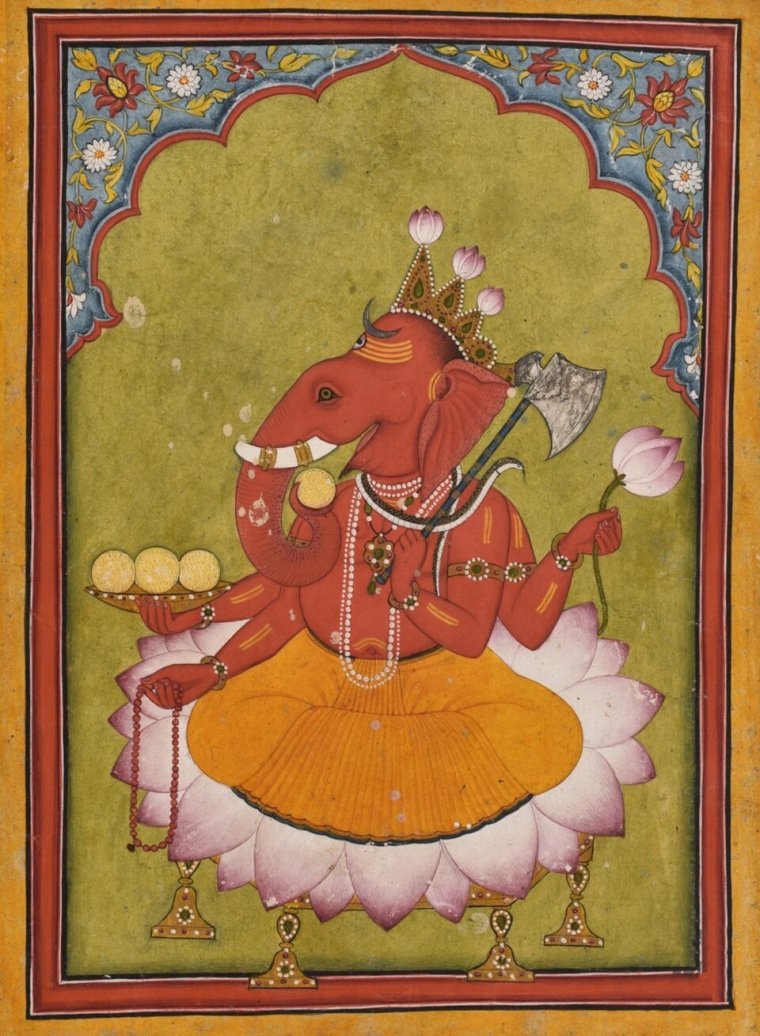
Ganesha getting ready to throw his lotus. (painting)
The Creation of the Guardian
The most famous legend of Ganesha’s birth begins with Parvati, the Divine Mother and consort of Lord Shiva. According to the Shiva Purana, Shiva was prone to long periods of deep meditation, often leaving Parvati alone in their mountain abode on Mount Kailash.
One day, desiring to take a bath and finding no one to guard the entrance to her chambers, Parvati felt a need for a loyal attendant who owed allegiance only to her. She took the turmeric paste and sandalwood from her own body—substances used for her ablutions—and fashioned the form of a young, handsome boy. With her divine breath, she infused him with life.
She named him her son and gave him a clear instruction: "Stand at the door. Let no one enter without my permission."
The boy, born of the Goddess’s will and essence, took his post with unwavering devotion. Shortly thereafter, Lord Shiva returned from his meditation. As he attempted to enter his own home, he was stopped by the boy.
Shiva, the destroyer of the universe, was perplexed. "Who are you to stop me?" he asked.
The boy replied firmly, "I am the son of Parvati, and I have orders to let no one pass."
Shiva, initially amused but then increasingly irritated, commanded his Ganas (his ghostly, loyal attendants) to remove the boy. However, the boy, empowered by Parvati’s energy, defeated the Ganas with ease. This escalated into a celestial battle. The gods—Indra, Agni, and even Vishnu—intervened, but the boy held his ground, fueled by the singular purpose of obeying his mother.
Finally, consumed by a rare and terrible rage (Krodha), Shiva took his trident (Trishula) and, in a swift motion, severed the boy’s head.
The Transformation and the Elephant Head
When Parvati emerged and saw her son lying lifeless and headless, her grief was boundless. Her sorrow quickly turned into a terrifying fury. She assumed the form of Adi Parashakti—the primordial power—and threatened to dissolve the entire cosmos. "How can a father kill his own son?" she cried.
The gods, trembling at the prospect of universal annihilation, pleaded with Shiva to rectify the situation. Shiva, now calm and realizing the boy’s merit, sought to appease Parvati. He commanded his followers to go into the forest and bring back the head of the first living creature they found facing the north, whose mother was not looking at it (symbolizing a detachment from the ego).
The followers encountered a young elephant. Some versions of the myth suggest it was Airavata’s offspring; others say it was Gajasura, a demon-devotee who had asked Shiva to be remembered forever. They took the head of the elephant and brought it back to Kailash.
Shiva attached the elephant head to the boy’s body and breathed life into him once more. The boy rose, now bearing the head of an elephant. To further appease Parvati and honor the boy’s incredible loyalty, Shiva declared that the boy would be the leader of his Ganas, bestowing upon him the name Ganapati (Lord of the Ganas). Furthermore, Shiva decreed that no prayer, ritual, or venture would be successful without first invoking Ganesha’s name.
The Race Around the World: Wisdom vs. Strength
As Ganesha grew, he lived alongside his brother, Kartikeya (also known as Murugan or Skanda), a fierce warrior and the commander of the gods' army. While Kartikeya was lean, athletic, and rode a swift peacock, Ganesha was portly and rode a humble mouse (Mushika).
A famous legend tells of a competition between the two brothers. The gods offered a miraculous fruit—the Jnana Phala (the fruit of knowledge)—to whoever could circle the world three times and return first.
Kartikeya immediately leapt onto his peacock and soared into the sky. He flew over oceans, mountains, and continents, determined to win through speed and physical prowess.
Ganesha, however, paused. He knew his mouse could never compete with a peacock in a race of distance. He looked at his parents, Shiva and Parvati, sitting together on their throne. With great devotion, he walked around them three times.
When Kartikeya returned, panting and exhausted, he found Ganesha already holding the fruit. "How is this possible?" Kartikeya asked.
Ganesha replied calmly, "My parents are my world. By circling them, I have circled the entire universe."
Shiva and Parvati were moved by his wisdom and devotion. This story illustrates the core of Ganesha’s character: he is the god of Buddhi (intellect) and Siddhi (attainment). He teaches that intelligence and perspective are often more powerful than raw strength or speed.
The Broken Tusk and the Scribe of the Mahabharata
Ganesha is almost always depicted with one broken tusk, earning him the name Ekadanta. There are two major legends explaining this.
The first involves the great sage Vyasa. When Vyasa conceived the Mahabharata, the longest epic poem in history, he needed a scribe who could keep up with the speed of his thoughts without making a single error. Brahma suggested Ganesha.
Ganesha agreed, but on one condition: Vyasa must dictate the epic without a single pause.
Vyasa countered with his own condition: Ganesha must understand the meaning of every verse before writing it down.
As they began, Vyasa would occasionally dictate a particularly complex verse to give himself time to compose the next section while Ganesha contemplated the meaning.
During this marathon of writing, Ganesha’s pen suddenly snapped. Rather than breaking the flow of the sacred text and violating his oath, Ganesha didn't hesitate. He broke off his own right tusk, dipped it in ink, and continued writing. This sacrifice symbolizes that no personal cost is too great for the pursuit of knowledge and the completion of a righteous task.
The second legend involves Parashurama, the sixth avatar of Vishnu. Parashurama went to Mount Kailash to visit Shiva, but Ganesha, ever the loyal guard, blocked his path because Shiva was meditating. A fierce fight ensued. Parashurama eventually threw his axe—a gift from Shiva himself—at Ganesha.
Recognizing his father’s weapon, Ganesha refused to block it out of respect. He allowed the axe to strike him, which severed his tusk. When Parvati saw her son injured, she was ready to curse Parashurama, but Ganesha’s humility and Shiva’s intervention restored peace.
Ganesha and the Moon
Another beloved story explains why Ganesha is associated with the phases of the moon and why it was traditionally considered bad luck to look at the moon on the night of Ganesh Chaturthi.
One night, after a grand feast where he had eaten many modaks (his favorite sweet dumplings), Ganesha was riding home on his mouse. A snake suddenly crossed their path, frightening the mouse. The mouse stumbled, and Ganesha fell, his belly bursting open from the impact and the sheer volume of sweets he had consumed.
Ganesha, unruffled, simply tucked the sweets back in, picked up the snake, and tied it around his waist like a belt to keep his stomach together.
The Moon (Chandra), witnessing this scene from the heavens, couldn't contain his amusement. He burst into mocking laughter at Ganesha’s ungainly appearance.
Ganesha, who represents the dignity of the self, was offended by the Moon’s vanity and arrogance. He broke off a piece of his tusk and hurled it at the Moon, cursing him: "You shall never be whole again, and your light will disappear from the world. Anyone who looks at you will suffer false accusations and bad luck."
The world fell into darkness. The gods and the Moon himself pleaded for mercy. Ganesha, whose anger was always short-lived, softened the curse. He said the Moon would no longer disappear forever but would instead wax and wane, reaching full brightness and then shrinking to nothingness every month, serving as a permanent reminder to the world to remain humble and never mock others.
The Symbolism of Ganesha’s Form
To look at Ganesha is to read a visual language of spiritual philosophy. Every part of his body carries a profound meaning for the seeker of truth:
The Large Elephant Head: Represents immense wisdom and the ability to think "big." It signifies the Atman (the soul), which is the ultimate reality.
The Small Eyes: Represent concentration and the ability to see the smallest details.
The Large Ears: These signify the importance of being a good listener. To gain wisdom, one must listen more than they speak. They also represent Ganesha’s ability to hear the prayers of all his devotees.
The Trunk: The trunk is a marvel of nature, capable of uprooting a tree or picking up a tiny needle. It symbolizes high adaptability and the balance between strength and finesse. Its curvature often represents the path of Kundalini energy.
The Large Belly: Ganesha is often called Lambodara. His large stomach signifies the ability to peacefully digest all the experiences of life—the good and the bad, the sweet and the bitter.
The Four Arms: Usually, Ganesha holds an axe (to cut away attachments), a rope (to pull the devotee toward the highest goal), a modak (the reward of spiritual pursuit), and a gesture of blessing (Abhaya Mudra).
The Mouse: The mouse is a creature of desire and greed, capable of nibbling away at stores of grain. By riding the mouse, Ganesha shows that he has conquered his desires and his ego. He is the master of his senses, not their slave.
Ganesha and Kubera: The Defeat of Vanity
Kubera, the god of wealth and the treasurer of the heavens, was once very proud of his immense riches. To show off his wealth, he organized a massive banquet and invited all the gods, including Shiva and Parvati.
Shiva, sensing Kubera’s pride, declined but suggested that young Ganesha go in his place.
When Ganesha arrived, he began to eat. And eat. And eat. He finished all the food prepared for the guests. Kubera ordered more, but Ganesha finished that too. He then began eating the dishes, the furniture, and eventually started eyeing the city itself.
Panic-stricken, Kubera ran to Shiva. "Lord, your son is devouring everything! How do I satisfy him?"
Shiva handed Kubera a handful of parched rice and said, "Give this to him with humility and love, not with a display of wealth."
Kubera returned and offered the simple rice to Ganesha with a humble heart. Ganesha ate it and immediately felt satisfied. Kubera realized that even the greatest wealth in the universe cannot satisfy a soul, but a simple gesture of true devotion can.
The Festival of Ganesh Chaturthi
The legend of Ganesha is celebrated most vibrantly during Ganesh Chaturthi, a ten-day festival that usually falls in August or September.
While the festival has ancient roots, it was revitalized in the late 19th century by the Indian freedom fighter Bal Gangadhar Tilak. He transformed a private household ritual into a grand public event to bypass British laws banning political gatherings, using the image of Ganesha to unite people of all castes and backgrounds.
The festival begins with Pranapratishtha—the invoking of life into clay idols of Ganesha. For ten days, he is treated as a royal guest. Families and communities offer him his favorite foods, particularly modaks.
On the final day, known as Anant Chaturdashi, the idols are carried in massive processions to rivers or the sea for immersion (Visarjan).
The immersion is highly symbolic. It reminds us that while the divine takes a form for us to worship, it is ultimately formless and returns to the elements. Ganpati Bappa Morya, Pudhchya Varshi Lavkar Ya (O Lord Ganesha, come back early next year) is the cry of the devotees, acknowledging the cycle of creation and dissolution.
Ganesha Beyond Borders
Ganesha’s influence extends far beyond India and Hinduism. In Buddhism, he appears as Vinayaka and is worshipped in Tibet, China, and Japan. In Japan, he is known as Kangiten, often depicted as a dual-bodied deity representing the union of opposites.
In Thailand, he is called Phra Phikanet, the god of success and the arts, and his image is found at the entrances of many businesses and theaters. In Indonesia, his image can be found on currency, signifying his role as the bringer of prosperity.
The Eternal Legend
The legend of Ganesha is ultimately the story of the human condition. We are all, in a sense, like the boy at the door—created by the divine, guarding our egos (the door) against the transformative power of the higher self (Shiva).
The "beheading" is not an act of violence but an act of grace—the removal of the limited human ego to make room for a larger, divine consciousness (the elephant head).
Ganesha’s broken tusk teaches us the value of sacrifice. His race around his parents teaches us the value of perspective. His belly teaches us to accept life in its entirety.
As the Vighnaharta, Ganesha does not just remove obstacles; he is also the Vighnakarta—the one who places obstacles in our path to test our resolve and force us to grow. He is the guardian of the threshold, standing at the beginning of every journey, reminding us that before we can conquer the world, we must first conquer ourselves.
In every Aum Gam Ganapataye Namah chanted by a devotee, the legend lives on. It is a story that begins with a mother’s love, continues through a father’s wisdom, and ends with the realization that the entire universe is contained within a single, compassionate heart.
Whether he is the playful child stealing butter, the wise scribe of an epic, or the majestic Lord of the Ganas, Ganesha remains the most accessible of deities—a reminder that divinity is not distant and cold, but warm, relatable, and always ready to help us navigate the obstacles of life.
YOU MAY ALSO LIKE