| / Stories, Legends, Myths |
Mahabharata (in brief)
The Mahabharata is one of the two major Sanskrit epics of ancient India (the other being the Ramayana). Traditionally ascribed to the sage Vyasa (who is also a character within the story), it is an epic narrative of the Kurukshetra War and the fates of the Kaurava and Pandava princes. More than just a story of a dynastic struggle, it is a vast repository of Hindu philosophy, ethics, statecraft, cosmology, and theology, famously containing the Bhagavad Gita.
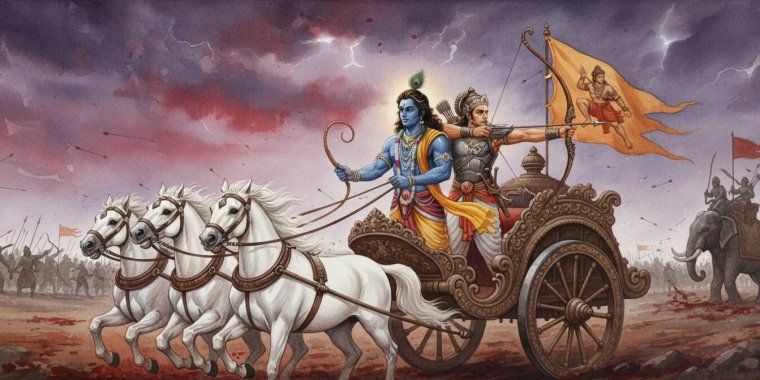
The core conflict centers on the Kuru dynasty, ruling from Hastinapura, and the escalating rivalry between two sets of cousins: the Pandavas (the five sons of Pandu) and the Kauravas (the hundred sons of Dhritarashtra).
I. The Origins and the Rivalry
The Lineage and the Curse
The story begins generations before the main conflict, establishing the complex lineage of the Kuru dynasty. King Shantanu of Hastinapura marries the river goddess Ganga. She drowns their first seven children, but Shantanu stops her from drowning the eighth, Devavrata. Ganga leaves, but Devavrata grows up to be a formidable warrior.
Later, Shantanu falls in love with a fisherwoman, Satyavati. Her father demands that Satyavati’s children inherit the throne, not Devavrata. To ensure his father's happiness, Devavrata takes a terrible vow of lifelong celibacy and relinquishes his claim to the throne. Due to this terrifying oath (Bhishma Pratijna), he is henceforth known as Bhishma. He becomes the patriarch and protector of the Kuru clan, bound by his vow to serve whoever sits on the throne of Hastinapura.
Satyavati has two sons, but both die early without producing heirs. To save the dynasty, Satyavati calls upon her illegitimate son, the sage Vyasa (born before her marriage to Shantanu), to father children with the widows of her younger son through the practice of niyoga.
Vyasa is unkempt and terrifying to look at.
The first widow, Ambika, shuts her eyes in fear during the union; her son, Dhritarashtra, is born blind.
The second widow, Ambalika, turns pale with fear; her son, Pandu, is born pale and sickly.
A maid is sent to Vyasa instead of the queens, and she approaches him with devotion; her son, Vidura, is born perfectly healthy and becomes renowned for his wisdom and righteousness, but being born of a maid, he cannot inherit the throne.
Because Dhritarashtra is blind, the younger brother, Pandu, is crowned King of Hastinapura.
The Birth of the Cousins
Pandu proves to be an excellent king. He has two wives: Kunti and Madri. However, while hunting, Pandu accidentally kills a sage and his wife who were mating in the form of deer. The dying sage curses Pandu: if he ever approaches a woman with desire, he will die. Heartbroken, Pandu renounces the throne and retreats to the forest with his wives, leaving his blind brother Dhritarashtra to rule as regent.
In the forest, Kunti reveals a boon she received in her youth from a sage: she can invoke any god to give her a child. Using this mantra, she and Madri have five sons, the Pandavas, fathered by the gods:
Yudhishthira (son of Dharma, the god of righteousness): Wise, truthful, and the rightful heir.
Bhima (son of Vayu, the wind god): Possessing immense physical strength and a fierce temper.
Arjuna (son of Indra, king of gods): The supreme archer and warrior.
Nakula and Sahadeva (sons of the Ashvins, twin healer gods, born to Madri): Exceptionally handsome and skilled in swordsmanship and animal husbandry.
(Before her marriage, Kunti had tested the mantra by invoking Surya, the sun god, resulting in the birth of Karna. Afraid of the stigma of an unwed pregnancy, she abandoned him in a river. Karna is raised by a charioteer and grows up to be a warrior matching Arjuna in skill, but carrying the deep wound of his unknown lineage.)
Meanwhile, in Hastinapura, Dhritarashtra's wife, Gandhari, who blindfolded herself upon marriage to share her husband's darkness, gives birth to one hundred sons and one daughter. These are the Kauravas. The eldest and most ambitious is Duryodhana, followed by his brother Dushasana.
One day, Pandu forgets his curse, embraces Madri, and dies. Madri joins him on the funeral pyre. Kunti returns to Hastinapura with the five young Pandavas.
Growing Up in Hastinapura
The Pandavas and Kauravas are raised together in the royal court, educated by the great masters Kripacharya and Dronacharya. From the beginning, the tension is palpable. The Pandavas, being of divine descent, excel in everything. Arjuna becomes Drona's favorite pupil and the greatest archer. Bhima’s immense strength constantly humiliates the Kaurava brothers in wrestling and play.
Duryodhana, consumed by jealousy and a sense of entitlement as the eldest son of the acting king, despises the Pandavas. He views Yudhishthira as a threat to his eventual succession. Duryodhana is constantly advised by his cunning uncle, Shakuni, who harbors a deep grudge against the Kuru house.
The rivalry solidifies during a tournament held to showcase the princes' skills. Arjuna dazzles the crowd, but the event is interrupted by the arrival of Karna. Karna challenges Arjuna, but because he is believed to be a charioteer's son, he is mocked and denied the right to duel a prince. Seeing an opportunity to gain a powerful ally against Arjuna, Duryodhana immediately steps forward, crowns Karna the King of Anga, and befriends him. Karna pledges lifelong loyalty to Duryodhana, setting the stage for one of the epic's most tragic arcs.
The House of Lac
As Yudhishthira comes of age, his virtues make him highly popular among the citizens, and Dhritarashtra is pressured into naming him the Crown Prince. Duryodhana is furious. With Shakuni's help, he plots to assassinate the Pandavas.
Duryodhana convinces his father to send the Pandavas and Kunti to the town of Varnavata for a festival. He has an architect build a beautiful palace for them there, entirely constructed from highly flammable materials like lac, resin, and ghee (the Lakshagriha). The plan is to burn them alive while they sleep.
However, the wise Vidura, aware of the plot, warns Yudhishthira in riddles and sends a miner to dig a secret tunnel from the palace to the nearby forest. When Duryodhana's men set the fire, the Pandavas and Kunti escape through the tunnel. They leave behind the bodies of a tribal woman and her five sons who happened to be sleeping there, making the Kauravas and the world believe the Pandavas are dead.
II. Exile, Marriage, and the Rise to Power
In Hiding and the Swayamvara
The Pandavas live in hiding as poor Brahmins. During this time, they hear of a swayamvara (a ceremony where a princess chooses a husband) being held for Draupadi, the beautiful daughter of King Drupada of Panchala.
Drupada has arranged a nearly impossible archery test: the suitor must string a massive, stiff bow and shoot five arrows through a continuously revolving ring to hit the eye of a golden fish suspended above, looking only at its reflection in a pool of oil below.
Many kings and princes fail, including Duryodhana. Karna steps up and easily strings the bow, but Draupadi stops him, declaring she will not marry a charioteer's son—a deeply humiliating moment for Karna. Finally, Arjuna, still disguised as a Brahmin, steps forward and successfully completes the challenge.
Arjuna brings Draupadi back to the hut where they are staying. Without looking, Kunti tells her sons from inside, "Whatever you have brought, share it equally amongst yourselves." Bound by their mother's word, and justified by a complex past-life karma explained by Vyasa, Draupadi becomes the common wife of all five Pandavas. This unconventional marriage binds the Pandavas inextricably together.
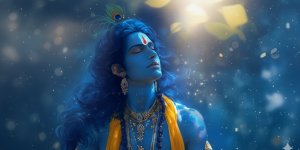
At the swayamvara, the Pandavas also make a crucial alliance. They meet Krishna, the prince of Dwarka and an avatar of the god Vishnu. Krishna recognizes them despite their disguise and becomes their lifelong friend, guide, and philosophical mentor.
Indraprastha: The City of Illusion
With their survival revealed and backed by the powerful King Drupada and Krishna, the Pandavas demand their share of the kingdom. Dhritarashtra, torn between his love for his son and his duty, agrees to a partition to avoid war. He gives the Kauravas the prosperous Hastinapura and gives the Pandavas a barren, arid tract of land called Khandavaprastha.
Undeterred, the Pandavas, with Krishna's help and the architectural genius of the celestial builder Maya, transform the wasteland into a magnificent, wealthy, and magically constructed city named Indraprastha. Yudhishthira is crowned king and performs the Rajasuya Yajna (an imperial sacrifice), establishing himself as an emperor to whom other kings pay tribute.
The splendor of Indraprastha and Yudhishthira's rising power incite severe envy in Duryodhana. When Duryodhana visits Indraprastha, he is humiliated by the magical illusions of the palace—falling into a pool he thought was a solid floor, prompting Draupadi (or her maids, depending on the version) to laugh and remark, "The son of a blind man is also blind." Duryodhana leaves burning with a desire for revenge.
The Game of Dice
Unable to defeat the Pandavas in war, Shakuni suggests a psychological attack. He proposes inviting Yudhishthira, who has a weakness for gambling, to a game of dice. Shakuni is a master of illusion and possesses magical dice that will only obey his command.
Yudhishthira, bound by the kshatriya (warrior) code that forbids refusing a challenge, accepts. The game takes place in the assembly hall of Hastinapura. Shakuni plays on Duryodhana's behalf.
Driven by the intoxicating frenzy of the game and Shakuni's taunts, Yudhishthira loses disastrously. He gambles away his wealth, his kingdom, and his brothers, one by one. Finally, he gambles away himself. Having lost everything, Shakuni asks if he has anything else. Yudhishthira wagers his wife, Draupadi, and loses her too.
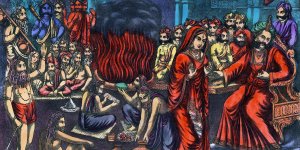
The Kauravas, victorious and cruel, drag Draupadi into the assembly hall by her hair. Dushasana, Duryodhana's brother, attempts to disrobe her in front of the elders—Bhishma, Drona, and Dhritarashtra—who all sit in silent shame, bound by technicalities of the law regarding ownership.
In her despair, Draupadi prays to Krishna. As Dushasana pulls at her sari, Krishna miraculously provides an endless stream of cloth. Dushasana pulls until he collapses from exhaustion, but Draupadi remains clothed. This horrific event—the Cheer-Haran—is the absolute turning point of the epic. The Pandavas are enraged, and Bhima takes a blood oath to tear open Dushasana's chest and drink his blood, and to break Duryodhana's thighs. Draupadi vows not to tie her hair until it is washed in Dushasana's blood.
Frightened by the ill omens following the attempted disrobing, Dhritarashtra returns everything to the Pandavas. However, Duryodhana manipulates his father into inviting Yudhishthira for one final game. The wager: the loser must go into exile in the forest for twelve years, followed by a thirteenth year living in incognito disguise. If they are discovered during the thirteenth year, the cycle of exile repeats. Yudhishthira loses again.
III. Exile and Preparations for War
The Forest Years (Vana Parva)
The Pandavas and Draupadi spend twelve years in the harsh wilderness. This period is a time of spiritual tempering. They meet various sages, hear numerous sub-stories (like the story of Nala and Damayanti, and Savitri and Satyavan), and undertake rigorous penances.
Arjuna travels to the Himalayas to perform austerities to appease Lord Shiva. Shiva tests him, and upon being satisfied, grants Arjuna the Pashupatastra, a weapon of mass destruction. Arjuna also travels to the heavenly realm of his father, Indra, where he spends years acquiring celestial weapons from the gods, preparing for the inevitable war.
Meanwhile, Karna, seeking weapons to rival Arjuna, disguises himself as a Brahmin to learn from the fierce sage Parashurama (who hates kshatriyas). Parashurama teaches him the supreme Brahmastra. However, one day, Parashurama falls asleep with his head on Karna's lap. A stinging insect bores into Karna's thigh, causing immense pain and bleeding. Enduring the agony so as not to wake his guru, Karna remains still. When Parashurama wakes and sees the blood, he realizes Karna's pain tolerance proves he is a kshatriya, not a Brahmin. Furious at the deception, Parashurama curses Karna: he will forget the incantation to invoke the Brahmastra at the exact moment he needs it most.
The Thirteenth Year (Virata Parva)
For their thirteenth year, the Pandavas must remain undiscovered. They travel to the kingdom of Matsya, ruled by King Virata, and adopt disguises:
Yudhishthira becomes a courtier and gambling companion to the king.
Bhima becomes the royal cook and wrestler.
Arjuna, utilizing a curse he received in heaven that turned him into a eunuch for a year, disguises himself as Brihannala, a dance teacher for the princess.
Nakula becomes the master of horses.
Sahadeva becomes the master of cattle.
Draupadi disguise herself as Sairandhri, a maid to the queen.
The year is tense. The queen's brother, the arrogant commander Keechaka, lusts after Draupadi. When he tries to assault her, Bhima secretly kills him, mangling his body so badly it looks like the work of a demon.
Hearing of Keechaka's death, Duryodhana suspects the Pandavas are hiding in Matsya. The Kauravas launch an attack to steal Matsya's cattle, hoping to draw the Pandavas out before the thirteenth year ends. The young prince of Matsya goes out to defend the kingdom, taking the "eunuch" Brihannala (Arjuna) as his charioteer. Once away from the city, Arjuna retrieves his hidden weapons, reveals his true identity, and single-handedly routes the entire Kaurava army.
The battle ends just as the timeframe for the thirteenth year officially expires. The Pandavas have successfully completed their exile.
Failed Negotiations (Udyoga Parva)
The Pandavas demand the return of Indraprastha. Duryodhana flatly refuses. The Pandavas are willing to compromise. Yudhishthira, desperate to avoid the slaughter of his kin, asks for merely five villages—one for each brother. Duryodhana arrogantly replies he will not give them enough land to cover the point of a needle.
Both sides begin gathering allies. The kings of India choose sides, splitting the subcontinent into two massive armies.
Krishna goes to Hastinapura as a peace envoy, making one last attempt to prevent war. He speaks eloquently of the devastation war will bring, but Duryodhana is obstinate and even attempts to arrest Krishna. Krishna reveals his Vishwaroopa (Universal Form), a terrifying and awe-inspiring manifestation of his divinity, blinding the court temporarily, before leaving. War is now inevitable.
Before the war, Krishna approaches Karna and reveals his true identity: Karna is Kunti's eldest son, the rightful king, and the eldest Pandava. Krishna offers him the empire if he switches sides. Karna is deeply moved but refuses. He explains that his loyalty lies with Duryodhana, the only man who gave him respect and shelter when the world mocked him. He promises Kunti, however, that he will only kill Arjuna; he will spare the other four Pandavas. Thus, Kunti will always have five sons.
IV. The Kurukshetra War
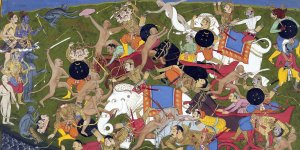
The two massive armies gather on the plains of Kurukshetra. It is an eighteen-day war of unprecedented scale and brutality, fought under rules of engagement that quickly degrade as the slaughter intensifies.
The Bhagavad Gita
On the morning of the first day, as the conches blow to signal the start of the battle, Arjuna asks his charioteer, Krishna, to drive him to the center of the battlefield to survey the opposing armies.
Looking across the field, Arjuna sees his grandfather Bhishma, his teacher Drona, his cousins, uncles, and friends arrayed against him. Overcome with deep grief, moral confusion, and the horror of killing his own kin, Arjuna drops his bow, Gandiva, and refuses to fight.
This crisis prompts the Bhagavad Gita (The Song of God), a 700-verse philosophical dialogue between Krishna and Arjuna. Krishna counsels Arjuna on his duty (Dharma). He explains:
The Immortality of the Soul: The body is temporary, but the Atman (soul) is eternal and indestructible. Death is merely a shedding of old clothes.
Karma Yoga (The Path of Action): One must perform their duty without attachment to the results. Arjuna's duty as a kshatriya is to fight against injustice. He must fight not out of hatred or desire for a kingdom, but as a sacred duty.
Bhakti Yoga (The Path of Devotion): Surrendering one's actions and ego to the Divine is the highest path to liberation.
Krishna once again reveals his universal form to Arjuna, demonstrating that he is the ultimate creator and destroyer, and that the warriors on the battlefield are already "dead" by cosmic design; Arjuna is merely the instrument. Reinvigorated and clear in his purpose, Arjuna picks up his bow. The war begins.
The Fall of the Elders
The Kaurava army is vastly superior in numbers and is led initially by the invincible patriarch, Bhishma. For ten days, Bhishma wreaks havoc on the Pandava army, though he avoids killing the Pandavas themselves. The Pandavas realize they cannot win as long as Bhishma commands.
Bhishma had a boon that he could only die when he chose to. The Pandavas approach him at night and ask him how he can be defeated. Bhishma tells them he will lay down his arms if confronted by someone who was born a woman. The Pandavas place Shikhandi (who was born female but became male, and is the reincarnation of a woman wronged by Bhishma in a past life) in front of Arjuna's chariot. Seeing Shikhandi, Bhishma lowers his bow. Arjuna shoots him with countless arrows, piercing his entire body. Bhishma falls, but the arrows are so thick they form a bed, keeping his body off the ground. He chooses to stay alive on this "bed of arrows" until the war ends.
Command passes to the teacher, Drona. Drona is ruthless and attempts to capture Yudhishthira to end the war quickly. During Drona's command, a tragic event occurs. The Kauravas form a complex, deadly military formation called the Chakravyuha. Arjuna is the only one who knows how to break it, but he is drawn away to another part of the battlefield.
Arjuna's young son, Abhimanyu, knows how to enter the formation but not how to exit. He enters and fights valiantly against multiple senior Kaurava warriors simultaneously. In a blatant violation of the rules of war, several prominent Kauravas (including Karna and Drona) gang up on the exhausted boy and brutally kill him. Arjuna is devastated and vows to kill the man responsible for trapping Abhimanyu (Jayadratha) by sunset the next day or immolate himself. With Krishna's help, who temporarily eclipses the sun, Arjuna succeeds.
The Pandavas realize Drona must be stopped. Krishna suggests a controversial tactic. Drona loves his son, Ashwatthama, more than anything. Bhima kills an elephant named Ashwatthama and roars, "Ashwatthama is dead!" Drona, refusing to believe Bhima, asks Yudhishthira, known for his absolute truthfulness. Yudhishthira replies, "Ashwatthama is dead," but mutters softly under his breath, "...the elephant." Hearing only the first part from the man of truth, Drona loses the will to live, drops his weapons, and sits in meditation. Drupada's son, Dhrishtadyumna, steps forward and beheads the defenseless teacher.
The Climax: Karna and Duryodhana
With Drona dead, Karna finally takes command of the Kaurava army. The long-awaited, monumental duel between Arjuna and Karna takes place on the seventeenth day.
It is a battle of equals, shaking the earth. However, Karna is plagued by curses. First, the wheel of his chariot sinks deep into the mud (a result of a curse from a Brahmin whose cow Karna accidentally killed). Karna asks Arjuna to pause the fight, as per the rules of war, while he dismounts to free his wheel.
Krishna urges Arjuna to show no mercy, reminding him of how Karna showed no mercy to Abhimanyu, and how Karna insulted Draupadi during the dice game. Just as Karna realizes he needs his ultimate weapon, Parashurama's curse takes effect, and he forgets the incantation. While Karna is desperately trying to lift his chariot wheel, unarmed and distracted, Arjuna shoots an arrow and decapitates him. The tragedy of Karna—the noble, generous warrior doomed by loyalty and circumstance—is fulfilled.
By the eighteenth day, the Kaurava army is annihilated. Shakuni is killed. Bhima fulfills his terrible vow, killing Dushasana, tearing his chest open, drinking his blood, and bringing it to Draupadi to wash her hair.
Only Duryodhana remains. He flees and hides in a lake, using magic to solidify the water around him. The Pandavas find him and challenge him. Duryodhana chooses to fight Bhima in a mace duel.
The fight is brutal and protracted. Duryodhana is the superior mace fighter and gains the upper hand. Krishna subtly reminds Bhima of his vow to break Duryodhana's thighs. Striking below the waist is strictly forbidden in a mace duel. However, driven by vengeance, Bhima swings his mace and smashes Duryodhana's thighs, violating the rules of engagement. Duryodhana falls, mortally wounded, accusing Krishna of deceit. Krishna replies that Duryodhana's lifetime of deceit and immorality brought this fate upon himself.
The Midnight Massacre
The war seems over. But that night, Drona's son, Ashwatthama, consumed by grief and rage over his father's deceitful death, sneaks into the Pandava camp. The Pandavas and Krishna are away. Ashwatthama slaughters the remaining Panchala warriors, Dhrishtadyumna, and brutally murders the five sleeping sons of Draupadi (the Upapandavas), believing them to be the Pandava brothers.
The next morning, the Pandavas discover the massacre. They pursue Ashwatthama. In desperation, Ashwatthama unleashes the apocalyptic Brahmashirsha astra (a weapon more powerful than the Brahmastra). Arjuna fires his own to counter it. To prevent the destruction of the world, sages order them to recall their weapons. Arjuna can, but Ashwatthama cannot. Instead, Ashwatthama spitefully directs the weapon into the womb of Uttara, Arjuna's daughter-in-law (Abhimanyu's widow), attempting to end the Pandava lineage.
Krishna curses Ashwatthama to wander the earth for 3,000 years, covered in unhealing sores, begging for death but unable to die. Krishna then uses his divine power to revive the stillborn child in Uttara's womb. This child, Parikshit, becomes the sole heir to the Kuru dynasty.
V. The Aftermath and the Ascent to Heaven
Grief and Rule (Shanti Parva and Anushasana Parva)
The war leaves millions dead. The plains of Kurukshetra are a graveyard. Yudhishthira is crowned king, but his victory is ashes in his mouth. He is overwhelmed by a profound depression, wishing to renounce the throne and retreat to the forest to atone for the slaughter of his relatives and teachers.
The elders, and finally the dying Bhishma (still on his bed of arrows), must counsel him. The Shanti Parva (Book of Peace) and Anushasana Parva (Book of Instructions) constitute a massive section of the epic where Bhishma lectures Yudhishthira on statecraft, duties of a king, ethics, religion, and philosophy. Having imparted his wisdom, and with the sun moving into the northern hemisphere (an auspicious time), Bhishma finally chooses to die.
Yudhishthira rules Hastinapura justly for 36 years. During this time, Dhritarashtra, Gandhari, and Kunti retire to the forest to live as ascetics. They eventually die in a forest fire.
The Destruction of the Yadavas (Mausala Parva)
The tragedy of the Mahabharata extends beyond the Kuru clan. Thirty-six years after the war, a curse laid upon Krishna by Gandhari (who blamed him for allowing the destruction of her hundred sons) comes to fruition.
Krishna's own clan, the Yadavas in Dwarka, succumb to decadence and internal strife. During a drunken festival, a massive brawl breaks out. They use reeds that magically transform into iron clubs (the result of another curse by angry sages) and slaughter each other entirely.
Krishna's brother, Balarama, dies in meditation. Krishna, knowing his time on earth is over, sits in a forest. A hunter, mistaking Krishna's foot for a deer, shoots him with a poisoned arrow, fulfilling the mortal end of his avatar. The magnificent city of Dwarka is subsequently swallowed by the sea.
The Final Journey (Mahaprasthanika Parva and Svargarohana Parva)
Hearing of the destruction of the Yadavas and Krishna's departure, the Pandavas realize their time has also come. They crown the young Parikshit as King of Hastinapura.
Yudhishthira, his four brothers, and Draupadi renounce the world. They dress in simple ascetic robes and begin a final pilgrimage, walking towards Mount Meru and the Himalayas, intending to climb to heaven in their mortal bodies. A stray dog joins them and follows them faithfully.
As they climb the freezing, arduous mountain path, they begin to fall one by one.
First Draupadi collapses and dies. Bhima asks why the virtuous queen fell. Yudhishthira replies it was because she secretly favored Arjuna over her other husbands.
Next, Sahadeva falls, due to his pride in his intelligence.
Then Nakula falls, due to his vanity regarding his physical beauty.
Then Arjuna falls, due to the sin of pride in his archery and his unfulfilled boast that he would kill all the enemies in one day.
Finally, Bhima falls, due to his gluttony and his tendency to boast about his immense strength.
Yudhishthira does not look back or grieve, knowing that attachments must be severed. He continues walking alone, accompanied only by the dog.
He eventually reaches the peak, where Indra, the king of heaven, arrives in a chariot to take him to Swarga (heaven). Indra tells Yudhishthira to leave the dog behind, as dogs are considered impure and not allowed in heaven. Yudhishthira refuses. He states that the dog has been absolutely loyal to him, and abandoning a devoted companion to attain heaven goes against Dharma. He chooses to stay out of heaven rather than abandon the dog.
At this moment, the dog transforms into Dharma, the god of righteousness and Yudhishthira's father. He praises Yudhishthira's supreme morality; it was a final test.
Yudhishthira enters heaven, but to his shock and horror, he does not see his brothers or Draupadi. Instead, he sees Duryodhana and the Kauravas, looking radiant and enjoying the pleasures of heaven. Yudhishthira demands to see his family.
A messenger takes him down a dark, foul-smelling, terrifying path into a realm of extreme suffering and torment. He hears the agonizing voices of his brothers, Draupadi, and Karna crying out to him, begging him to stay because his presence brings a cool, soothing breeze to their torture.
Overwhelmed by anger at the injustice of the cosmos, Yudhishthira decides he will stay in hell with his loved ones rather than live in a heaven shared with his enemies.
Suddenly, the illusions vanish. The gods, led by Indra and Dharma, appear. They explain that this was an illusion, a final necessity. Everyone who has sinned must experience hell, and everyone who has done good must experience heaven.
The Kauravas, having died bravely on the battlefield (fulfilling their warrior duty), earned a brief stay in heaven before they will be sent to hell for their lifetimes of deceit.
The Pandavas, being fundamentally righteous but having committed "sins of necessity" during the war (like the deceptions used to kill Bhishma, Drona, Karna, and Duryodhana), had to experience a brief moment of hell before ascending permanently to heaven.
Yudhishthira bathes in the celestial river Ganga, shedding his mortal body and human grief. He finally reunites with his brothers, Draupadi, Karna, and all the fallen warriors in a state of eternal peace and spiritual resolution.
Core Themes of the Mahabharata
The Mahabharata is profoundly complex and refuses to offer simple moral binaries. Its themes resonate deeply with the human condition:
• Dharma (Righteousness/Duty). This is the central pillar of the epic. Dharma is not just "goodness"; it is the natural order of things, social duty, and cosmic law. The epic constantly explores the complexities of Dharma. What happens when duties conflict? (e.g., Arjuna's duty as a warrior vs. his duty to his family). The Mahabharata teaches that Dharma is subtle (sukshma) and context-dependent.
• Karma and Destiny. Every action has consequences, often spanning across multiple lifetimes. Characters are frequently trapped by the karma of their past actions or the curses laid upon them. The war itself is seen as an inevitable cosmic event intended to cleanse the earth of burdens.
• The Illusion of Right and Wrong. Unlike many Western epics, the "good guys" (Pandavas) do incredibly questionable things to win, and the "bad guys" (Kauravas) often exhibit great nobility, courage, and loyalty. Yudhishthira tells lies, Arjuna shoots an unarmed man, and Bhima strikes below the belt. The epic suggests that in a corrupt world (Kali Yuga), rigid adherence to rules sometimes leads to the defeat of righteousness.
• The Tragedy of War. The Mahabharata is one of the most anti-war epics ever written. It does not glorify the Kurukshetra war; it depicts it as a horrific holocaust that destroys a generation, leaving the victors ruling over a graveyard, consumed by grief and trauma.
• Detachment and Devotion. Through the Bhagavad Gita, the epic offers a path through the suffering of life. By acting without attachment to the fruits of action and surrendering to the divine, a person can navigate the complexities of karma and attain liberation (Moksha).
The Mahabharata ends not with a triumphant victory parade, but with immense loss, profound philosophical reflection, and the ultimate dissolution of the ego in the face of the divine, reminding the reader that everything in the material world is temporary, except the consequences of one's actions.
YOU MAY ALSO LIKE