| / Stories, Legends, Myths |
The Story of Xuanzang
The story of Xuanzang (born circa 602 CE – died 664 CE) is one of the greatest real-life adventure tales in human history. He was a Chinese Buddhist monk, scholar, traveler, and translator who walked thousands of miles from China to India and back.
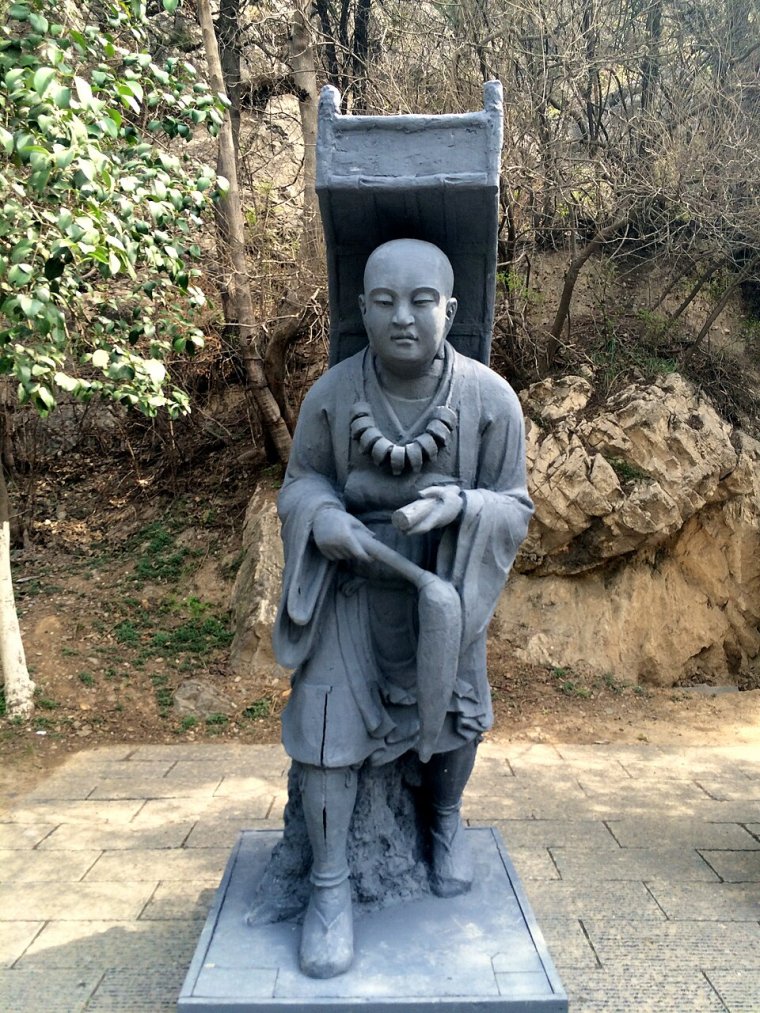
Xuan Zang Statue at Longmen Grottoes, Luoyang, China. Photo: Charlie/Wikipedia
While he is globally famous today as the inspiration for the monk in the classic Chinese fantasy novel Journey to the West (accompanied by the Monkey King), the historical Xuanzang was a man of staggering intellect, unbreakable willpower, and immense historical importance.
Here is the brief story of his epic 17-year journey.
I. The Calling and the Confusion
Xuanzang was born into a family of scholars during the transition from the Sui to the Tang Dynasty in China. He showed a genius-level intellect early on and was ordained as a fully-fledged Buddhist monk by the age of 20.
As he studied the Buddhist texts available in China, he became deeply frustrated. The texts had been translated from Sanskrit to Chinese over several centuries by different people, leading to massive contradictions, missing chapters, and confusing theology. Xuanzang realized that to truly understand Buddhism, he could not rely on flawed Chinese translations.
He needed to go to the source: India, the birthplace of the Buddha. He specifically wanted to find a master text called the Yogacarabhumi-sastra.
II. The Forbidden Departure (627 CE)
At this time, the early Tang Dynasty was at war with nomadic Turkic tribes along its borders. Emperor Taizong issued a strict decree: no civilian was allowed to leave the empire.
When Xuanzang requested permission to travel to India, the Emperor refused. Undeterred by the threat of execution for treason, Xuanzang decided to sneak out.
Hiding by day and traveling by night, dodging imperial guards and watchtowers, he slipped past the westernmost gates of the Chinese empire and stepped into the brutal, lawless expanse of the Silk Road.
III. The Perilous Journey West
Xuanzang’s journey to India was not a direct southern route; the Himalayas made that impossible. He had to travel west through Central Asia, across deserts, and then south into the Indian subcontinent. His survival was a miracle.
The Desert of Death: He had to cross the Taklamakan Desert (often called the "Desert of Death"). At one point, he accidentally dropped his water skin, losing his entire water supply.
For four days and five nights, he walked without a drop of water, collapsing in the sand. He survived only because his horse eventually sniffed out an oasis.
The King of Turpan: He arrived in the wealthy oasis kingdom of Turpan. The Buddhist king there was so captivated by Xuanzang’s brilliance that he refused to let him leave, demanding he stay and be the head of the kingdom's monks.
Xuanzang went on a hunger strike. Touched by his absolute devotion, the king relented, gave him royal letters of transit, gold, and a caravan of guards, and sent him on his way.
Bandits and Avalanches: He crossed the freezing Tian Shan mountains and the Hindu Kush. He was robbed by bandits multiple times. In the treacherous mountain passes, avalanches and freezing temperatures killed several of his traveling companions and pack animals.
IV. Arrival in the Holy Land (630 CE)
After roughly three years of grueling travel through modern-day Kyrgyzstan, Uzbekistan, Afghanistan, and Pakistan, Xuanzang finally reached the plains of northern India.
He spent the next few years traveling as a pilgrim to the most sacred sites in Buddhism:
• Lumbini (where the Buddha was born).
• Bodh Gaya (where the Buddha achieved enlightenment under the Bodhi tree).
• Sarnath (where the Buddha gave his first sermon).
• Kushinagar (where the Buddha died).
Xuanzang wept at the Bodhi tree, lamenting that he had been born centuries after the Buddha had lived.
V. Nalanda University
The climax of his journey was reaching Nalanda, the greatest monastic university of the ancient world, located in present-day Bihar, India. Nalanda housed thousands of scholars and millions of manuscripts.
Here, Xuanzang finally found his master: Silabhadra, a 106-year-old monk who was the highest authority on Buddhist philosophy. Xuanzang spent years at Nalanda mastering Sanskrit, Buddhist logic, and the complex doctrines he had traveled so far to understand. He became one of the university's most brilliant debaters.
VI. The Great Debate and King Harsha
Xuanzang’s fame spread across India. He caught the attention of King Harsha, the powerful emperor of Northern India. Harsha was a patron of Buddhism and invited Xuanzang to his capital for a grand theological debate.
Xuanzang stood before thousands of rival monks, Hindu priests, and Jain scholars. He put his head on the line, declaring that if anyone could defeat him in debate or find a logical flaw in his arguments, he would forfeit his life. The debate lasted 18 days. No one could defeat him. King Harsha showered him with gold and requested that he stay in India permanently, but Xuanzang refused. His mission was to bring the truth back to China.
VII. The Triumphant Return (645 CE)
Packing up hundreds of Sanskrit manuscripts, golden statues, and holy relics, Xuanzang began the long, dangerous trek back to China. He lost some texts when a boat capsized in the Indus River, but managed to save the vast majority.
When he arrived at the Tang capital of Chang'an (modern-day Xi'an) 17 years after he had sneaked out as a fugitive, he was not arrested. Instead, Emperor Taizong, now deeply impressed by Xuanzang's fame and the geographic knowledge he possessed, welcomed him with a massive parade. Hundreds of thousands of people lined the streets to see him.
The Emperor offered Xuanzang a high-ranking government position as an advisor on foreign affairs. Xuanzang politely declined, asking only for a quiet place to translate his books.
VIII. The Legacy of a Lifetime
The Emperor built the Giant Wild Goose Pagoda in Chang'an specifically to house the texts Xuanzang brought back. (This pagoda still stands in Xi'an today).
Xuanzang spent the rest of his life working tirelessly with a team of linguists, translating 657 Sanskrit texts into Chinese. His translations were so accurate that they became the standard for East Asian Buddhism.
Before his death, at the Emperor's request, Xuanzang also wrote a detailed book about his travels: Great Tang Records on the Western Regions.
Centuries later, Buddhism was largely wiped out in India, and the locations of the great holy sites (like Bodh Gaya and Nalanda) were lost to the jungle and buried under dirt.
In the 19th and 20th centuries, British and Indian archaeologists used Xuanzang's book as a literal treasure map. His descriptions of distances, landmarks, and ruined stupas were so incredibly precise that archaeologists used them to rediscover and excavate Nalanda University, Sarnath, and the original Bodhi tree site.
Xuanzang was a man who literally connected two of the greatest ancient civilizations—India and China. He risked his life for the pursuit of pure knowledge.
Without him, a massive portion of Buddhist philosophy would have been lost to history, and the ancient geography of India might have remained a mystery forever.
YOU MAY ALSO LIKE