| / Stories, Legends, Myths |
Ramayana
The Ramayana is one of the foundational epics of India and world literature. Attributed to the ancient sage Valmiki, it is far more than a simple tale of good triumphing over evil. It is a profound philosophical exploration of Dharma—duty, righteousness, and cosmic order. Spanning tens of thousands of verses in its original Sanskrit, the epic weaves together theology, politics, human psychology, and absolute devotion.
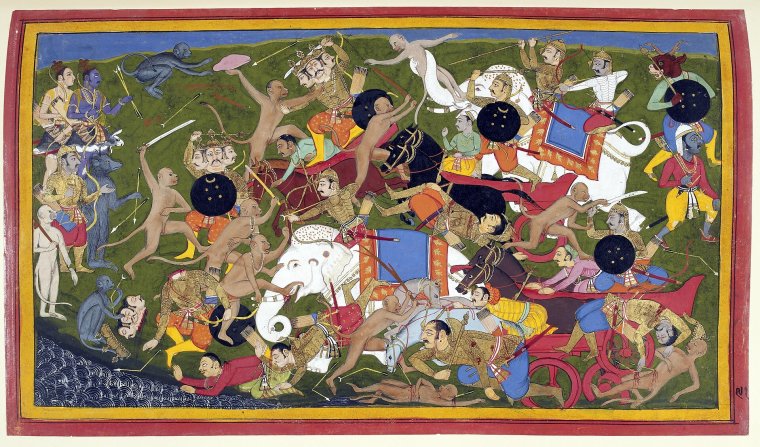
The Battle at Lanka, Ramayana by Sahibdin. Battle between the armies of Rama and the King of Lanka. Udaipur, 1649–1653./British Library
What follows is a deeply detailed retelling of the epic, structured through its seven traditional books, or Kandas.
1. Bala Kanda: The Book of Youth
Long ago, in the fertile plains of northern India, lay the kingdom of Kosala. Its capital was Ayodhya, a city of unimaginable wealth, unparalleled architecture, and absolute justice. Ayodhya was ruled by King Dasharatha of the legendary Ikshvaku dynasty. Dasharatha was a valiant warrior and a beloved ruler, but a deep sorrow gnawed at his heart: he had three noble wives—Kausalya, Kaikeyi, and Sumitra—but no heir to inherit his vast empire.
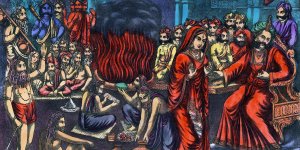
Following the advice of his royal preceptor, Sage Vashistha, Dasharatha organized the Putrakameshti Yajna, an elaborate and powerful fire sacrifice aimed at appeasing the gods to grant him children. During the ritual, a radiant divine figure emerged from the sacrificial fire bearing a golden bowl of celestial nectar (payasam). The figure instructed Dasharatha to distribute the nectar among his wives.
Unknown to the humans, this event was orchestrated by the heavens. The cosmos was being terrorized by Ravana, the ten-headed demon king of Lanka. Ravana had practiced immense austerities and obtained a boon from Lord Brahma that he could not be killed by gods, demons, or celestial spirits. In his immense hubris, he had forgotten to ask for protection against mortal men and animals, deeming them too weak to pose a threat. To restore cosmic balance, Lord Vishnu, the Preserver of the Universe, agreed to incarnate as a mortal man to bypass Ravana’s boon and destroy him.
Upon drinking the nectar, the queens conceived. Kausalya gave birth to Rama, who possessed half of Vishnu's divine essence. Kaikeyi gave birth to Bharata. Sumitra gave birth to twins, Lakshmana and Shatrughna.
The four princes grew up closely knit, but a special, unbreakable bond formed between Rama and Lakshmana, while Bharata and Shatrughna were equally inseparable. The boys were educated in the Vedas, statecraft, and the martial arts. Rama, with his dark-blue complexion resembling a storm cloud, radiated an aura of perfect peace, immense strength, and unyielding adherence to dharma.
When Rama was still a teenager, the great sage Vishwamitra arrived at Dasharatha’s court. He demanded that the king send Rama to protect his forest rituals from the demonic forces of Maricha and Subahu, who were defiling his sacred fires with blood and flesh. Though terrified for his young son, Dasharatha bowed to his duty and allowed Rama, accompanied by the ever-faithful Lakshmana, to go.
In the wild forests, Vishwamitra imparted divine weaponry and ancient mantras to the brothers. Rama killed the terrifying demoness Tadaka and dispatched the demons disrupting the sage's sacrifice. Along the way, Rama also redeemed Ahalya, a woman who had been turned to stone due to a curse, liberating her with the mere touch of his foot.
Vishwamitra then led the brothers to the kingdom of Mithila, ruled by King Janaka. Janaka possessed the mighty bow of Lord Shiva, a weapon so heavy that no man or god could lift it. Janaka had declared that his beautiful daughter, Sita—who was not born of woman but found miraculously in a furrow of the earth—would only marry the man who could string Shiva’s bow.
At the Swayamvara (the ceremony where a bride chooses her groom), mighty kings from across the world failed to even budge the bow. At Vishwamitra’s nod, Rama stepped forward. He effortlessly lifted the colossal weapon, bent it to attach the string, and applied such force that the bow snapped in half with a sound like a thunderclap that shook the earth.
Overjoyed, Janaka gave Sita’s hand in marriage to Rama. Messengers were sent to Ayodhya, and Dasharatha arrived with his court. In a grand, majestic ceremony, all four brothers were married to princesses of Mithila: Rama to Sita, Lakshmana to Urmila, Bharata to Mandavi, and Shatrughna to Shrutakirti. The princes returned to Ayodhya, and the city bathed in an era of profound joy.
2. Ayodhya Kanda: The Book of Ayodhya
Twelve years of peace and happiness passed. King Dasharatha, feeling the weight of his advancing years, decided to retire and crown Rama as the Prince Regent (Yuvaraja). The citizens of Ayodhya, who adored Rama for his compassion, wisdom, and perfect justice, were ecstatic. The city was festooned with banners, flowers, and lights.
However, darkness slithered into the palace through Manthara, a hunchbacked maidservant deeply devoted to Queen Kaikeyi. Seeing the preparations, Manthara's mind was poisoned by paranoia. She convinced Kaikeyi that if Rama became king, Kausalya would subjugate her, and Bharata would be exiled or killed.
Kaikeyi, who had always loved Rama as her own son, succumbed to Manthara’s toxic whisperings. Years prior, during a great celestial war, Kaikeyi had saved Dasharatha’s life on the battlefield. In gratitude, the king had granted her two unconditional boons, which she had saved for a later date. Retreating to the "Chamber of Wrath," Kaikeyi cast off her jewels and wept until Dasharatha found her.
Blind with love for his youngest queen, Dasharatha swore by Rama's name to grant her whatever she wished. Kaikeyi struck with lethal precision, demanding her two boons: First, Bharata must be crowned the heir apparent. Second, Rama must be banished to the dangerous Dandaka Forest for fourteen years, living as an ascetic clad in tree bark.
Dasharatha was paralyzed. To break his word was a supreme violation of his dharma as a king; to banish his beloved son was a violation of his heart. He collapsed in an agony of grief.
When Rama was summoned, he found his father broken and his stepmother defiant. Upon hearing the demands, Rama did not flinch. His face remained as serene as a calm ocean. For Rama, a father's honor was paramount. He willingly renounced the crown, viewing the wealth of an empire and the dirt of the forest as completely equal.
When Sita heard of the exile, she refused to remain in Ayodhya. She argued fiercely that a wife's dharma is to walk beside her husband, declaring that the dangerous forest would be a paradise as long as she was with him. Lakshmana, burning with furious indignation at the injustice, threatened to rebel against their father. Rama calmed him, explaining the supreme nature of destiny and duty. Lakshmana, unable to live without his brother, abandoned his own wife and comforts to serve as Rama's protector.
Casting aside royal silks, the trio donned coarse ascetic robes. As they walked out of Ayodhya, the entire city wept. Citizens tried to follow them into the wilderness, but Rama slipped away in the night.
Back in Ayodhya, King Dasharatha could not bear the separation. Haunted by a past sin—having accidentally killed a young boy named Shravan Kumar in his youth and bearing the curse of the boy's blind parents—Dasharatha's heart gave out, and he died in agonizing sorrow.
Bharata, who had been visiting his maternal uncle, was summoned back to Ayodhya. Upon discovering what his mother had done in his name, he was horrified and disgusted. He publicly disowned Kaikeyi, performed his father's funeral rites, and immediately marched into the forest with the entire royal court and army to beg Rama to return.
The brothers reunited at the serene mountain of Chitrakoot. Bharata wept, offering the kingdom back to Rama. But Rama remained immovable. He delivered a profound discourse on duty, stating that the dead king's promise must be honored. Realizing Rama would not break his vow, Bharata requested Rama's wooden sandals (paduka). Bharata returned to the outskirts of Ayodhya, placed the sandals on the royal throne, and ruled the kingdom strictly as a regent and ascetic for the next fourteen years, waiting for his brother's return.
3. Aranya Kanda: The Book of the Forest
Rama, Sita, and Lakshmana journeyed deeper into the Dandaka Forest to avoid the citizens who kept visiting them at Chitrakoot. Over the next ten years, they lived a harsh but beautiful ascetic life. They moved from one hermitage to another, seeking the blessings of great sages like Atri and Agastya. Rama pledged to protect the ascetic communities from the monstrous Rakshasas (demons) who roamed the wild, terrorizing the holy men.
Eventually, they built a modest but idyllic hut in Panchavati, on the banks of the river Godavari. Here, the true conflict of the epic was ignited.
A demoness named Surpanakha, the sister of Ravana, was wandering through the woods when she laid eyes on the incredibly handsome Rama. Consumed by lust, she approached him and demanded he marry her. Rama amusedly rejected her, pointing out he was already married, and jokingly directed her to Lakshmana. Lakshmana also spurned her. Enraged and humiliated, Surpanakha transformed into her monstrous true form and lunged at Sita, intending to devour her romantic rival. In a flash, Lakshmana drew his sword and sliced off the demoness’s nose and ears.
Bleeding and screaming, Surpanakha fled to her demonic brothers, Khara and Dushana, who ruled that region of the forest. They marched on Panchavati with an army of 14,000 terrifying demons. In an awe-inspiring display of martial prowess, Rama told Lakshmana to hide Sita in a cave while he faced the army alone. Moving so fast that he appeared as a blur, Rama unleashed a storm of divine arrows, annihilating the entire army, along with Khara and Dushana, in a matter of hours.
Surpanakha, now the sole survivor, fled across the ocean to the golden island city of Lanka, throwing herself at the feet of her mighty brother, Ravana. She knew Ravana’s weakness. Instead of merely begging for revenge, she vividly described the unparalleled, mesmerizing beauty of Sita, claiming that the universe's most beautiful woman rightfully belonged to the universe's most powerful king.
Lust and pride awakened in Ravana's dark heart. He flew his magical chariot across the ocean and sought the help of his uncle, the sorcerer Maricha. Ravana commanded Maricha to transform into a captivating, magical golden deer to lure Rama away from Sita.
Maricha took the form of a deer with a golden coat adorned with silver spots and glowing antlers, and pranced near the hermitage at Panchavati. Sita, enchanted by its supernatural beauty, begged Rama to catch it for her. Though Lakshmana suspected a demonic illusion, Rama, eager to please his wife, pursued the creature deep into the woods.
When Rama finally shot the elusive deer, the dying Maricha reverted to his demon form and mimicked Rama’s voice, screaming, "Ah, Sita! Ah, Lakshmana!"
Hearing her husband's agonizing cry, Sita panicked. She ordered Lakshmana to go to his aid. Lakshmana hesitated, knowing Rama was invincible and fearing it was a trap. Sita, in her terror, accused Lakshmana of harboring dark desires for her if Rama died. Deeply wounded by these words, Lakshmana agreed to go, but before leaving, he used the tip of his bow to draw a mystical, protective boundary line around the hut—the Lakshmana Rekha—warning Sita not to cross it under any circumstances.
As soon as Sita was alone, Ravana emerged from the shadows disguised as a frail, wandering ascetic seeking alms. He praised her beauty and asked for food. When Ravana tried to step into the hermitage, the Lakshmana Rekha repelled him with walls of invisible fire. He cunningly feigned offense, stating he would curse her family if she did not step out to offer hospitality.
Bound by the sacred duty to feed a holy guest, Sita took a step across the line. Instantly, Ravana discarded his disguise, revealing his terrifying ten-headed, twenty-armed form. He grabbed Sita by her hair, dragged her into his flying chariot (Pushpaka Vimana), and launched into the sky towards Lanka.
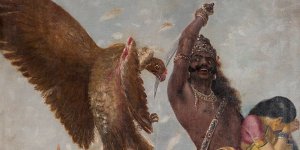
Sita wept and cried out to the trees, the rivers, and the animals to tell Rama what had happened. An ancient, colossal vulture named Jatayu, an old friend of King Dasharatha, heard her cries. Despite his immense age, Jatayu fiercely attacked Ravana in mid-air. A brutal aerial battle ensued, but Ravana eventually drew his great sword and severed the noble bird's wings, sending him crashing to the earth.
When Rama and Lakshmana returned to the empty hermitage, Rama descended into an apocalyptic grief. The calm, composed prince lost his mind, wandering the forest, weeping, and threatening to destroy the entire universe with his arrows if the gods did not return his wife. It was Lakshmana who grounded him, reminding him of his duty and strength.
While searching, they stumbled upon the dying Jatayu. With his last breath, the heroic bird informed them that the demon king Ravana had taken Sita southwards. Rama wept for the bird, giving him a prince's cremation and securing his soul’s passage to heaven. Moving further south, they encountered a cursed, headless demon named Kabandha, whom they liberated. In return, Kabandha told them to seek the alliance of the exiled monkey king, Sugriva, at Mount Rishyamuka. Continuing their journey, they visited the ashram of an elderly, low-caste ascetic woman named Shabari, whose pure, innocent devotion to Rama was so absolute that she tasted every wild berry before offering them to him to ensure they were sweet. Touched by her love, Rama ate the half-bitten berries, proving that true devotion transcends all rules of caste and ritual purity.
4. Kishkindha Kanda: The Book of the Monkey Kingdom
Arriving at the beautiful Lake Pampa, Rama and Lakshmana were spotted by the Vanaras (a magical race of monkey-humanoids) who lived on Mount Rishyamuka. Sugriva, a Vanara prince living in terror of his incredibly powerful elder brother Vali, saw the armed humans and feared they were assassins. He sent his greatest minister, Hanuman, disguised as a Brahmin priest, to ascertain their intentions.
Hanuman approached the brothers. His speech was so eloquent, grammatically flawless, and deeply respectful that Rama immediately recognized him as a great scholar and a noble soul. Upon learning their identity, Hanuman dropped his disguise, fell to his knees, and found his life's ultimate purpose in his absolute, unwavering devotion to Lord Rama.
Hanuman carried the brothers on his shoulders up the mountain to meet Sugriva. Before a sacred fire, Rama and Sugriva formed a pact of friendship. Sugriva explained his plight: his brother Vali, the king of Kishkindha, had mistakenly believed Sugriva betrayed him, usurped his kingdom, drove him into exile, and taken his wife, Ruma. Rama promised to kill Vali and restore Sugriva to the throne, while Sugriva swore to use the entire Vanara army to scour the earth for Sita.
The ethical complexity of the Ramayana is deeply highlighted in the death of Vali. Sugriva challenged Vali to a bare-handed duel. As the two identical brothers fought fiercely, Rama hid behind a tree, waiting for an opening. When Sugriva was near death, Rama shot Vali through the chest with a single, devastating arrow.
As Vali lay dying, he bitterly questioned Rama's dharma: How could the noble Lord Rama shoot an unarmed combatant from hiding? Rama approached and delivered a stern defense. He explained that Vali had committed a grave sin by taking his younger brother's wife, which is akin to incest, and by acting as an unreasoning beast. Therefore, he was punished as a hunter hunts a beast—from hiding. Recognizing the absolute authority and divine justice of Rama, Vali repented, handed over his son Angada to Rama’s care, and breathed his last.
Sugriva was crowned king, but soon the monsoon season arrived, making travel and military campaigns impossible. For four months, Rama agonized in a cave, watching the rain, his heart breaking for Sita. In Kishkindha, Sugriva became intoxicated with power, wine, and women, entirely forgetting his promise to Rama.
When the skies finally cleared, Rama’s grief turned to a terrifying wrath. He sent an enraged Lakshmana to Kishkindha. Lakshmana kicked down the gates of the palace, his anger so terrifying that the entire monkey kingdom trembled. A terrified and repentant Sugriva, guided by the wise Hanuman, immediately mobilized his forces. Millions of Vanaras gathered from all corners of the earth.
Sugriva organized them into four massive search parties, sending them in all four cardinal directions. The southern expedition was led by the young prince Angada, the wise ancient bear Jambavan, and the mighty Hanuman. They scoured the southern lands for months, starving and nearing despair, until they reached the edge of the vast, seemingly endless southern ocean.
There, they met a gigantic, wingless vulture named Sampati, the elder brother of Jatayu. Upon hearing of his brother's heroic death, Sampati used his telescopic, mystical vision and looked across the churning sea. He told them that Sita was being held captive on the island fortress of Lanka, a hundred yojanas (roughly 800 miles) across the impassable waters.
5. Sundara Kanda: The Book of Beauty
The Sundara Kanda is widely considered the heart and soul of the Ramayana, focusing entirely on the heroism, intellect, and profound devotion of Hanuman.
Standing before the roaring ocean, the Vanara army was paralyzed with despair. None possessed the strength to leap across the sea. Jambavan approached Hanuman, who was sitting quietly apart from the rest. Hanuman had been cursed in his youth to forget his own divine strength—he was the son of Vayu, the Wind God. Jambavan sang praises of Hanuman’s birth and past glories, breaking the curse.
Suddenly, Hanuman began to grow. He expanded into a colossal, mountainous giant. With a mighty roar of "Jai Shri Ram!" he pressed his feet against the mountain, shattering the rock beneath him, and launched himself into the sky, flying like a released arrow across the ocean.
His flight was not without trials. He faced the golden mountain Mainaka, who offered him rest, but Hanuman politely touched it and moved on, refusing to delay his master's work. He outwitted the mother of serpents, Surasa, who tried to swallow him, by growing to the size of a cloud and then suddenly shrinking to the size of a thumb, flying into her mouth and out her ear before she could close her jaws. He brutally dispatched the shadow-catching demoness Simhika, bursting through her stomach.
Landing on the shores of Lanka, Hanuman shrank himself to the size of a cat to avoid detection. He waited for nightfall and crept into the golden city. Valmiki describes Lanka as a place of staggering wealth and intoxicating decadence, with streets paved in gold, mansions of crystal, and demons engaging in endless revelry. Hanuman searched the taverns, the mansions, and eventually Ravana's unimaginably opulent palace and harem. For a terrifying moment, seeing the beautiful women sleeping around Ravana, Hanuman feared Sita might have succumbed to the demon king. But he quickly realized the pure Sita could never exist in such a place of base indulgence.
Finally, in the early hours of the morning, he wandered into the Ashoka Vatika, a grove of beautiful, sorrowless Ashoka trees. There, sitting on the bare earth, surrounded by hideous, terrifying demonesses guarding her with weapons, was Sita. She was unwashed, clad in the same faded garment she wore when abducted, and dangerously thin. Yet, she glowed with an inner fire of purity and absolute devotion, continuously chanting Rama's name. She was like a bright flame obscured by smoke.
As Hanuman watched from the branches, Ravana arrived in all his terrifying majesty. He offered Sita the wealth of the world, begging her to become his chief queen. When she refused, placing a blade of grass between them to signify how little she thought of him, Ravana’s lust turned to fury. He drew his sword, giving her an ultimatum: she had one month to submit, or he would have his cooks chop her to pieces for his breakfast.
After Ravana left and the demon guards fell asleep, Hanuman began to softly sing the story of Rama from the tree above. Hearing her husband's life story, Sita looked up. Hanuman leaped down, assuming a gentle, humble form. To prove his identity, he handed her Rama’s golden signet ring.
Sita pressed the ring to her eyes and wept tears of profound joy, feeling as though Rama himself were there. Hanuman, eager to end her suffering, offered to carry her on his back and fly her across the ocean. Sita gently declined. She stated that it would be an insult to Rama's honor if she were smuggled out like a thief. Rama must come himself, defeat Ravana in open war, and rescue her to uphold his dharma and glory. She handed Hanuman her Chudamani (a divine hair ornament) to give to Rama as proof of their meeting.
Before leaving, Hanuman decided to test the martial strength of Lanka and strike fear into Ravana’s heart. He assumed a massive form and began uprooting the beautiful Ashoka grove, destroying everything except the tree under which Sita sat. He slaughtered tens of thousands of demon guards, crushed Ravana’s mighty generals, and even killed Ravana’s younger son, Akshaya Kumara, in a brutal fight.
Finally, Ravana’s eldest son, the terrifying sorcerer Indrajit, arrived. Knowing he could not physically defeat Hanuman, Indrajit deployed the Brahmastra, a supreme divine weapon. Out of respect for the weapon's creator, Lord Brahma, Hanuman allowed himself to be bound and captured.
Dragged into Ravana’s court, Hanuman fearlessly faced the ten-headed tyrant. He delivered a masterful diplomatic speech, warning Ravana to return Sita and beg for Rama's mercy, or face the utter annihilation of his race. Ravana, insulted by a "mere monkey," ordered Hanuman's execution. However, Vibhishana, Ravana's righteous younger brother, intervened, pointing out that killing an envoy is a gross violation of statecraft.
Instead, Ravana ordered that Hanuman’s tail—a monkey’s pride—be set on fire. The demons wrapped his tail in miles of oil-soaked rags and set it ablaze. But Hanuman used his magic to shrink, slipping out of his bonds. With his tail burning like a blazing meteor, he leaped from rooftop to rooftop, intentionally setting the golden city of Lanka on fire. He burned the mansions, the arsenals, and the docks, giving Ravana a terrifying preview of the destruction to come.
Satisfied, he extinguished his tail in the ocean, leapt back across the sea, and reunited with the search party. They rushed back to Kishkindha. Approaching Rama, Hanuman did not want to cause even a second of suspense, so he respectfully reversed the sentence structure of his news, announcing: "Drishta Sita" (Seen is Sita). He placed the Chudamani in Rama’s hands, bringing the weeping prince back to life.
6. Yuddha Kanda: The Book of War
The time for sorrow had passed; the time for war had come. Rama, Lakshmana, Sugriva, and millions of Vanaras marched south until they reached the shores of the Indian Ocean.
In Lanka, a fierce debate raged. Vibhishana, the righteous brother, pleaded with Ravana to return Sita, warning that Rama was no mere mortal and that the burning of Lanka was an omen of their utter destruction. Ravana, blinded by supreme arrogance, physically kicked his brother out of the court. Vibhishana flew across the ocean and sought refuge at Rama's camp. Though the Vanara generals were deeply suspicious of the demon, Rama accepted him with open arms, declaring a fundamental tenet of his avatar: "Whosoever seeks my refuge, even once, saying 'I am yours,' I shall protect him from all beings. This is my eternal vow." Rama immediately crowned Vibhishana the king of Lanka in exile.
To cross the ocean, Rama sat in penance for three days, requesting the Ocean God to part the waters. When the ocean remained arrogant and unresponsive, Rama’s legendary patience snapped. He strung his bow and threatened to loose a cosmic arrow that would boil the seas and burn the creatures of the deep. Terrified, the Ocean God materialized and begged for mercy. He instructed the Vanara engineers, Nala and Nila, to construct a bridge. The Vanaras brought massive boulders and mountains, writing the name "Rama" upon them, causing the heavy stones to miraculously float. The great Ram Setu (Rama's Bridge) was built in five days, and the monkey army marched across to the island fortress.
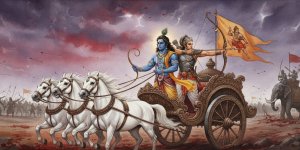
The siege of Lanka began. After a final peace mission by Angada was arrogantly rejected by Ravana, the drums of war sounded. The Yuddha Kanda describes battles of staggering, apocalyptic scale. Millions of Vanaras, fighting with uprooted trees, boulders, and their bare fangs, clashed with millions of heavily armored Rakshasas wielding dark magic and iron weapons. Rivers of blood flowed into the ocean.
Rama and Lakshmana fought like gods of death, their arrows blocking out the sun. Realizing the conventional demon army was being slaughtered, Ravana awoke his brother, the colossal giant Kumbhakarna. Kumbhakarna slept for six months a year due to a curse, but when awake, he was an unstoppable force of nature, eating thousands of monkeys alive. He knew Ravana was wrong to abduct Sita, but bound by absolute loyalty to his elder brother, he marched to war. It took the combined might of the Vanara army and a barrage of celestial arrows from Rama to finally sever the giant's limbs and sever his head.
The greatest terror of the war, however, was Indrajit, Ravana’s son. Indrajit had conquered the heavens and possessed terrifying magical abilities. He fought invisibly from the clouds. In one encounter, he bound Rama and Lakshmana in a serpentine noose (Nagapasha), bringing them near death until the divine eagle Garuda, the enemy of snakes, descended to heal them.
Later, Indrajit struck Lakshmana in the chest with a devastating, mystical spear (Shakti). Lakshmana fell, his life force quickly fading. The Vanara physician declared that the only cure was the Sanjeevani herb, which grew exclusively on the Dronagiri mountain in the distant Himalayas—and it had to be brought before sunrise.
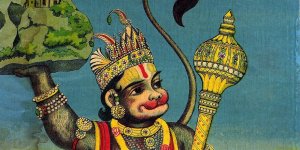
Hanuman instantly launched himself into the sky, flying across the entire Indian subcontinent in a matter of hours. Reaching the Himalayas, he could not identify the specific glowing herb. With no time to spare, the mighty Hanuman uprooted the entire mountain and flew back to Lanka with it resting in his palm. The crushed herbs healed Lakshmana instantly. Lakshmana, having survived the fatal blow, then engaged Indrajit in a terrifying duel of divine weaponry and finally killed the great sorcerer.
With his sons and brothers dead, Ravana himself rode out onto the battlefield. The final duel between Rama and Ravana was a battle of cosmic proportions. The gods gathered in the sky to watch. When Ravana used his magical chariot, the king of the gods, Indra, sent his own celestial chariot to Rama.
For days, they fought. Rama repeatedly cut off Ravana’s ten heads, but through the power of dark magic and ancient boons, the heads instantly regenerated. The demon king seemed immortal. Finally, Vibhishana revealed his brother's ultimate secret to Rama: Ravana held a vessel of the nectar of immortality (Amrita) within his navel.
Rama chanted the ancient, sacred mantras and invoked the Brahmastra—the ultimate weapon of the creator. He fired the blinding, sun-like arrow directly into Ravana’s chest. The arrow pierced his navel, evaporating the nectar of immortality, and exited through his back, returning to Rama’s quiver. Ravana, the terror of the three worlds, collapsed and died. The war was over.
What followed is one of the most controversial and fiercely debated episodes in the epic. Sita was brought before Rama in the camp. The Vanaras expected a joyous reunion. Instead, Rama’s face was dark. In front of the entire army, he told Sita that he had fought the war not for her, but to avenge the insult to his family's honor. He stated that a woman who had lived in the house of another man for a year could not be accepted back by a king.
Sita was shattered, yet her dignity was towering. She chided Rama for thinking like a common, suspicious man and ignoring her absolute, spiritual purity. She turned to Lakshmana and commanded him to build a great pyre. If she was pure in thought, word, and deed, the fire would not harm her.
Sita walked into the blazing flames—the Agni Pariksha (Test of Fire). The whole world gasped. But the flames did not burn her. Agni, the God of Fire, materialized from the pyre, carrying the unblemished Sita, and presented her to Rama. Rama smiled, his eyes softening. He revealed to the heavens that he never doubted Sita for a second. He knew she was pure. However, as a future king, he knew the public might whisper that he took back a tainted woman out of blind lust. The test was a necessary, tragic theater to prove her purity to the world so no one could ever question his queen's character.
The fourteen years of exile were now complete. Rama, Sita, Lakshmana, Hanuman, and the Vanara heroes boarded the magical Pushpaka Vimana and flew north, back to Ayodhya. They arrived to find Bharata ready to throw himself into a fire if Rama had delayed even a day. The brothers reunited in an embrace of supreme love, and Rama was finally crowned King of Ayodhya.
7. Uttara Kanda: The Final Chapter
With Rama’s coronation began the legendary Ram Rajya—an era of profound peace, prosperity, and perfect justice. The earth yielded abundant crops, diseases vanished, and everyone lived in total harmony with dharma.
Yet, the burden of the crown is heavy, and the Ramayana is an epic steeped in poignant tragedy.
A few years into Rama's reign, his spies informed him of a disturbing rumor. A common washerman in the city had beaten his wife, who had stayed out late, shouting, "I am not like King Rama, who happily accepts a wife who lived in another man's house!" The whispers were spreading through Ayodhya, threatening to undermine the moral authority of the throne.
Rama was confronted with a horrifying ethical dilemma: the duty of a husband versus the duty of a king. According to his royal dharma, a king must be entirely above public suspicion to maintain order. Heartbroken, weeping tears of blood, Rama made the agonizing decision to banish the pregnant Sita to the forest.
He commanded a devastated Lakshmana to drive her into the woods and leave her there. When Sita realized she was being abandoned, she did not curse Rama. She understood the cruel demands of statecraft and her husband’s entrapment by duty. She wept, but she accepted her fate with tragic grace.
Alone in the forest, Sita was found by the venerable Sage Valmiki—the very author of the epic. He gave her shelter in his ashram. There, Sita gave birth to twin boys, Luv and Kush. They grew up strong, brilliant, and unaware of their royal lineage. Valmiki composed the Ramayana and taught the boys to sing the glorious deeds of King Rama, keeping the identity of their father a secret.
Years later, to establish universal peace, King Rama organized an Ashvamedha Yajna (a horse sacrifice). A royal horse was allowed to wander the earth, followed by the imperial army. Anyone who stopped the horse challenged the king's authority.
The horse wandered near Valmiki's ashram. The young boys, Luv and Kush, saw it and fearlessly captured it. When the Ayodhya army tried to retrieve it, the boys defeated them. Even Lakshmana, Bharata, and Hanuman were incapacitated by the incredibly skilled youths. Finally, Rama himself had to come to the battlefield. Seeing the beautiful, valiant boys who looked exactly like him, Rama hesitated.
Sage Valmiki intervened, stopping the fight and revealing the truth: these were Rama's own sons. The boys sang the epic poem to the royal court, moving the entire city to tears.
Rama, longing to have his family back, sent for Sita. He asked her to return to Ayodhya and take her place as queen, provided she proved her purity before the assembly one last time to silence the gossips forever.
Sita arrived, dressed in ascetic orange, radiating an overwhelming, silent power. She looked at Rama, the love of her life, and realized that the world of men would always demand tests of a woman. She had suffered enough for the sake of royal dharma. She chose not to return.
Looking down at the ground, she folded her hands and spoke an ancient oath: "If I have never thought of any man but Rama, if my love has been true and my purity absolute, then let my mother, the Earth, open and take me back into her womb."
Suddenly, the ground began to tremble. A massive chasm ripped open in the floor of the court. From the depths, a magnificent golden throne arose, carried by cosmic serpents. On it sat Bhumi Devi, the Goddess of the Earth. She reached out, embraced her daughter Sita, and pulled her down. The earth closed back up, sealing perfectly. Sita was gone forever.
Rama was utterly devastated. He threatened to tear the earth apart to get her back, but the creator god Brahma appeared, reminding Rama of his divine nature and that his time on earth was nearing its end.
Rama ruled for a thousand more years, establishing absolute peace, but his heart was forever broken, remaining a widower and keeping a golden statue of Sita by his side during all royal rituals. Eventually, knowing his earthly task was complete, Rama passed the kingdom to his sons and his nephews. Accompanied by his brothers, the citizens of Ayodhya, and the Vanaras, Rama walked into the holy waters of the Sarayu River. Shedding his mortal, human avatar, he merged back into the eternal, cosmic form of Lord Vishnu, reuniting with his beloved Sita (the Goddess Lakshmi) in the heavens.
Conclusion: The Legacy of the Ramayana
The Ramayana is not merely a story of ancient kings and demons; it is a profound sociological, psychological, and spiritual text. It explores the extreme sacrifices required by Dharma. Rama sacrifices his kingdom for his father, Sita sacrifices her comfort for her husband, Lakshmana sacrifices his personal life for his brother, and Hanuman exemplifies the ultimate sacrifice of the ego in absolute devotion.
Yet, the epic does not flinch from the tragic consequences of duty. Rama’s perfection as a king costs him his personal happiness as a husband. The Ramayana teaches that the path of righteousness is rarely easy, often demanding immense personal suffering.
For millennia, the poetry of Valmiki has lived in the hearts of millions. From the grand temples of India to the shadow puppet theaters of Indonesia and the royal dances of Thailand, the story of Rama’s steadfastness, Sita’s unparalleled dignity, and Hanuman’s supreme devotion continues to serve as the ultimate moral compass, illuminating the triumph of light over the darkest of shadows.
YOU MAY ALSO LIKE