| / Stories, Legends, Myths |
The Epic of Ravana: The Scholar, The Devotee, The Emperor, and The Tragic Titan
In the vast, sprawling tapestry of Hindu mythology, few figures cast a shadow as long, as complex, and as magnificent as Ravana. Universally recognized as the central antagonist of the great Indian epic, the Ramayana, Ravana is too often reduced to a mere caricature of evil—a ten-headed monster who abducted a queen.
However, the ancient scriptures paint a vastly different portrait. Ravana was a Brahmin, a peerless scholar of the Vedas, a maestro of the veena, a master of statecraft, an invincible warrior, and perhaps the greatest devotee of Lord Shiva to have ever walked the earth.
His story is not merely a tale of villainy; it is a profound cosmic tragedy. It is the story of how unchecked ego, unparalleled power, and a tragic destiny conspired to bring down a being of godlike brilliance.
To understand Ravana is to understand the terrifying duality of existence, where the highest spiritual knowledge can coexist with the darkest earthly desires.
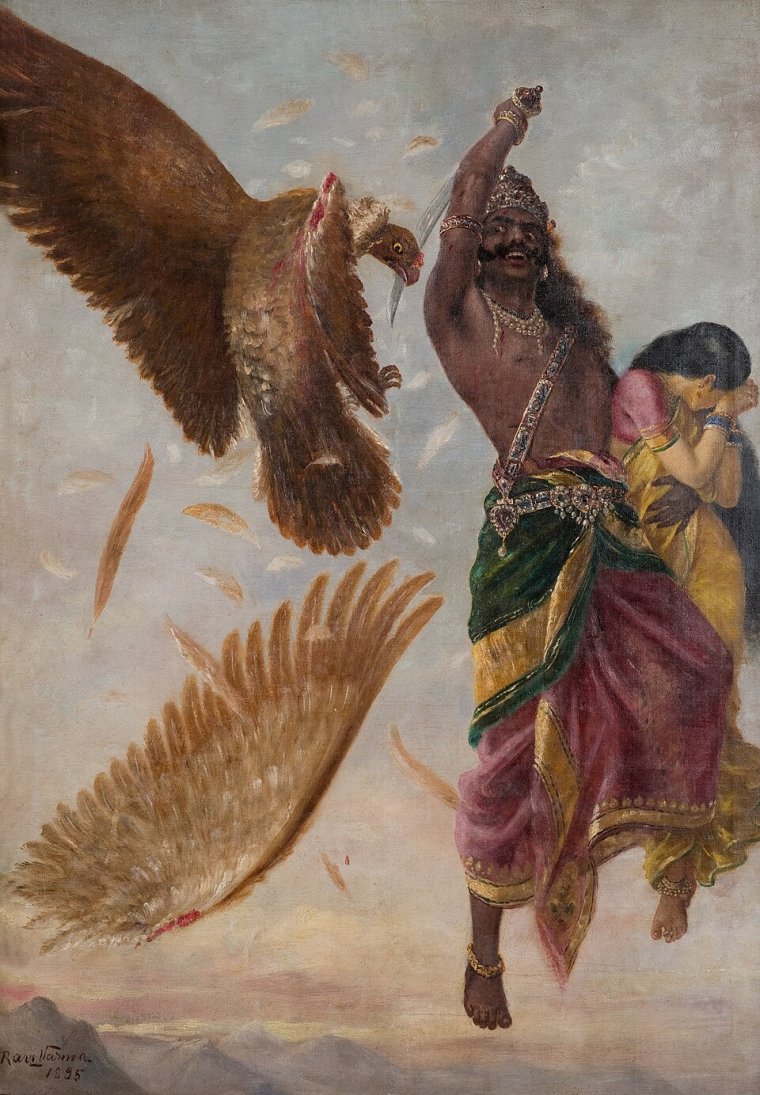
Ravana cutting Jatayu's wing. Painting by Jatayu Vadham
I. The Cosmic Prelude and the Fall from Vaikuntha
To understand the birth of Ravana, one must look far beyond the earthly realm, past the clouds and the stars, into Vaikuntha, the supreme abode of Lord Vishnu, the preserver of the universe.
The gates of Vaikuntha were guarded by two formidable, celestial doorkeepers named Jaya and Vijaya. They were fiercely loyal to Lord Vishnu and took their duties with utmost seriousness. One day, the Four Kumaras—Sanaka, Sanandana, Sanatana, and Sanatkumara—arrived at the gates. These Kumaras were the mind-born sons of Brahma the creator. Due to their immense spiritual purity, they appeared as young, naked children, despite being older than the universe itself.
When the Kumaras attempted to enter Vaikuntha to have the darshan (divine sight) of Lord Vishnu, Jaya and Vijaya, mistaking them for mere mischievous children, barred their path. They rudely ordered the sages to leave, stating that the Lord was resting.
Insulted by the ignorance and arrogance of the guards, the Kumaras pronounced a terrible curse: "You who are so bound by the dualities of pride and ignorance are unfit to reside in the absolute purity of Vaikuntha. We curse you to fall from this divine realm and be born on Earth as mortals, subject to the cycles of birth, death, anger, and desire."
Horrified, Jaya and Vijaya fell at the feet of the sages, begging for mercy. Lord Vishnu himself emerged from his cosmic slumber, realizing what had transpired. Vishnu told his guards that the curse of the sages could not be reversed, but it could be modified. He offered them a choice:
"You may either be born on Earth seven times as my devoted followers, living righteous lives, or you may be born three times as my sworn enemies, possessed of terrifying power and hatred for me. If you choose the latter, I myself will descend to Earth to slay you, and through death by my hands, you will be liberated and return to me faster."
Driven by the agonizing thought of being separated from their beloved Lord for seven lifetimes, Jaya and Vijaya chose the path of enmity. They reasoned that three lifetimes of hatred, ending in death at the hands of God, was a faster route back home than seven lifetimes of devotion.
In their first incarnation, they were born as the terrifying demons Hiranyaksha and Hiranyakashipu, who were slain by Vishnu's avatars, Varaha (the boar) and Narasimha (the man-lion).
In their second incarnation, Jaya and Vijaya were destined to become the defining figures of the Treta Yuga. They were to be born as Kumbhakarna and the supreme titan, Ravana.
II. The Union of Light and Darkness
The birth of Ravana on Earth was a fusion of two wildly contrasting lineages: the exalted purity of the Brahmin sages and the fierce, ambitious blood of the Rakshasas (demons).
During the Treta Yuga, the Rakshasa race was in decline. Their king, Sumali, had been driven out of his golden kingdom of Lanka by the god-king Kubera, the lord of wealth. Sumali and his kin were forced into hiding in the dark, subterranean realm of Patala. Sumali harbored a burning desire to reclaim his lost glory and realized that raw demonic strength was no longer enough; he needed an alliance with spiritual power.
Sumali had a daughter, Kaikesi, who possessed immense beauty, ambition, and a fierce devotion to her father's cause. Sumali instructed Kaikesi to go to the mortal realm and seek out Sage Vishrava to be her husband. Vishrava was no ordinary ascetic. He was the son of Sage Pulastya, one of the ten Prajapatis (mind-born sons of Brahma), making Vishrava the grandson of the Creator himself. Vishrava was highly revered, incredibly powerful, and already the father of Kubera, the very god who had ousted the Rakshasas.
Kaikesi approached Sage Vishrava’s ashram during the inauspicious twilight hour—a time when dark forces wander the earth. A terrible storm raged as she stood before the meditating sage. When Vishrava opened his eyes, he was captivated by her beauty but perceived the dark omen of the hour.
"O beautiful one," Vishrava said, "you have approached me with the desire for offspring during a destructive and inauspicious hour. Therefore, the children born of our union will be terrible, possessed of cruel natures and terrifying forms. They will be Rakshasas."
Kaikesi wept and fell at his feet, pleading, "O great sage, I do not wish for all my children to be wicked. Please grant me at least one son who will inherit your noble, righteous nature."
Moved by her tears, Vishrava relented slightly. "So be it. Your youngest son will be a follower of dharma."
From this complex union of extreme piety and fierce ambition, four children were born.
The eldest was born with a terrifying visage, possessing ten heads and twenty arms. His wails caused the earth to tremble, and storms raged across the sky. He was named Dashagriva (the one with ten necks). This was the boy who would become Ravana.
Following him was Kumbhakarna, a giant of a boy with insatiable hunger and earth-shattering strength. The third was a daughter, Surpanakha, possessing a cruel and fickle nature. The youngest, born as a boon to Kaikesi, was Vibhishana. Unlike his siblings, Vibhishana was serene, pious, and devoted to righteousness from the moment he drew breath.
III. The Scholar and the Ascetic
Despite his terrifying appearance and Rakshasa blood, Dashagriva was raised in the ashram of his father. Under Sage Vishrava’s strict tutelage, Dashagriva proved to be a prodigy of unparalleled intellect.
His ten heads were not merely a physical anomaly; they were highly symbolic. They represented his mastery over the six Shastras (philosophical systems) and the four Vedas. There was no scripture he had not memorized, no philosophical debate he could not win. Dashagriva also mastered Ayurveda (medicine), writing the Arka Prakasham, a treatise on the medicinal properties of extracts. He delved deep into astrology, authoring the Ravana Samhita, a text so profound that astrologers consult its principles to this day.
Yet, beneath the robes of the scholar beat the heart of a Rakshasa conqueror. Dashagriva was intensely aware of his mother's lineage and her sorrow over the loss of Lanka. He knew that knowledge alone would not restore the Rakshasa empire; he needed absolute, unassailable power.
When he reached manhood, Dashagriva, along with his brothers Kumbhakarna and Vibhishana, retreated to the dense forests of Gokarna to perform tapasya (severe penance) to Lord Brahma, the Creator.
For thousands of years, the brothers tortured their bodies. They stood on one leg, gave up food and water, and meditated through scorching summers and freezing winters. When Brahma still did not appear, Dashagriva’s determination morphed into a terrifying fanaticism.
He lit a sacred sacrificial fire. To prove his ultimate detachment from his physical form and his supreme devotion, Dashagriva drew his sword and chopped off one of his ten heads, offering it into the roaring flames. He waited. When Brahma did not appear, he chopped off a second head. Then a third.
Years passed in agonizing sequence. Dashagriva sacrificed his heads one by one, pouring his lifeblood into the fire. Just as he raised his sword to decapitate his tenth and final head—the ultimate sacrifice of his life—the heavens parted. Lord Brahma, moved and terrified by such extreme resolve, materialized before him.
"Stop, Dashagriva!" Brahma commanded, restoring the severed heads instantly. "I am pleased with your unparalleled penance. Ask of me what you will."
Dashagriva bowed, his restored ten faces glowing with triumph. "O Lord of Creation, if you are pleased, grant me immortality. Let me never die."
Brahma shook his head. "Absolute immortality is against the laws of the universe. Whatever is born must die. Ask for something else."
Dashagriva’s brilliant mind worked quickly. He calculated the threats in the universe. "Then, O Brahma, grant me this: Let me be invincible and safe from the gods, the celestial beings, the Nagas, the Yakshas, the Rakshasas, the Kinnaras, and all wild beasts and demons. Let none of these races be able to slay me."
Brahma smiled, noticing a glaring omission. "What of humans? What of normal animals, like monkeys or bears?"
Dashagriva laughed, his ten voices booming with arrogance. "Humans? Monkeys? They are mere food for us Rakshasas. I do not fear them. I need no protection from such weak, insignificant creatures."
"So be it," Brahma declared. "You shall be invincible against the races you named. Furthermore, because of the devotion you showed by sacrificing your heads, you shall possess magical powers of illusion, and your knowledge of weapons will be unmatched."
Next, Brahma turned to Kumbhakarna. The gods, terrified of the giant’s strength, had requested Saraswati, the goddess of speech, to sit on his tongue. When Brahma asked what he wanted, Kumbhakarna meant to say Indrasana (the throne of Indra, king of gods), but under Saraswati's influence, he blurted out Nidrasana (the bed of sleep). Brahma granted it instantly, cursing the giant to sleep for six months at a time.
Finally, Brahma turned to Vibhishana. "And you, righteous one?"
"O Lord," Vibhishana said, "I only ask that my mind always remains fixed on dharma (righteousness), even in the face of ultimate peril, and that I may learn the supreme weapon, the Brahmastra, without formal instruction." Brahma happily granted this noble request.
Armed with invincibility, Dashagriva returned to the world, no longer merely a scholar, but a force of nature.
IV. The Usurper and the Birth of Ravana
Empowered by Brahma’s boon, Dashagriva’s first objective was to fulfill his mother’s dream: the reclamation of Lanka.
Lanka, a magnificent island city built of solid gold by the divine architect Vishwakarma, was currently ruled by Dashagriva’s half-brother, Kubera. Dashagriva marched to Lanka and sent an ultimatum to Kubera: surrender the city or face annihilation.
Kubera, knowing of Dashagriva’s invincibility, consulted his father, Sage Vishrava. The sage advised Kubera to leave peacefully to avoid unnecessary bloodshed. Kubera abandoned Lanka and retreated to Mount Kailash in the Himalayas. Thus, without striking a single blow, Dashagriva became the Emperor of Lanka.
Not satisfied with just the city, Dashagriva pursued Kubera, defeated him in a brief battle, and violently snatched away Kubera’s most prized possession: the Pushpaka Vimana, a flying chariot of unimaginable beauty and speed, capable of expanding to accommodate any number of passengers.
Now the unquestioned lord of the Rakshasas, Dashagriva began a campaign of terror and conquest across the three worlds. He defeated the Yakshas, subjugated the Nagas, and even marched upon Amaravati, the capital of the gods, routing Lord Indra and the celestial armies. The universe trembled beneath his boots.
It was during this era of conquest that the defining moment of his spiritual life occurred.
Puffed up with immense pride after defeating Kubera, Dashagriva was flying his Pushpaka Vimana over the Himalayas when the chariot suddenly stopped. It refused to fly over a particular mountain. Dashagriva descended and met Nandi, the bull-faced guardian of Lord Shiva.
Nandi informed him that this was Mount Kailash, the abode of Lord Shiva and Goddess Parvati, and no one was allowed to fly over it. Dashagriva, insulted that a mere mountain dared to halt his progress, mocked Nandi's monkey-like face. Nandi, enraged, cursed him: "Because you mock my face, a race of monkeys will one day be the cause of your destruction!"
Ignoring the curse, Dashagriva declared, "If this mountain blocks my path, I will uproot it and toss it aside!"
He plunged his twenty powerful arms deep into the base of Mount Kailash and heaved. The great mountain shook. The peaks crumbled, and the animals fled in terror. Goddess Parvati, startled by the earthquake, clung to Lord Shiva.
Shiva, the supreme ascetic, remained unperturbed. Realizing that the arrogant Rakshasa needed to be taught a lesson, Shiva simply pressed down his great toe upon the mountain floor.
The weight of the universe transferred into that single toe. Mount Kailash slammed back down, trapping Dashagriva’s twenty arms beneath billions of tons of rock. The pain was beyond comprehension. Dashagriva let out a scream of absolute agony, a roar so terrifying that it shook the three worlds. The universe quaked at the sound.
Trapped, crushed, and his pride shattered, Dashagriva realized he had offended the Supreme Lord. His grandfather, Sage Pulastya, appeared to him in a vision and advised him to sing the praises of Shiva to seek mercy.
Summoning his vast knowledge of music and the Vedas, Dashagriva performed a horrific yet beautiful act. With his arms pinned, he tore open his own stomach, pulled out his intestines, and strung them to his toes, creating a makeshift veena. Plucking his own bloody entrails, he began to sing.
He composed the Shiva Tandava Stotram, a hymn of such breathtaking linguistic complexity, rhythmic perfection, and raw, thunderous power that it remains one of the greatest devotional prayers in Hinduism today. He sang of Shiva's matted hair, the Ganges flowing from it, and the cosmic dance of destruction. He sang for a thousand years.
Finally, Shiva, the easily pleased (Bholenath), melted with compassion. He lifted his toe, freeing the battered emperor. Shiva manifested before him, highly pleased with the music.
"Your cry of pain made the universe weep," Shiva said. "From this day forth, you shall no longer be known as Dashagriva. You shall be called Ravana—He whose roar makes the universe tremble."
Shiva bestowed upon him the Chandrahas, an indestructible, crescent-shaped sword, and blessed him. Ravana returned to Lanka, his devotion to Shiva permanently etched into his soul, yet his arrogance remained largely unchecked.
Part V. The Golden Age of Lanka and the Seeds of Destruction
Under Emperor Ravana, Lanka experienced a golden age. The city of gold became a beacon of prosperity. Ravana was a surprisingly just and brilliant administrator for his own people. No one in Lanka went hungry; the poorest homes ate from vessels of gold. The air was filled with the chanting of the Vedas and the scent of sacrificial fires.
Ravana married the spectacularly beautiful and deeply virtuous Mandodari, the daughter of Mayasura (the architect of the demons) and an Apsara (celestial nymph). Mandodari loved Ravana deeply, matching his intellect, and often acted as his moral compass, though he rarely heeded her warnings. Together they had several mighty sons, the greatest of whom was Meghanada.
Meghanada was a warrior so powerful that he conquered the heavens, captured Lord Indra, and brought him as a prisoner to Lanka. For this impossible feat, Meghanada earned the title Indrajit (Conqueror of Indra). With sons like Indrajit, a brother like Kumbhakarna, and his own invincibility, Ravana believed his empire was eternal.
However, power breeds hubris, and hubris breeds ruin. Ravana’s uncontrollable lust and arrogance led him to commit grievous sins, accumulating a deadly collection of curses.
Once, Ravana attempted to violate the celestial nymph Rambha, who was betrothed to Nalakuvara, the son of Kubera. Nalakuvara pronounced a terrifying curse upon Ravana: "If you ever force yourself upon an unwilling woman again, your ten heads will instantly shatter into a thousand pieces." This curse effectively put a magical restraint on Ravana’s lust, forcing him to seek consent from the women he captured.
On another occasion, Ravana was wandering in the Himalayas when he came across a stunningly beautiful ascetic woman named Vedavati. She was deep in meditation, performing penance to obtain Lord Vishnu as her husband. Overcome by lust, Ravana approached her and mockingly pulled her by her hair, telling her that asceticism did not suit her beauty and that she should become his queen.
Outraged by his impure touch, Vedavati severed her own hair with her hand. "You have polluted me with your touch, you despicable demon," she declared, her eyes blazing with spiritual fire. "Because of you, I can no longer continue my penance in this body. I will enter the fire and end my life now. But hear this: I will be reborn for the sole purpose of becoming the cause of your destruction!"
With that, she leaped into a blazing fire and perished. Vedavati’s soul waited in the cosmic ether, destined to be reborn as Sita.
Ravana brushed off these curses, blinded by his boons. He had conquered the earth, heaven, and the underworld. He believed he was God. He forgot Brahma’s warning. He forgot that he had not asked for protection from mere humans.
And in the kingdom of Ayodhya, a human prince named Rama—the seventh avatar of Lord Vishnu—was born. The cosmic wheel, set in motion by the curse of the Kumaras at the gates of Vaikuntha, had begun to turn toward its bloody conclusion.
VI. The Catalyst and the Crime
The direct conflict between Rama and Ravana was not initiated by the emperor himself, but by his sister, Surpanakha.
Rama, the crown prince of Ayodhya, had been exiled to the Dandakaranya forest for fourteen years, accompanied by his beautiful wife, Sita (the reincarnation of Vedavati), and his fiercely loyal brother, Lakshmana.
Surpanakha, wandering the forests, saw the handsome Rama and was instantly smitten. She approached him, offering herself, but Rama politely declined, stating he was married, and pointed her to Lakshmana. Lakshmana, angered by her persistence, mocked her. Enraged, Surpanakha assumed her demonic form and lunged at Sita to devour her. In a flash, Lakshmana drew his sword and sliced off Surpanakha’s nose and ears.
Bleeding and screaming for vengeance, Surpanakha fled to her brothers, Khara and Dushasana, who ruled the forest outpost. They attacked Rama with an army of 14,000 Rakshasas. In a display of terrifying martial prowess, the mortal human Rama annihilated the entire army single-handedly.
When the news reached Lanka, Ravana’s fury knew no bounds. His sister mutilated, his armies slaughtered by a mere human! Surpanakha manipulated Ravana, not just by demanding revenge, but by describing the unearthly beauty of Sita. "She is fit only for the Emperor of Lanka," Surpanakha hissed. "Avenge me by taking his most prized possession."
Lust and vengeance clouded Ravana's brilliant intellect. He flew his Pushpaka Vimana to the ashram of Maricha, his uncle. Maricha had faced Rama before and knew the human prince was an incarnation of supreme divinity. He begged Ravana to abandon this suicidal path.
"You do not know Rama," Maricha warned. "He is death personified. Taking his wife will bring ruin to Lanka."
Ravana, blinded by ego, drew his sword. "Help me, or die by my hand right now."
Given the choice, Maricha chose to die at the hands of the divine Rama rather than the demonic Ravana. Using his magical powers, Maricha transformed into a mesmerizing, golden deer studded with gems. He grazed near Rama's ashram, catching Sita’s eye. Entranced, Sita begged Rama to catch it for her.
Rama chased the deer deep into the forest. When Rama finally shot the deer, Maricha, reverting to his demon form, cried out in Rama's voice: "O Sita! O Lakshmana! Help me!"
Hearing the cry, Sita panicked and forced Lakshmana to leave her and find Rama. Before leaving, Lakshmana drew a mystical line of protection—the Lakshman Rekha—around the hut, warning Sita not to cross it.
With Sita alone, Ravana made his move. He knew he could not cross the magical barrier, so he disguised himself as a frail, wandering sage begging for alms. When Sita tried to hand him food from within the boundary, Ravana refused, feigning insult at her lack of hospitality. To appease the "sage," Sita stepped across the line.
Instantly, the frail ascetic vanished. Before her stood the terrifying ten-headed titan. Before Sita could scream, Ravana grabbed her, dragged her onto his flying chariot, and took to the skies.
As they flew south, an ancient vulture, Jatayu, an old friend of Rama’s father, heard Sita’s cries. Jatayu bravely intercepted the great emperor. Despite his old age, the bird fought ferociously, tearing Ravana’s flesh with his beak and talons. But a bird cannot defeat a titan. Ravana drew his sword, Chandrahas, and severed Jatayu’s wings, sending the noble creature plummeting to the earth.
Ravana brought Sita to Lanka. Because of Nalakuvara’s curse, he could not force himself upon her. He imprisoned her in the beautiful Ashok Vatika (a grove of Ashoka trees), surrounded her with terrifying demonesses to break her spirit, and gave her a year to accept him as her husband.
Part VII. The Gathering Storm
Ravana believed that taking Sita was the end of the matter. A mere human living in the forest without an army could never cross the vast southern ocean, let alone breach the impenetrable defenses of golden Lanka.
He was wrong. Rama was no ordinary human. Driven by immense grief and a righteous fury, Rama allied with the Vanaras (a race of powerful, intelligent monkeys and apes), fulfilling Nandi’s ancient curse.
The first crack in Ravana’s armor of invincibility occurred with the arrival of Hanuman.
Hanuman, the supreme devotee of Rama and a Vanara of godlike power, leaped across the ocean and infiltrated Lanka. He found Sita in the Ashok Vatika, gave her Rama’s ring as a sign of hope, and promised her that Rama was coming.
Before leaving, Hanuman decided to test Lanka’s defenses. He destroyed the beautiful gardens, killed thousands of guards, and even slew Ravana’s youngest son, Aksha Kumara. Finally, Indrajit captured Hanuman using the Brahmastra and dragged him before Ravana’s court.
Ravana looked down at the monkey with contempt. "Who are you, and why have you destroyed my city?"
Hanuman stood tall. "I am the servant of Lord Rama. Return Sita, O Ravana, and fall at his feet, or you and your entire race will be erased from existence."
Ravana, incensed by the disrespect, ordered the monkey's tail to be set on fire. It was a fatal miscalculation. Using his mystical powers, Hanuman lengthened his tail, broke free of his bonds, and leaped from roof to roof. Within hours, the magnificent golden city of Lanka was a blazing inferno. Hanuman extinguished his tail in the ocean and leaped back to Rama.
The burning of Lanka sent shockwaves through the Rakshasa empire. Rebuilding the city with his immense wealth, Ravana called a council of war.
His righteous brother, Vibhishana, stood up. "Brother, this is no ordinary monkey, and Rama is no ordinary man. You have stolen the wife of another. This is against dharma. Return Sita and save our race from slaughter."
Ravana’s ego exploded. He called Vibhishana a traitor, a coward, and a stain on the Rakshasa bloodline. He kicked Vibhishana off his throne and banished him from Lanka. Vibhishana flew across the ocean and sought refuge at the feet of Rama, who welcomed him with open arms and crowned him the future King of Lanka in exile.
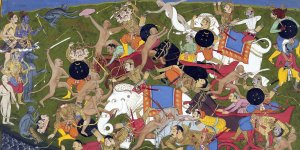
Soon after, the impossible happened. Millions of Vanaras, under the direction of the engineer Nala, built a floating bridge of stones across the ocean. Rama, Lakshmana, and the monkey army crossed the sea and laid siege to Lanka.
The Great War had begun.
Part VIII. The Yuddha Kanda (The War of Extinction)
The war of Lanka was a cataclysmic event, a clash of titans that turned the white sands of the beaches red with blood.
Initially, Ravana watched from his balconies, amused by the monkeys throwing stones and trees. But soon, his amusement turned to horror. Rama and Lakshmana, armed with divine archery, slaughtered the greatest generals of the Rakshasa army.
Realizing the gravity of the situation, Ravana awakened his giant brother, Kumbhakarna. Kumbhakarna, rudely awoken from his magical sleep, was furious. When Ravana explained the situation, Kumbhakarna, like Vibhishana, reprimanded him. "You have committed a great sin, brother. You abducted the mother of the universe. Yet, you are my king and my elder brother. I will fight for you, and I will die for you."
Kumbhakarna entered the battlefield like a walking mountain. He crushed hundreds of Vanaras under his feet and ate them by the handful. He nearly turned the tide of the war until Rama stepped forward. A brutal duel ensued, ending when Rama severed the giant’s limbs and finally decapitated him with the Indrastra.
When Ravana heard of Kumbhakarna’s death, the emperor wept openly. For the first time, fear gripped his heart. But his pride refused to let him surrender.
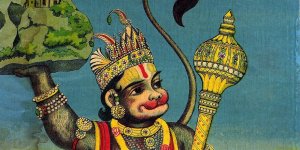
He sent his greatest weapon, his son Indrajit. Indrajit fought from behind the clouds using illusions. He unleashed terrifying serpentine weapons (Nagapash) that bound Rama and Lakshmana, until Garuda the divine eagle arrived to save them. Later, Indrajit unleashed the supreme weapon, the Brahmastra, rendering millions of monkeys unconscious. He even gravely wounded Lakshmana, forcing Hanuman to fetch the Sanjeevani mountain to save him.
But eventually, Lakshmana, matching Indrajit’s magical warfare with pure righteousness and focus, slew the conqueror of Indra.
When the dead body of Indrajit was brought into the palace, Ravana’s spirit broke. He lost his brother and his most beloved son. His wives wailed. Mandodari begged him one last time. "It is not too late. Give her back. Rama is compassionate; he will forgive you."
Ravana looked at his queen, his ten faces etched with profound sorrow, ancient wisdom, and immovable ego.
"Mandodari," Ravana said softly, the scholar within him speaking. "Do you think I do not know who Rama is? Do you think a mere human could kill Khara, Dushasana, Kumbhakarna, and Indrajit? I know he is Lord Narayana himself. I am Jaya, the cursed gatekeeper of Vaikuntha. This is my destiny. I cannot surrender. A Rakshasa emperor does not beg for mercy. I will go to the battlefield. I will either kill the Lord and rule the universe, or I will be killed by God himself and attain ultimate liberation."
Ravana put on his impenetrable golden armor. He mounted his terrifying chariot, drawn by demonic horses, and rode out onto the battlefield for the final confrontation.
Part IX. The Final Duel and the Fall of the Titan
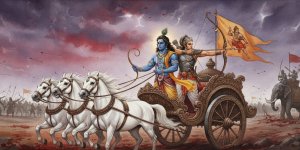
When Ravana arrived on the battlefield, the earth shuddered. His presence was so overpowering, his aura so terrifying, that the Vanara army scattered in panic. Lord Indra, watching from the heavens, realized that Rama, fighting on foot, was at a disadvantage against Ravana’s flying chariot. Indra sent his own divine chariot, driven by his charioteer Matali, down to earth for Rama.
The battle between Rama and Ravana was the pinnacle of martial combat. It was a duel that defied description. For days and nights, the two warriors exchanged volleys of divine arrows. The sky was blotted out by fire, lightning, and darkness as they countered each other's celestial weapons (astras).
Ravana unleashed weapons of fire; Rama countered with weapons of water. Ravana unleashed serpent weapons; Rama countered with eagle weapons. The clash of their energies created storms that churned the ocean and tore the clouds apart.
Rama, maintaining total calm, drew back his bow and fired an arrow that neatly decapitated one of Ravana’s ten heads. The head rolled onto the bloody battlefield. But instantly, by the power of his ancient boon, a new head sprouted from Ravana’s neck.
Rama shot another arrow, severing another head. Another grew back. He severed Ravana's arms; they regenerated. Over and over, Rama cut down the titan, and over and over, Ravana resurrected, roaring with laughter. The ten heads were symbolic of his endless desires and ego; no matter how many times you cut down ego, if the root remains, it grows back.
Rama paused, exhausted and perplexed. How do you kill a being who cannot die?
At that moment, Vibhishana, who knew the deepest secrets of Lanka, rushed to Rama’s side. "Lord," Vibhishana whispered over the din of battle, "you cannot kill him by cutting his heads. During his penance, Brahma granted him a vial of Amrita (the nectar of immortality) and embedded it deep within his navel. As long as the nectar is intact, his life force will regenerate. You must strike his navel and dry up the nectar."
Rama nodded. He realized ordinary arrows would not suffice. He summoned the ultimate weapon, the Brahmastra—a weapon imbued with the absolute power of creation and destruction, chanting the sacred mantras imparted to him by Sage Agastya.
The Brahmastra blazed like a thousand suns. Rama mounted it on his bow, drew the string to his ear, and took aim.
Ravana saw the blazing light. In that briefest of moments, he knew the end had come. The curse of the Kumaras, the curse of Nandi, the curse of Vedavati—all coalesced into the glowing tip of Rama's arrow.
Rama released the string. The arrow tore through the air, vibrating with a cosmic hum. It struck Ravana squarely in the navel. The divine fire of the weapon instantly vaporized the nectar of immortality. The arrow then pierced Ravana's massive chest, tearing through his heart, before returning to Rama's quiver.
The Emperor of Lanka froze. His weapons dropped from his hands. His ten faces lost their terrifying ferocity, replaced by a look of sudden, profound peace. The massive titan swayed like a giant tree severed at its trunk, and then, with a thud that echoed across the three worlds, Ravana crashed to the earth.
The Great War was over.
Part X. The Final Lesson and the Ultimate Liberation
As Ravana lay dying on the blood-soaked sands of Lanka, his lifeblood pooling around him, the heavens rejoiced. Flowers rained down upon Rama. Yet, Rama did not celebrate immediately. He looked at the fallen king with a deep sense of respect.
Rama turned to his brother. "Lakshmana, Ravana is not just a demon. He is a great Brahmin, the greatest scholar of our time, and a master of statecraft. With his death, an immense treasury of knowledge will be lost to the world. Go to him. Stand near his feet—for one must never stand near the head of a teacher—and ask him to share his wisdom."
Lakshmana, surprised but obedient, approached the dying titan and stood respectfully near his feet.
Ravana, his life fading, opened his eyes. He saw Lakshmana and understood Rama's intent. Even in death, his intellect remained sharp. He spoke his final words, imparting profound lessons of politics and life to the prince:
"Do not delay good actions, and delay bad actions as much as possible." Ravana confessed that he delayed recognizing Rama's divinity and returning Sita, but was quick to act on his lust and anger.
"Never underestimate your enemy." He admitted his fatal flaw was asking Brahma for protection from gods and demons, but ignoring humans and monkeys, considering them too weak to be a threat.
"Keep your deepest secrets to yourself." He looked toward Vibhishana. Ravana lamented that trusting his brother with the secret of the nectar in his navel led to his ultimate downfall.
Having imparted his final wisdom, Ravana closed his eyes. In his dying moments, he did not see the human prince Rama standing over him; he saw the cosmic, eternal form of Lord Vishnu, his beloved master whom he had guarded at the gates of Vaikuntha eons ago.
The hatred, the ego, the ten heads of worldly desire dissolved. The curse of the Kumaras was fulfilled. A brilliant light emerged from Ravana’s body and merged into Lord Rama. Jaya had finally returned home.
Conclusion: The Legacy of a Tragic Titan
Following Ravana's death, Rama instructed Vibhishana to perform the last rites of his brother with the utmost honor and respect befitting an emperor and a Brahmin. Rama himself stated that his enmity with Ravana ended with the titan's death, acknowledging the greatness that existed alongside the evil.
Ravana remains one of the most compelling characters in global mythology. He is the ultimate embodiment of the paradox of human existence. He possessed the greatest knowledge in the universe, yet he lacked the wisdom to apply it righteously. He was the greatest devotee of God (Shiva), yet he fought against God (Rama). He built a paradise for his people, but his selfish desires reduced it to ashes.
His ten heads stand as an eternal warning against the ten negative emotions: Kama (lust), Krodha (anger), Moha (delusion), Lobha (greed), Mada (pride), Matsarya (envy), Manas (mind/ego), Buddhi (intellect corrupted by power), Chitta (will), and Ahamkara (the self-centered ego). Ravana had mastered the external world, but he failed to conquer the internal demons of his own mind.
To this day, effigies of Ravana are burned during the festival of Dussehra, symbolizing the triumph of good over evil. Yet, in certain parts of India, Sri Lanka, and among certain Brahmin lineages, he is still revered. Temples exist dedicated to his worship, honoring his devotion to Shiva and his peerless astrological texts.
The story of Ravana is not merely about a villain who gets defeated. It is a profound philosophical epic that teaches a chilling truth: no amount of wealth, no degree of intelligence, and no intensity of religious devotion can save a soul if it abandons morality and surrenders to the ego. Ravana was a being capable of touching the stars, but his own shadow dragged him back to the dust.
YOU MAY ALSO LIKE