| / Stories, Legends, Myths |
The Story of Rama (in brief)
The story of Rama is a blueprint for human conduct. Rama is the Maryada Purushottama—the perfect man who never deviates from the law, even at the cost of his own heart. To hear the story of Rama, as the tradition says, is to be reminded that even in the darkest forest, the light of Dharma never truly goes out.
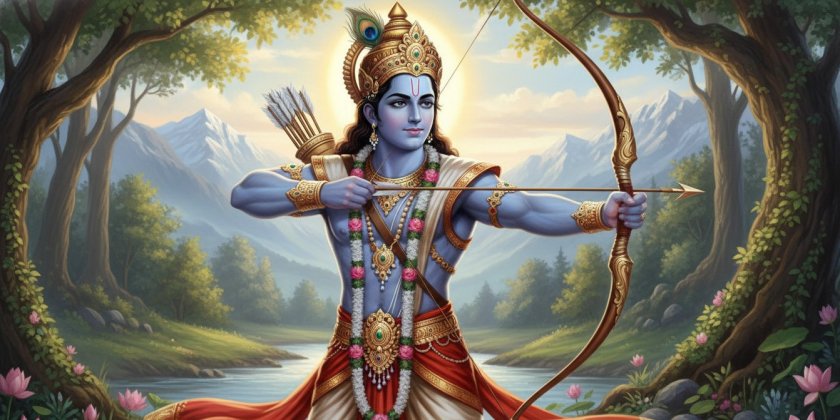
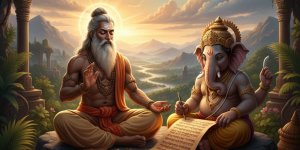
Rama. Photo: Google Ai Studio
I. The Dawn in Ayodhya
The story begins in the majestic city of Ayodhya, the capital of the kingdom of Kosala, situated on the banks of the sacred Sarayu River. Ayodhya was a city of unparalleled beauty, governed by King Dasharatha, a monarch of the Ikshvaku dynasty known for his wisdom and valor. Despite his many virtues and the prosperity of his kingdom, Dasharatha bore a heavy sorrow: he had no heir to continue his lineage.
On the advice of his royal priest, Vashistha, Dasharatha performed the Putrakameshti Yagna, a grand sacrificial ritual to invoke the blessings of the gods. From the sacrificial fire emerged a celestial being bearing a vessel of divine nectar. Dasharatha distributed this nectar among his three queens: Kausalya, Kaikeyi, and Sumitra.
In due time, the queens gave birth to four sons. Kausalya bore Rama, the eldest and the incarnation of Lord Vishnu, the Preserver of the Universe. Kaikeyi gave birth to Bharata, and Sumitra bore the twins, Lakshmana and Shatrughna.
The princes grew up in an environment of love and rigorous training. While all four were exceptional, a special bond formed between Rama and Lakshmana, and between Bharata and Shatrughna. Rama, however, was the jewel of Ayodhya—composed, compassionate, and a master of every art and weapon.
II. The Path of the Warrior
When the princes were still in their youth, the great sage Vishwamitra arrived at Dasharatha’s court. He requested that Rama be sent with him to the forest to protect his sacred rituals from the demons (Rakshasas) who were desecrating them. Dasharatha was hesitant to send his beloved son, but Vashistha reminded him of Rama’s divine destiny. Rama, followed by the ever-loyal Lakshmana, departed with the sage.
In the forest, Vishwamitra initiated the brothers into the use of divine weapons and mantras. Rama proved his prowess by slaying the demoness Tataka and driving away the brothers Subahu and Maricha. Pleased with their discipline, Vishwamitra led them to the kingdom of Mithila, ruled by the saintly King Janaka.
Janaka possessed a celestial bow of Lord Shiva, so heavy that no king or warrior could even lift it. He had declared that his daughter, Sita—born from the earth and discovered by Janaka in a furrow—would be married only to the man who could string this bow. Many had tried and failed.
When Rama stepped forward, he not only lifted the bow with ease but, in the process of stringing it, snapped it in two. The sound echoed like a thunderclap across the world. Rama and Sita were wed in a grand ceremony, alongside their brothers and the daughters of Janaka’s family. They returned to Ayodhya, and for several years, the city lived in a golden age of happiness.
III. The Shadow of Exile
As Dasharatha aged, he decided to crown Rama as the Yuvaraja (Crown Prince). The city erupted in joy, preparing for the coronation. However, the shadow of discord loomed. Manthara, a hunchbacked maid and confidante to Queen Kaikeyi, began to poison the queen’s mind with jealousy. She convinced Kaikeyi that if Rama became king, Bharata would be a servant and Kaikeyi would lose her status.
Kaikeyi, who had once saved Dasharatha’s life on the battlefield and been granted two boons, chose this moment to claim them. On the eve of the coronation, she went to the King and demanded: first, that her son Bharata be crowned King; and second, that Rama be exiled to the Dandaka forest for fourteen years.
Dasharatha was devastated. He pleaded, wept, and collapsed, but his commitment to truth—his Dharma—forbade him from breaking a promise. When Rama learned of the boons, he remained unshaken. To him, the honor of his father’s word was more important than a kingdom. He prepared to leave immediately. Sita, despite Rama’s pleas for her to stay in the palace, insisted on following her husband, stating that "wherever Rama is, there is my Ayodhya." Lakshmana, too, refused to be left behind, choosing a life of hardship over a life without his brother.
The trio donned garments of tree bark and departed as the citizens of Ayodhya wept. Shortly after their departure, Dasharatha, unable to bear the grief of separation from his eldest son, passed away.
IV. The Life in the Wild
While Rama was in exile, Bharata, who had been away at his maternal uncle’s home, returned to Ayodhya. He was horrified by his mother’s actions. Refusing to take the throne, he tracked Rama to the forest at Chitrakoot. Bharata begged Rama to return, but Rama stood firm on his vow. In a gesture of supreme devotion, Bharata took Rama’s wooden sandals (padukas), placed them on the throne, and ruled as a regent from outside the city walls, living as an ascetic until Rama’s return.
Rama, Sita, and Lakshmana moved deeper into the forest, eventually settling at Panchavati on the banks of the Godavari. For years, they lived a simple, harmonious life, protecting the hermits from demons. However, their peace was shattered by the arrival of Shurpanakha, the sister of Ravana, the demon-king of Lanka.
Ravana was a figure of immense power. He was a scholar, a devotee of Shiva, and had ten heads representing his vast knowledge. But he was also consumed by ego and lust. When Shurpanakha attempted to kill Sita out of jealousy and Rama and Lakshmana repelled her—Lakshmana cutting off her nose in the scuffle—she fled to her brother Ravana, fueling his rage and describing Sita’s incomparable beauty.
V. The Golden Deer and the Abduction
Ravana devised a sinister plan. He enlisted the demon Maricha, who transformed himself into a dazzling golden deer. Sita, captivated by its beauty, asked Rama to capture it for her. Sensing danger but wanting to please Sita, Rama went after the deer, leaving Lakshmana to guard the hermitage.
As Rama’s arrow struck Maricha, the demon mimicked Rama’s voice, crying out for help. Fearing for her husband’s life, Sita urged Lakshmana to go. Lakshmana, sensing a trap, was hesitant, but Sita’s distress forced his hand. Before leaving, he drew a protective line—the Lakshmana Rekha—around the hut, warning Sita not to cross it.
With the brothers away, Ravana approached the hut disguised as a wandering mendicant. He tricked Sita into crossing the line to offer him alms. The moment she stepped out, he revealed his true, monstrous form and forcibly carried her away in his flying chariot, the Pushpaka Vimana.
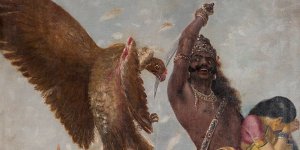
As Ravana flew south, the aged vulture-king Jatayu attempted to rescue Sita. He fought valiantly, but Ravana clipped his wings, leaving him to die. Sita, in her grief, dropped her ornaments over a mountain where a group of monkeys sat, hoping they would serve as a trail for Rama.
VI. The Search and the Alliance
Rama and Lakshmana returned to find an empty hut. Rama’s grief was profound; he wandered through the forest, asking the trees, the rivers, and the deer if they had seen his beloved. They found the dying Jatayu, who told them of Ravana’s direction before breathing his last.
Their search led them to Lake Pampa, where they met the monkey-god Hanuman, a minister to the exiled monkey-prince Sugriva. Hanuman recognized Rama’s divinity immediately and brought the brothers to Sugriva.
Sugriva was in a bitter conflict with his brother Vali, the King of Kishkindha, who had usurped his throne and wife. Rama and Sugriva formed an alliance: Rama would help Sugriva regain his kingdom, and Sugriva would lend his vast army of Vanaras (forest-dwellers/monkeys) to find Sita. Rama killed Vali, and Sugriva was crowned king.
However, as the rainy season arrived, Sugriva became lost in the pleasures of his restored kingdom. It was Lakshmana’s fierce intervention that reminded him of his promise. Sugriva then dispatched search parties to the four corners of the world. The southern party, led by the prince Angad and including Hanuman and the wise bear Jambavan, reached the edge of the vast ocean. They learned from Sampati (Jatayu’s brother) that Sita was being held captive in the island kingdom of Lanka, a hundred leagues across the sea.
VII. The Flight of Hanuman
The Vanaras stood at the shore, daunted by the expanse of the ocean. It was Jambavan who reminded Hanuman of his latent divine powers. Hanuman grew to a mountain’s size and, with a mighty roar, leaped across the ocean.
In Lanka, Hanuman searched every corner of the opulent city until he found Sita in the Ashoka Vatika, a grove of Ashoka trees. She was surrounded by demonesses, pale and thin, her mind constantly fixed on Rama. Hanuman watched as Ravana approached her, alternately threatening her and pleading for her affection, only to be met with her unwavering scorn.
Once Ravana left, Hanuman approached Sita, showing her Rama’s signet ring as proof of his identity. He offered to carry her back, but Sita refused; she insisted that Rama himself must come and defeat Ravana to restore her honor. Hanuman, wanting to test the strength of Lanka, allowed himself to be captured after destroying the grove.
Brought before Ravana’s court, Hanuman warned the demon-king to return Sita and seek Rama’s forgiveness. Enraged, Ravana ordered Hanuman’s tail to be set on fire. Hanuman, using his divine powers, grew his tail, escaped his bonds, and leaped from rooftop to rooftop, setting the golden city of Lanka ablaze before returning to Rama with Sita’s message and a jewel she had given him.
VIII. The War of the Worlds
With the location of Sita confirmed, the Vanara army marched to the shore. There, they were joined by Vibhishana, Ravana’s younger brother. Vibhishana was a man of Dharma who had tried to convince Ravana to return Sita; when Ravana kicked him out of the court, he sought refuge with Rama. Rama, embodying the virtue of Sharanagata Vatsala (protector of those who seek refuge), accepted him.
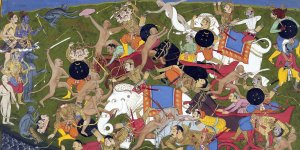
To cross the ocean, the Vanaras built a magnificent bridge—the Ram Setu—using stones that floated by the grace of Rama’s name. The army crossed into Lanka, and one of the greatest wars in the history of the cosmos began.
The war was a spectacle of divine and demonic weaponry. Great warriors fell on both sides. Lakshmana was nearly killed by a magical spear from Ravana’s son, Indrajit. To save him, Hanuman flew to the Himalayas to find the Sanjeevani herb. Unable to identify the plant, he lifted the entire mountain and flew back to the battlefield in time to revive Lakshmana.
Ravana’s giant brother, Kumbhakarna, was awakened from his deep slumber and entered the fray, causing mass destruction before being slain by Rama. Finally, after Indrajit was killed by Lakshmana, Ravana himself entered the battlefield.
The duel between Rama and Ravana lasted for days. Rama severed Ravana’s heads repeatedly, but they grew back instantly. Finally, on the advice of Agastya and with the secret revealed by Vibhishana—that Ravana’s life force lay in his navel—Rama invoked the Brahmastra, the most powerful of divine weapons. The arrow pierced Ravana’s heart, and the demon-king fell, his soul finally finding liberation in death.
IX. The Fire Ordeal and the Return
With the war over, Sita was brought to Rama. However, to the shock of everyone, Rama spoke to her with coldness. He stated that since she had lived in the house of another man, her purity might be questioned by the world. Devastated, Sita asked Lakshmana to build a funeral pyre. She entered the flames, declaring that if she had been faithful to Rama in thought, word, and deed, the fire would not harm her. Agni, the god of fire, rose from the pyre, carrying Sita and testifying to her absolute purity.
Rama accepted her, explaining that he never doubted her but needed this public testimony to silence future critics. The fourteen years of exile were now complete.
Rama, Sita, and Lakshmana, along with their allies, returned to Ayodhya in the Pushpaka Vimana. The city was a sea of lamps; the citizens celebrated the return of their rightful king with a joy that gave birth to the festival of Diwali. Rama was crowned King, and thus began the era of Rama Rajya—a kingdom of perfect peace, justice, and prosperity where there was no poverty, no disease, and no sorrow.
X. The Bitter End (The Uttara Kanda)
While many versions of the story end with the coronation, the Uttara Kanda provides a poignant and controversial epilogue.
Despite the fire ordeal, rumors about Sita’s purity persisted among some citizens of Ayodhya. Rama, prioritizing his duty as a king (who must be above all reproach) over his personal happiness, made the agonizing decision to exile a pregnant Sita.
Sita found refuge in the hermitage of Sage Valmiki, where she gave birth to twin sons, Luv and Kush. They grew up hearing the story of Rama from Valmiki and became masters of the epic. Years later, during an Ashwamedha Yagna performed by Rama, the boys sang the Ramayana in the royal court, leading to Rama’s realization of their identity.
Rama called for Sita to return and prove her innocence one last time. Sita, weary of the world’s judgments, called upon her mother, the Earth. "If I have never thought of any man but Rama," she prayed, "then, Mother Earth, take me back into your bosom." The earth split open, and a divine throne emerged to carry Sita away.
Rama, heartbroken, ruled for several more years before eventually walking into the Sarayu River to return to his divine form as Vishnu, followed by his brothers and the faithful citizens of Ayodhya.
YOU MAY ALSO LIKE