| / Stories, Legends, Myths |
The Story of Vyasa
Vyasa, a figure of paramount importance in the annals of Hindu tradition, is much more than just a sage; he is considered a divine incarnation, a compiler of sacred texts, and the author of the world's longest epic poem.
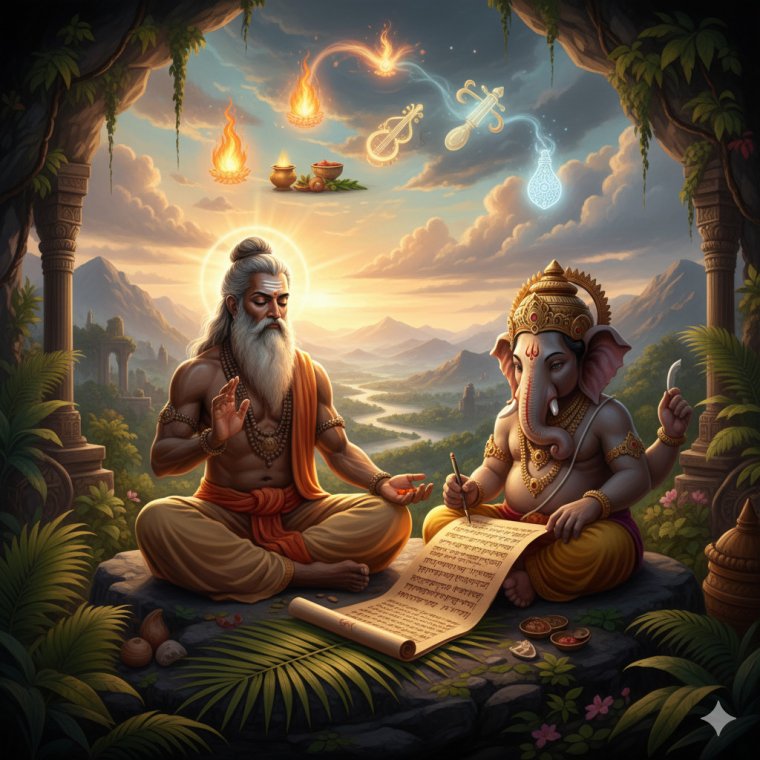
Vyasa dictating the Mahabharata to Ganesha. Photo: Google AI Studio
The Enigmatic Birth
The story of Vyasa's birth is as extraordinary as the man himself, a testament to the intricate tapestry of divine intervention and human circumstance that often characterizes ancient Indian narratives. His mother was Satyavati, a young woman of breathtaking beauty born into a family of fishermen. Her given name was Matsyagandha, literally "fish-smelling," a rather unfortunate attribute that emanated from her body due to a celestial curse or perhaps a unique physical characteristic.
One day, as Satyavati was diligently performing her duty as a ferrywoman across the sacred Yamuna River, she encountered the revered sage Parashara. Parashara was a renowned scholar, a master of Vedic knowledge, and a man of immense spiritual power, but also one who occasionally engaged in worldly affairs. He was immediately captivated by Satyavati's ethereal beauty and, moved by an irresistible urge, expressed his desire to have a child with her.
Satyavati, a virtuous maiden, was naturally hesitant. She raised several objections: her unpleasant fishy odor, the fact that she was a virgin and concerned about her reputation, and the potential embarrassment of such a union occurring in broad daylight, visible to all. Parashara, however, was not easily deterred. With his yogic powers, he addressed her concerns.
He granted her a boon, instantly transforming her fishy odor into an exquisite, divine fragrance that spread for miles around. From that moment, she was known as Gandhavati, the "fragrant one." To ensure their privacy and uphold her honor, he conjured a dense, supernatural fog that enveloped the entire area, obscuring them from any prying eyes. Convinced and honored by the sage's sincerity and power, Satyavati consented.
From this extraordinary union, on an island (dvipa) in the middle of the Yamuna River, a child was born. He was dark-complexioned, which earned him the name Krishna (meaning "dark"). Being born on an island, he was also called Dvaipayana. Thus, he became Krishna Dvaipayana. Immediately upon his birth, a miraculous event occurred: the child, instead of being an infant, manifested with the wisdom and austerity of a fully grown sage.
He promised his mother that he would appear whenever she needed him, and then, with the detachment of a true ascetic, he departed to pursue a life of intense spiritual discipline, study, and meditation in the Himalayas. This early departure highlights Vyasa's inherent divine nature and his destined path towards profound spiritual endeavors, rather than worldly attachments.
Compiling the Vedas
In the ancient Vedic period, knowledge was primarily transmitted orally. The Vedas, the foundational scriptures of Hinduism, were a vast and sprawling collection of hymns, prayers, philosophical treatises (Upanishads), and sacrificial formulas. They were an unorganized mass of divine revelation, held in the collective memory of generations of sages and priests.
However, as the Yuga (epoch) progressed, and human intellect and memory began to decline, Vyasa foresaw a time when humanity would struggle to comprehend, memorize, and preserve this immense body of sacred knowledge.
Driven by a profound sense of responsibility for the spiritual well-being of future generations, Vyasa undertook the Herculean task of organizing and categorizing the Vedas. This was not a mere editorial exercise; it was an act of profound spiritual insight and immense scholarly rigor. He meticulously analyzed, classified, and arranged the diverse hymns and verses into four distinct and coherent collections, each with its specific focus and purpose:
Rig Veda: The oldest and most important of the Vedas, primarily a collection of hymns (ṛc) addressed to various deities, often praising their attributes and invoking their blessings. It is considered the fundamental text for understanding Vedic cosmology and mythology.
Yajur Veda: This Veda focuses on the formulas and mantras (yajus) used in rituals and sacrifices (yajna). It serves as a practical guide for priests performing these elaborate ceremonies, providing the precise words and actions required.
Sama Veda: Comprising melodies and chants (sāman), this Veda draws heavily from the Rig Veda, adapting many of its hymns to be sung during Soma sacrifices and other rituals. It is the Veda of music and liturgy, emphasizing the power of sound and rhythm in spiritual practice.
Atharva Veda: Distinct from the other three, the Atharva Veda contains hymns, spells, and incantations primarily concerned with daily life, health, protection from evil, prosperity, and even aspects of governance. It reflects a more practical and folk-oriented side of Vedic religion.
It was this monumental achievement of classification and systematization that earned Krishna Dvaipayana the esteemed title of "Vyasa," which literally means "compiler," "arranger," or "editor." Through this act, he not only preserved the Vedas but also made them accessible and understandable for countless generations to come, ensuring their continuity and influence on Hindu thought.
Authoring the Mahabharata
While the compilation of the Vedas was a towering intellectual and spiritual achievement, Vyasa's most famous and enduring legacy is undeniably the authorship of the Mahabharata. This epic, far more than just a story, is a veritable encyclopedia of ancient Indian culture, ethics, philosophy, and dharma.
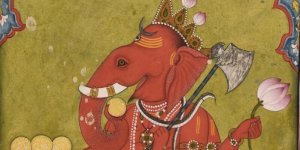
The legend of its composition is as fascinating as the epic itself. Vyasa, having conceived the entire vast narrative in his mind, recognized the sheer impossibility of writing it down by himself. It was too immense, too complex, and too rich in detail. He needed a divine scribe. He reportedly approached Lord Brahma, the creator god, who advised him to seek the assistance of Ganesha, the elephant-headed god, revered as the remover of obstacles and the scribe of the gods.
Ganesha, upon being approached by Vyasa, agreed to undertake the task but stipulated a challenging condition: Vyasa must dictate the entire epic continuously, without a single pause. Should Vyasa stop, Ganesha would cease writing and depart. Vyasa, equally astute, accepted the condition but counter-proposed his own: Ganesha, in turn, must not write down anything unless he had fully understood its meaning.
This unique and intellectually stimulating partnership gave birth to the Mahabharata. Vyasa would dictate incredibly complex, multi-layered verses, often weaving in philosophical discussions, ethical dilemmas, and intricate narratives. Ganesha, true to his word, would pause to fully comprehend the profound meaning of the verses before committing them to palm leaves. These moments of pause, created by Vyasa's deliberate use of abstruse verses, gave the sage just enough time to compose the next set of verses in his mind. The process was a cosmic dance of divine intellects, resulting in an epic of unparalleled depth and scope.
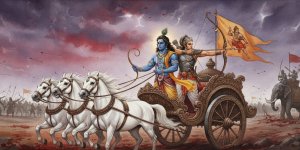
The Mahabharata, at its core, narrates the events leading up to and during the Kurukshetra War, a catastrophic fratricidal conflict between the Kauravas and the Pandavas, two branches of the Kuru dynasty. However, it is far more than a war story. Interspersed within the narrative are countless smaller stories, parables, philosophical discourses, and moral injunctions. Its most celebrated section is the Bhagavad Gita, a profound philosophical dialogue between Lord Krishna and Arjuna on the eve of the battle, discussing dharma, duty, selflessness, and the nature of reality.
The Mahabharata, often referred to as the "fifth Veda," is an authoritative text on dharma (righteous conduct), artha (economic prosperity), kama (desire and pleasure), and moksha (spiritual liberation). Vyasa embedded within it a wealth of knowledge, addressing every conceivable aspect of human existence, from statecraft and ethics to cosmology and spiritual practices. It is said that "what is not in the Bharata is not in Bharata" (referring to India itself), highlighting the epic's comprehensive nature.
Vyasa's Role in the Kuru Dynasty
Beyond his literary and spiritual contributions, Vyasa plays a critical, albeit unusual, role in the very lineage of the Kuru dynasty, the central family of the Mahabharata. His involvement stems from a desperate situation faced by his mother, Satyavati, who, after her marriage to King Shantanu, became the queen mother of Hastinapura.
Shantanu had three sons: Devavrata (Bhishma) from his first wife, Ganga, and then Vichitravirya and Chitrangada from Satyavati. Chitrangada died young in battle. Vichitravirya married two princesses, Ambika and Ambalika, but tragically died heirless due to illness before he could produce any children. This left the Kuru dynasty in a precarious position, facing the unthinkable prospect of extinction.
In ancient India, the continuation of the lineage was of paramount importance, especially for a royal family. Satyavati, remembering her extraordinary firstborn son, Vyasa, and the promise he had made to always come when needed, called upon him. She implored him to perpetuate the Kuru line through a practice known as Niyoga.
Niyoga was a sanctioned practice wherein a childless widow could conceive a child with a worthy male (often a brother-in-law or a sage) to continue the family line, with the understanding that the child would legally belong to the deceased husband.
Vyasa, despite his ascetic detachment, agreed to his mother's plea out of duty to the dharma and to his family. However, his appearance was far from regal. He was a forest-dwelling ascetic, with matted hair, a long beard, and a body hardened by years of rigorous penance. Satyavati, aware of this, tried to prepare her daughters-in-law.
When Ambika was led to Vyasa, she was overwhelmed by his austere, intense, and somewhat fearsome appearance. In fear and repulsion, she closed her eyes throughout their union. As a result, her son, Dhritarashtra, was born blind. Vyasa prophesied that due to his mother's closed eyes, the child would be born without sight.
Next was Ambalika. She too was terrified by Vyasa's form, and her fear caused her to turn completely pale during their union. Consequently, her son, Pandu, was born with a pale complexion and a somewhat sickly constitution, also leading to a prophecy from Vyasa that Pandu would not be physically robust and would suffer from a curse that would prevent him from having children naturally.
Disappointed by the less-than-perfect heirs, Satyavati requested Vyasa to unite with Ambika a second time, hoping for a healthy and robust successor. However, Ambika, still unwilling to face Vyasa, sent her intelligent and virtuous maid in her place. The maid, unperturbed by Vyasa's appearance and filled with respect, approached him with humility and composure. From this union was born Vidura, who, though not of royal blood, was born exceptionally wise, righteous, and a great statesman, embodying pure dharma.
Thus, Vyasa became the biological father of Dhritarashtra, Pandu, and Vidura. This made him the grandfather of the hundred Kauravas (sons of Dhritarashtra) and the five Pandavas (sons of Pandu), the two warring factions of the Mahabharata. His presence throughout the epic is not merely as its author but as a living participant and a moral compass.
He frequently appears to offer profound advice, warnings, and prophecies to the Kuru elders and the princes, always urging them towards righteousness and averting conflict, though his warnings often go unheeded. His omniscience allows him to witness events from afar and guide those who seek his counsel.
Puranas and Enduring Legacy
Vyasa's literary output is not limited to the Vedas and the Mahabharata. He is also traditionally credited with composing the 18 major Puranas (Mahapuranas) and several Upa-Puranas. The Puranas are a vast genre of Hindu religious texts that elaborate on ancient myths, legends, genealogies of gods, goddesses, kings, and sages, cosmogony, philosophy, and rituals. They are often presented in a narrative style, making complex spiritual and philosophical concepts accessible to the common people. They serve as encyclopedias of popular Hinduism, detailing the stories and attributes of various deities, holy places, and festivals.
Furthermore, Vyasa is considered one of the eight Chiranjivis ("immortals") in Hindu tradition, figures who are believed to remain alive on Earth until the end of the Kali Yuga. This belief underscores his enduring spiritual presence and significance.
Vyasa's teachings and legacy are multifaceted:
Dharma and Ethics: Through the Mahabharata, he elucidated the complexities of dharma, demonstrating its application in real-life situations, its challenges, and its ultimate triumph. The epic is a constant exploration of moral dilemmas, duty, and consequence.
Philosophical Depth: The Bhagavad Gita, nestled within the Mahabharata, is a testament to Vyasa's profound philosophical insight, providing guidance on yoga, karma, jnana (knowledge), and bhakti (devotion).
Cultural Preserver: By compiling the Vedas and composing the Puranas, he ensured the preservation and accessibility of India's ancient spiritual and cultural heritage for millennia.
Ideal Guru: Vyasa is revered as the ultimate Guru (teacher). His birthday is celebrated across India as "Guru Purnima," a day dedicated to honoring one's teachers and spiritual mentors, recognizing his foundational contribution to knowledge and spiritual guidance.
Divine Incarnation: He is regarded as an incarnation of Lord Vishnu, sent to Earth to organize knowledge and guide humanity during challenging times.
In essence, Vyasa is the quintessential sage-scholar of Hinduism. His life story, from his miraculous birth to his monumental literary achievements and his pivotal role in the Mahabharata's narrative, is a saga of divine purpose, intellectual prowess, and unwavering commitment to dharma.
He wove the spiritual and ethical fabric of a civilization, leaving an indelible mark on the collective consciousness of India and indeed, the world. His works continue to inspire, instruct, and provide profound insights into the human condition, making Vyasa an eternal beacon of wisdom and enlightenment.
YOU MAY ALSO LIKE