| / Stories, Legends, Myths |
The Saga of Mahadeva: The Story of Shiva
To tell the story of Shiva is not to tell a linear biography, for Shiva is Anadi (without beginning) and Ananta (without end). His story is the story of consciousness itself—the silent observer of the cosmic play.
In the vast pantheon of Sanatana Dharma, no figure is as paradoxical as Shiva. He is the Mahadeva—the Great God. He is the supreme ascetic, sitting in frozen silence on the peaks of Mount Kailash, yet he is the cosmic dancer whose rhythm shatters the universe. He is the terrifying Bhairava who haunts cremation grounds, yet he is Bholenath, the innocent one, easily pleased by the simplest prayer.
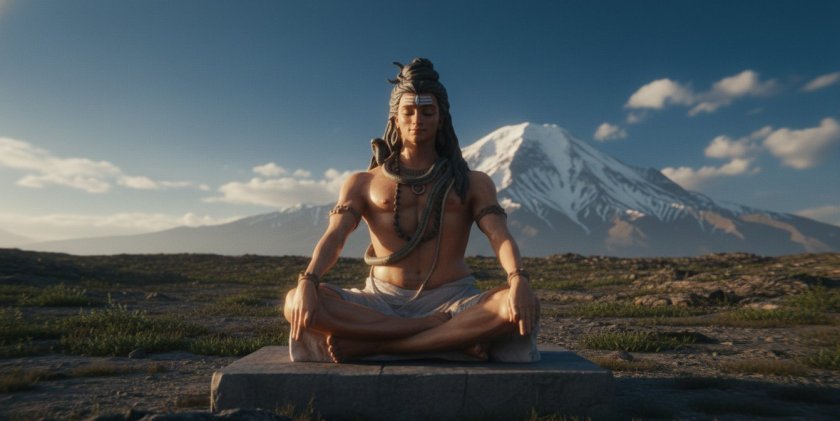
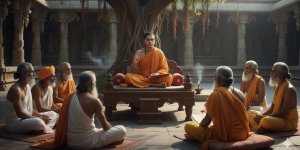
Shiva meditating. Photo: Google AI Studio
I: The Pillar of Fire and the Birth of Time
Before the universe was manifest, there was only the Shunya—the void. In this primordial state, Brahma (the Creator) and Vishnu (the Preserver) found themselves in a grand argument. Each claimed to be the supreme deity of the cosmos.
As their celestial weapons were drawn and the very fabric of the unformed universe trembled, a massive pillar of light suddenly erupted between them.
This was the Jyotirlinga, a pillar of fire so vast that it seemed to have no top and no bottom.
Confused and humbled, Brahma took the form of a swan and flew upward to find the pillar’s peak. Vishnu took the form of a boar (Varaha) and burrowed deep into the earth to find its base. Eons passed. Vishnu returned, admitting he could not find the beginning. Brahma, however, lied—claiming he had reached the top, showing a Ketaki flower as false evidence.
At that moment, the pillar split open, and Shiva emerged. This was his first manifestation. He rebuked Brahma for his ego and praised Vishnu for his honesty.
This story establishes Shiva’s primary role: he is the Ultimate Reality (Brahman) that exists beyond the reach of even the creator and preserver. He is the axis of the universe.
II: The Sacrifice of Sati
The most poignant chapter of Shiva’s existence involves his first marriage. Shiva was originally a hermit, uninterested in the affairs of the world. However, the Great Goddess (Shakti) took birth as Sati, the daughter of King Daksha, to bring Shiva into the realm of householders.
Daksha was a king of high status and rigid ritual. He despised Shiva, whom he saw as a "madman" who wore tiger skins, smeared his body with ash, and kept company with ghosts and outcasts. Despite her father’s disapproval, Sati performed intense penance and won Shiva’s heart. They were married and retired to Mount Kailash.
The tragedy occurred when Daksha organized a Yajna (a massive sacrificial ritual). He invited every god, sage, and king in the universe—except Shiva. Sati, believing her father would not truly turn her away, went to the ceremony uninvited. There, Daksha publicly insulted Shiva, calling him a vagabond and a destroyer of auspiciousness.
Unable to bear the insult to her husband, Sati invoked her yogic powers and self-immolated in the sacrificial fire.
When news reached Shiva, his grief transformed into a primal rage. He tore a lock of his hair and dashed it against the ground, creating the terrifying warriors Virabhadra and Bhadrakali. They descended upon Daksha’s palace, decapitated the king, and destroyed the sacrifice.
Shiva then took Sati’s charred body upon his shoulders and performed the Tandava—the dance of destruction. The world began to crumble under his feet.
To save the universe, Vishnu used his Sudarshana Chakra to cut Sati’s body into 51 pieces, which fell across the Indian subcontinent (becoming the Shakti Peethas). Shiva, left with nothing, returned to Kailash and sank into a deep, icy meditation that lasted for thousands of years.
III: The Churning of the Ocean and the Blue Throat
While Shiva meditated, the world fell into chaos. The Devas (gods) and Asuras (demons) were locked in a constant war. They decided to churn the cosmic Ocean of Milk (Samudra Manthan) to obtain the nectar of immortality.
Using the serpent Vasuki as a rope and Mount Mandara as a churning rod, they began. However, before the nectar could emerge, the ocean produced a lethal poison called Halahala. The fumes were so toxic they threatened to extinguish all life in the universe. Neither Vishnu nor Brahma could contain it.
The gods ran to the frozen peaks of Kailash and pleaded with Shiva. In his infinite compassion, Shiva took the poison and drank it. To prevent it from reaching his stomach and harming the universe within him, his consort (in the form of Parvati) gripped his throat. The poison remained lodged in his throat, turning it a deep, bruised blue.
Thus, Shiva earned the name Neelakantha (The Blue-Throated One). This story defines Shiva’s role as the "Redeemer"—the one who absorbs the negativity and "poison" of the world so that others may live.
IV: The Return of the Goddess (Parvati)
With Sati gone, the universe was out of balance. A demon named Tarakasura had gained a boon that he could only be killed by a son of Shiva. Knowing Shiva was a celibate hermit, the demon felt invincible.
Sati was reborn as Parvati, the daughter of the Himalayas. Unlike Sati, who was born into royalty, Parvati chose the path of the ascetic. She went to the high caves where Shiva meditated and served him for years, but he remained unmoved, his eyes closed in the silence of the Self.
The gods, desperate, sent Kamadeva (the god of love) to strike Shiva with an arrow of desire. When the arrow hit, Shiva’s eyes snapped open. Furious at the distraction, he opened his Third Eye—the eye of cosmic knowledge—and a beam of fire instantly turned Kamadeva to ash.
Parvati realized that Shiva could not be won through beauty or desire, but only through Tapas (spirituality). She discarded her princess robes and performed such intense penance that the heat of her devotion shook the heavens.
Finally, Shiva tested her by appearing as an old Brahmin and mocking "the ash-covered hermit Shiva." Parvati’s fierce defense of him proved her love. Shiva finally accepted her, saying, "From this moment, I am your slave, bought by your penance."
V: The Wedding and the Birth of Ganesha
The marriage of Shiva and Parvati is celebrated as the union of Purusha (Consciousness) and Prakriti (Matter). On their wedding night, Shiva arrived not as a king, but as a yogi, followed by a procession of ghosts, ghouls, and wild animals.
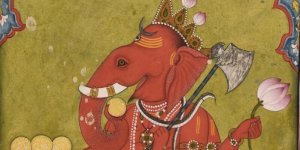
From this union (and through various miraculous means), two sons were born: Kartikeya (the warrior god who defeated Tarakasura) and Ganesha (the elephant-headed god).
The story of Ganesha’s birth is a cornerstone of Shiva’s lore. One day, while Shiva was away, Parvati created a boy out of turmeric paste to guard her door while she bathed. When Shiva returned, the boy refused to let him in. In a fit of divine rage, not knowing the boy was Parvati’s creation, Shiva cut off his head.
Parvati’s grief was so immense she threatened to destroy the universe. To make amends, Shiva ordered his followers (the Ganas) to bring the head of the first living creature they found facing north. They returned with the head of an elephant. Shiva attached it to the boy’s body, breathed life into him, and named him Ganesha, the leader of his divine armies and the remover of all obstacles.
VI: The Lord of the Dance (Nataraja)
Perhaps the most iconic image of Shiva is the Nataraja. This story takes place in the forest of Darukavana, where a group of sages believed that they could control the universe through rituals alone, ignoring the underlying spirit.
Shiva appeared as a beautiful beggar (Bhikshatana) to humble them. The sages, in their arrogance, tried to kill him using black magic. They sent a fierce tiger; Shiva killed it with his fingernail and wore its skin. They sent a venomous snake; he wrapped it around his neck as an ornament. They sent a powerful dwarf demon named Apasmara (representing ignorance).
Shiva did not kill the demon. Instead, he stepped upon the dwarf’s back and began to dance.
This was the Ananda Tandava—the Dance of Bliss. In his right hand, he held the Damaru (drum), creating the first sounds of the universe. His other hand was held in a gesture of "Fear Not."
One foot was planted on Ignorance, and the other was raised, symbolizing liberation. Fires flared around him, representing the destruction of the old to make way for the new. The sages realized that ritual was nothing without the rhythm of the soul.
VII: The Descent of the Ganga
For eons, the Earth was parched, and the souls of the ancestors of King Bhagiratha lay in unrest, unable to achieve liberation because they had been reduced to ashes by the curse of a sage. Bhagiratha, a king of immense resolve, knew that only the celestial river Ganga—who flowed through the heavens—could purify their souls.
Through thousands of years of penance, Bhagiratha finally persuaded the River Goddess Ganga to descend to Earth. However, Ganga was proud. She laughed with a voice like crashing thunder, saying, "If I descend from the heavens, the sheer force of my fall will shatter the Earth and wash it away into the netherworld. Who can break my fall?"
Bhagiratha turned once again to the only being capable of sustaining such power: Shiva.
Shiva, the compassionate Mahadeva, stood upon the Himalayas, his feet planted firmly like the roots of the universe. As Ganga plummeted from the sky in a terrifying torrent, intending to sweep Shiva away in her arrogance, Shiva simply opened his matted locks (Jatas). Like a vast, golden labyrinth, his hair caught the goddess. She thrashed and spun, trying to find an exit, but she was lost in the infinite tresses of the Lord.
Shiva kept her imprisoned in his hair until her pride was crushed. Only then, at Bhagiratha's plea, did he allow her to trickle out in seven gentle streams. This act symbolizes Shiva as the "shantifier" of raw energy. Without the "locks" of discipline and consciousness (Shiva), the flow of divine energy (Shakti/Ganga) can be destructive. As Gangadhara, Shiva becomes the bridge between the celestial and the terrestrial.
VIII: Tripurantaka – The Destroyer of the Three Cities
The story of the Tripura is perhaps the greatest testament to Shiva’s patience and his singular power. Three demon brothers—Tarakaksha, Viryavana, and Vidyunmali—performed great penance and asked Brahma for immortality.
When Brahma refused, they asked for three impregnable cities that would revolve in the sky, only aligning once every thousand years. They could only be destroyed if all three cities were pierced by a single arrow.
These cities—one of gold, one of silver, and one of iron—became hubs of cosmic terror. The demons, protected by their complex fortress, began to oppress the three worlds. Even the combined might of the Devas and Vishnu could not breach their defenses because the cities were never in the same place at the same time.
The gods turned to Shiva. But Shiva did not simply draw a bow. He required a chariot built from the entire universe. The Earth became the chariot, the Sun and Moon its wheels, the Vedas its horses, and Brahma its charioteer. Vishnu himself became the arrow, and Agni the arrowhead.
As the thousand years drew to a close, the three cities began to align for a fleeting second. The gods waited in breathless anticipation for Shiva to fire. But Shiva did not move. He looked at the vast complexity of the war machine the gods had built—the chariot, the horses, the bow—and he smiled.
In that smile, a flash of divine fire emerged. Before he even pulled the bowstring, the cities were reduced to ash. Shiva showed that for the Supreme Being, the entire "machinery" of the universe is but a play; the destruction of evil happens through the mere will of consciousness. However, to satisfy the gods, he let fly the arrow, formally completing the rite as Tripurantaka.
IX: Markandeya and the Conquest of Death
In the annals of Shiva’s mercy, the story of the boy-sage Markandeya stands supreme. Markandeya was a devotee of Shiva destined to die at the age of sixteen. When his sixteenth birthday arrived, the messengers of Yama (the God of Death) came to claim him, but they could not approach because of the intense aura of his devotion.
Finally, Yama himself arrived on his dark buffalo, casting his noose to pull the boy’s soul from his body. Terrified, Markandeya threw his arms around a Shiva Lingam (the symbol of Shiva), weeping and chanting the Mahamrityunjaya Mantra.
Yama’s noose fell not just around the boy, but around the Lingam itself.
To touch the Lingam with the intention of death was a cosmic affront. The Lingam split open, and Shiva emerged in his most terrifying form: Kalantaka, the Ender of Time. Shiva struck Yama down, protecting his devotee.
The gods trembled. If Death was dead, the universe would be overrun with life, and the balance would fail. At the plea of the gods, Shiva revived Yama but granted Markandeya the boon of "eternal sixteen"—he would live forever, never aging, as a testament that the soul which identifies with Shiva is beyond the reach of time (Kala).
X: Ardhanarishvara – The Non-Dual Reality
Once, the sage Bhrigu was so devoted to Shiva that he refused to acknowledge anyone else—even Parvati. When he visited Kailash, he attempted to circumambulate (walk around) Shiva, but intentionally bypassed Parvati.
To teach him that male and female, spirit and matter, are inseparable, Parvati sat on Shiva’s lap. Bhrigu, taking the form of a small bird, tried to fly between them to circle only Shiva.
In response, Shiva and Parvati merged their bodies into one. The right side was the masculine Shiva, with matted hair and a snake; the left side was the feminine Parvati, with silken hair and jewelry. This form is Ardhanarishvara.
Bhrigu, still stubborn, took the form of a worm and tried to bore a hole through the center of the merged body. Seeing his folly, Shiva finally enlightened him: there is no Shiva without Shakti, and no Shakti without Shiva.
Shiva is the silent Witness (Consciousness), and Shakti is the Movement (Energy). One cannot exist without the other, just as a word cannot exist without its meaning.
XI: Shiva in the Mahabharata – The Kirata and the Hero
In the great epic Mahabharata, the hero Arjuna realized that he needed celestial weapons to defeat the formidable Kaurava army. He went to the Himalayas to perform penance to Shiva.
Shiva decided to test Arjuna’s ego. He took the form of a Kirata (a wild forest hunter). Just as Arjuna was about to shoot a wild boar that was attacking him, the Hunter’s arrow struck the beast at the same moment. An argument ensued over who killed the animal.
The prince and the hunter engaged in a fierce duel. Arjuna, the greatest archer of his age, was shocked to find that this "simple hunter" absorbed his arrows like they were straws. They wrestled, and Arjuna felt as if he were wrestling a mountain.
Exhausted and humbled, Arjuna realized this was no ordinary man. He fashioned a small clay Lingam to pray for strength, and the flowers he placed on the Lingam miraculously appeared on the Hunter’s head.
Arjuna fell at the Hunter’s feet. Shiva revealed his true form, laughing with the sound of a thousand waterfalls. He praised Arjuna’s courage and gifted him the Pashupata, one of the most powerful weapons in existence, but warned him: "Use it only when all other means fail, for it has the power to destroy the entire creation."
XII: The Twelve Jyotirlingas and the Sacred Map
Shiva does not live in a palace; he lives in the hearts of his devotees and in the very soil of the earth. Throughout India, there are twelve sites where Shiva is said to have appeared as a pillar of light (Jyotirlinga).
Somnath: Where he cured the Moon God of a curse.
Mallikarjuna: Where he stayed to be near his son Kartikeya.
Mahakaleshwar: Where he reigns as the Lord of Time in Ujjain.
Omkareshwar: The island shaped like the holy syllable 'Om'.
Kedarnath: The high Himalayan shrine where he took the form of a bull to test the Pandavas.
Bhimashankar: Where he destroyed the demon Bhima.
Kashi Vishwanath: The "City of Light" (Varanasi), where Shiva grants liberation to those who die there.
Trimbakeshwar: The source of the Godavari river.
Vaidyanath: Where he is worshipped as the Supreme Healer.
Nageshwar: The Lord of Snakes.
Rameshwaram: Where Lord Rama himself built a Lingam to worship Shiva before invading Lanka.
Grishneshwar: The Lord of Compassion.
These sites create a "spiritual grid" across the land, suggesting that Shiva is not a distant deity but a presence embedded in the geography of the world.
XIII: The Symbolism of the Mahadeva
To understand Shiva’s story, one must understand his form, for every attribute is a metaphor:
The Ash (Bhasma): Shiva smears his body with the ash of the cremation grounds. This reminds us that everything in the material world is transient. Everything will eventually burn and turn to ash; only the soul (Shiva) remains.
The Snake (Vasuki): While most fear snakes, they adorn Shiva’s neck. This symbolizes that he has mastered the "poison" of the ego and the cycles of time (the snake shedding its skin). It also represents the Kundalini energy coiled at the base of the spine.
The Crescent Moon: He wears the moon of the fifth day on his head. This symbolizes his control over time and the cycles of the mind.
The Trident (Trishula): The three prongs represent the three Gunas (qualities) of nature: Sattva (purity), Rajas (passion), and Tamas (inertia). By holding the trident, he shows he is the master of these forces.
The Third Eye: Usually closed, it opens to destroy illusion (Maya). It represents direct perception of the Truth.
The Damaru (Drum): The shape represents the two triangles of male and female meeting. The sound is the "Nada Brahman," the vibration from which the universe is born.
XIV: Maha Shivaratri – The Great Night
The most holy night for a devotee of Shiva is Maha Shivaratri. There are many legends regarding its origin. Some say it is the night Shiva performed the Tandava; others say it is the night he married Parvati.
But the most profound story is that of the hunter who was lost in the forest. To stay safe from predators, he climbed a Bilva tree. To stay awake, he plucked leaves and dropped them one by one.
Unbeknownst to him, there was a Shiva Lingam at the foot of the tree. It was the night of Shivaratri. Though he did it unintentionally, his vigil and his offering of leaves (which are sacred to Shiva) pleased the Lord so much that he was granted instant liberation.
The message of Shivaratri is that even the most "sinful" or "ignorant" soul can find God through a single night of focused awareness. It is a night of deep meditation, where the "Sun" of the mind sets and the "Moon" of the spirit rises.
XV: The Bhairava and the Cremation Grounds
In his most terrifying form, Shiva is Kala Bhairava. He is the "Lord of Dread." He is often depicted with a dog, wandering the cremation grounds at night.
To the uninitiated, this is frightening. But to the yogi, the cremation ground is the most sacred place. It is where the "I-consciousness" (the ego) is finally burned away.
Shiva haunts these places to remind us that death is not the end, but a transformation. He is the God of the outcasts—the beggars, the lepers, the madmen—because in the eyes of the Infinite, the social distinctions of the world are meaningless.
XVI: Mahapralaya – The Final Dissolution
Everything that is born must die. The universe itself has a lifespan. At the end of the Kalpa (a vast cycle of billions of years), Shiva begins the Mahapralaya Tandava.
This is not a dance of anger, but a dance of necessity. As he dances, the suns go dark, the oceans boil away, and the stars are shaken from the sky like autumn leaves. He breathes in, and the entire manifestation of the universe is drawn back into his being.
Then, there is silence.
Shiva remains alone in the Shunya (the void), sitting in perfect meditation. He is the seed of the next universe. In the darkness, he waits until the desire to create stirs again, and the cycle repeats.
The Eternal Presence
The story of Shiva is the journey from the external world of noise and distraction to the internal world of silence and peace. He is the "God of the Gaps"—the silence between two breaths, the stillness between two thoughts.
He is Ashutosh (easily pleased). He does not ask for grand temples or gold; he asks for a single leaf, a drop of water, and a heart that is willing to let go of its ego.
In the end, Shiva is not a person living on a mountain; Shiva is the name given to the vast, infinite consciousness that lives within every being.
As the ancient sages said: Shivoham, Shivoham — I am Shiva, I am Shiva.
YOU MAY ALSO LIKE