| / Terms, Glossaries, Dictionaries |
Tandava, the cosmic dance of Shiva
The Tandava (or Tandavam) is the divine cosmic dance performed by the Hindu god Shiva. It is one of the most important symbols in Hindu mythology, representing the cycle of the universe—from creation and preservation to destruction and liberation.
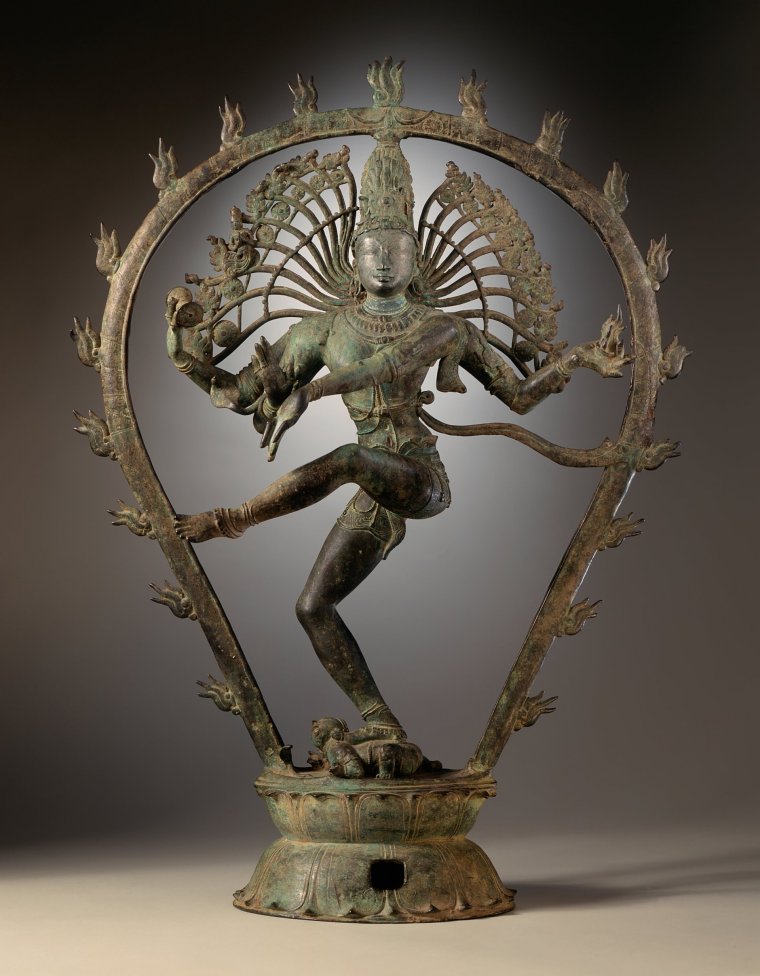
Tandava, the cosmic dance of Shiva.
The word "Tandava" is derived from Tandu, the attendant of Shiva who instructed the sage Bharata (the author of the Natya Shastra) in the art of this dance.
Unlike many traditional dances that are purely for entertainment, the Tandava is a "masculine" (Paurusha) dance characterized by vigorous, rhythmic, and powerful movements.
The Two Faces of Tandava
While often associated with destruction, the Tandava has two distinct moods:
Rudra (Raudra) Tandava: This is the "furious" dance. It is performed in moments of intense anger or to destroy an exhausted or evil universe. It depicts Shiva as the destroyer, surrounded by fire and wild energy.
Ananda Tandava: This is the "dance of bliss." In this form, Shiva dances in a state of joy. It symbolizes the continuous flow of energy and the creation of the universe. This is the version most commonly depicted in the famous Nataraja (Lord of the Dance) statues.
The types of Tandava found in the Hindu texts are: Ananda Tandava, Tripura Tandava, Sandhya Tandava, Samhara Tandava, Kali (Kalika) Tandava, Uma Tandava, Shiva Tandava, Krishna Tandava and Gauri Tandava
The "Panchakritya" (The Five Functions)
According to Hindu philosophy, the Tandava represents the five essential acts of the Divine that keep the cosmos functioning:
Srishti (Creation): Represented by the Damaru (drum) in his upper right hand, which produces the first sounds of the universe.
Sthiti (Preservation): Represented by his lower right hand in the Abhaya Mudra (the "fear not" gesture).
Samhara (Destruction): Represented by the fire (Agni) in his upper left hand, which dissolves the universe.
Tirobhava (Illusion/Concealment): Represented by his foot planted on the demon Apasmara (the demon of ignorance and ego).
Anugraha (Liberation/Grace): Represented by his raised foot, signifying the path to salvation.
The Iconography of Nataraja
The Ring of Fire: The circle of flames surrounding him represents the manifest universe.
Flying Hair: His long, matted locks fly out to the sides, showing the immense power and speed of his dance.
The Smile: Despite the chaotic energy of the dance, Shiva’s face remains calm and meditative, symbolizing the balance between the physical world and spiritual peace.
In Hindu aesthetics, the Tandava is the masculine counterpart to the Lasya dance.
Tandava is bold, fast, and energetic (Shiva).
Lasya is graceful, gentle, and lyrical (performed by Shiva’s consort, Parvati). Together, they represent the union of male and female energies (Purusha and Prakriti) that sustain the world.
The Tandava is the foundational root of several Indian classical dance forms, most notably Bharatanatyam and Kathakali.
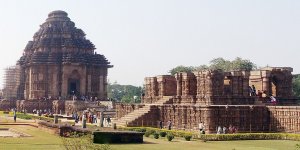
The Natya Shastra describes 108 different poses (Karanas) of the Tandava, which are carved into the walls of many ancient Indian temples, such as the Chidambaram Nataraja Temple in Tamil Nadu.
The Tandava is not just a dance of destruction; it is a dance of change. It reminds us that for something new to be created, the old must pass away, and that the entire universe is in a constant state of rhythmic movement and transformation.
YOU MAY ALSO LIKE