| / Stories, Legends, Myths |
The Life of Shankara
In the quaint village of Kalady, nestled on the banks of the Periyar River in present-day Kerala, India, a child was born to a Nambudiri Brahmin couple, Shivaguru and Aryamba. This child, named Shankara, was destined to become one of India's greatest thinkers and spiritual leaders.
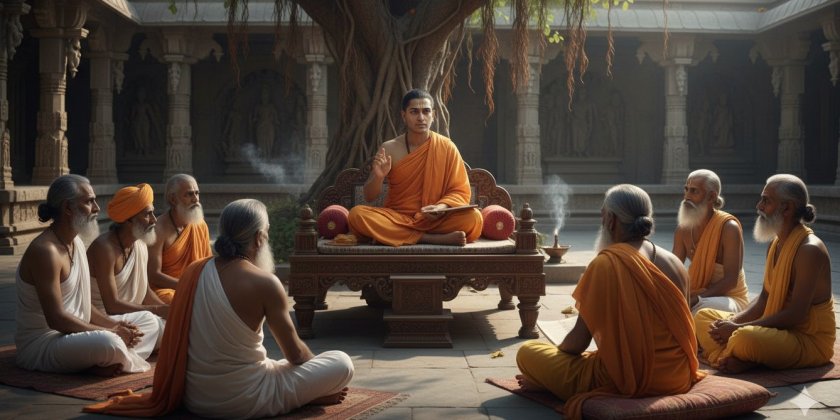
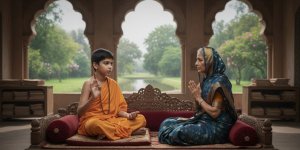
Shankara teaching Advaita Vedanta. Image: Google Ai Studio.
Even in his early years, Shankara displayed extraordinary intelligence and a profound spiritual inclination, mastering the Vedas and ancient scriptures with remarkable ease.
However, joy soon turned to sorrow when Shankara's father passed away, leaving Aryamba to raise their gifted son alone. Young Shankara, though saddened, continued his studies, his mind drawn ever more deeply into philosophical inquiry.
He felt an undeniable pull towards renunciation, a desire to dedicate his life entirely to the pursuit of ultimate truth. His mother, however, was reluctant to let go of her only son.
One day, while bathing in the Periyar River, a crocodile seized Shankara's leg. In that moment of peril, he cried out to his mother, "Mother, a crocodile has caught me! Let me take sannyasa now, or I shall die!"
In her desperation, Aryamba agreed. Miraculously, the crocodile released him, and Shankara, now free, was granted permission to embark on his spiritual journey. He promised his mother that he would be there for her in her final moments.
Leaving Kalady, Shankara journeyed northward, his quest for knowledge leading him to the banks of the Narmada River. There, he found his guru, Govinda Bhagavatpada, a disciple of the great Gaudapada.
Under Govinda Bhagavatpada's tutelage, Shankara delved into the intricacies of Advaita Vedanta, the philosophy of non-duality, which posits that the individual soul (Atman) is identical with the ultimate reality (Brahman). His guru recognized the immense potential in Shankara and soon initiated him into the monastic order.
Upon completing his education, Shankara was tasked by his guru to write commentaries on the Brahma Sutras, the Upanishads, and the Bhagavad Gita, to revive and spread the tenets of Advaita Vedanta.
Thus began Shankara's epic journey across the length and breadth of India, engaging in profound philosophical debates and establishing the Advaita tradition.
His travels led him to Varanasi, the ancient city of learning, where he began writing his seminal commentaries. It was here that he famously encountered a Chandala (an outcaste) and his four dogs.
Shankara initially asked the Chandala to move aside, but the Chandala's profound response, questioning the distinction between bodies and the Atman within, opened Shankara's eyes to the true meaning of non-duality. He prostrated before the Chandala, recognizing the Brahman in all beings, an event that led to the composition of his "Manisha Panchakam."
Shankara's intellectual prowess was legendary. He engaged in numerous debates ( शास्त्रार्थ – shastrartha) with scholars of different philosophical schools, including Mimamsa, Samkhya, Nyaya, Vaisheshika, and various Buddhist and Jain schools.
One of his most famous debates was with Mandana Misra, a prominent Mimamsa scholar. The debate was intense, lasting for many days, with Mandana Misra's learned wife, Bharati, acting as the impartial arbiter.
When it seemed Mandana was losing, Bharati challenged Shankara on the science of Kama Shastra (erotics), a subject a celibate sannyasi would not know. To answer this, Shankara entered the body of a recently deceased king, Amaruka, for a short period to gain the necessary experience, then returned to his own body to complete the debate and emerge victorious.
Shankara ultimately emerged victorious, and Mandana Misra, along with Bharati, became his disciples, adopting monasticism.
To firmly establish and propagate the Advaita tradition, Adi Shankara founded four major monastic institutions (Mathas) in the four cardinal directions of India:
Sringeri Sharada Peetham in the South,
Dwarka Sharada Peetham in the West,
Puri Govardhan Peetham in the East
Jyotirmath (Badrikashrama) in the North.
These Mathas continue to serve as important centers for the study and preservation of Advaita Vedanta to this day. He also organized the monastic order into ten primary groups (Dasanamis), further solidifying the structure of the Advaita tradition.
Amidst his tireless travels and teachings, Shankara remembered his promise to his mother.
When his mother was on her deathbed, Shankara, through his yogic powers, transported himself to her side. He performed her last rites, even though sannyasis are traditionally not supposed to perform such rituals. It is believed he even had a vision of Lord Shiva at this time, who came to grant his mother liberation.
Adi Shankara's philosophical contributions were immense. He systematized Advaita Vedanta, emphasizing the concept of Maya (the illusory nature of the material world) and the ultimate reality of Brahman, which is nirguna (without attributes) and nirakara (without form).
He taught that liberation (moksha) is achieved through the realization of the identity of Atman and Brahman, a realization that dispels ignorance (avidya) and leads to true freedom.
His teachings, encapsulated in his commentaries, hymns, and treatises, revitalized Hinduism and had a profound impact on Indian thought.
After a life dedicated to spiritual awakening, philosophical discourse, and the establishment of a robust monastic tradition, Adi Shankara is believed to have attained Mahasamadhi at the age of 32 in Kedarnath, a sacred pilgrimage site in the Himalayas.
His short but incredibly impactful life left an indelible mark on Indian spirituality, reminding generations that true wisdom lies in recognizing the oneness of all existence.
YOU MAY ALSO LIKE