| / Stories, Legends, Myths |
The Legend of Kapila
The legend of Kapila (also known as Kapila Muni) is one of the most significant in Hindu mythology and Vedic philosophy. He is revered as an incarnation (Avatar) of Lord Vishnu and is credited as the founder of the Samkhya school of philosophy, one of the oldest systematic thought systems in India.
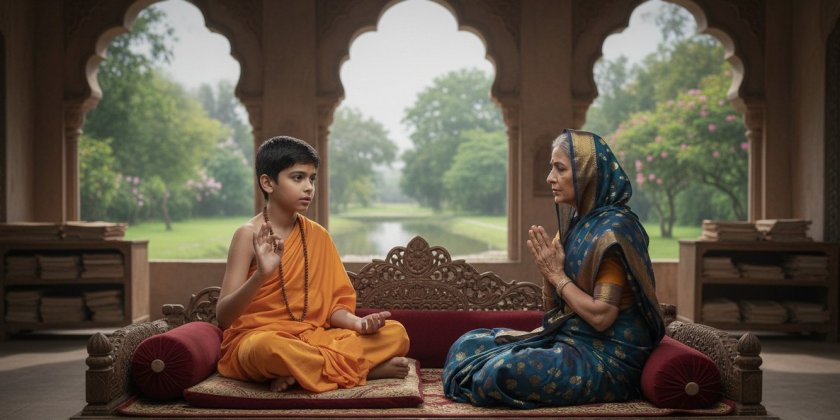
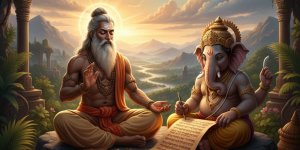
Kapila giving teaching to his mother. Photo: Google AI Studio
His story is primarily told in the Srimad Bhagavatam and the Ramayana. There are two major dimensions to his legend: his role as a divine teacher and his role in the descent of the River Ganges.
The Birth and Divine Purpose
Kapila was born to the great sage Kardama Muni and his wife Devahuti.
The story of Kapila’s birth begins with a strange deal. His father, Kardama Muni, was a powerful yogi who practiced austerities for 10,000 years. When Lord Vishnu appeared to him, Kardama asked for a wife who was his equal in virtue.
Vishnu directed him to Devahuti, the daughter of the first man, Svayambhuva Manu. However, Kardama agreed to the marriage on one condition: He would only stay with her until they had children. Once he had fulfilled his duty as a householder, he would leave to become a monk again.
Devahuti agreed. To provide for her, Kardama used his yogic powers to create a massive flying palace (a Vimana) that had gardens, lakes, and hundreds of servants.
They spent a hundred years traveling the universe. They had nine daughters first, who grew up to marry the Prajapatis (the progenitors of the human race, like Atri and Vashistha). Finally, Vishnu himself entered Devahuti’s womb and was born as Kapila.
When Kapila was born, he exhibited signs of divinity and immense wisdom from infancy.
Shortly after Kapila’s birth, his father, Kardama, decided to leave the household life to become a wandering ascetic. However, he was worried about leaving his wife Devahuti behind.
Kapila reassured his father, telling him that he had incarnated specifically to teach the path of self-realization to his mother and, by extension, to all of humanity.
The Teachings to Devahuti (Kapila Gita)
When Kapila's father, Kardama, left for the forest, Devahuti felt a profound sense of emptiness despite her luxury. She approached her son, Kapila, realizing he was the Supreme Lord in human form.
Devahuti, seeking liberation from the cycle of birth and death, asked her son for spiritual guidance.
Kapila taught her Samkhya Yoga, which focuses on:
Discrimination: Distinguishing between Purusha (the eternal spirit/consciousness) and Prakriti (matter/nature).
Detachment: Understanding that the soul is a witness to the changes of the body and mind.
Bhakti (Devotion): He emphasized that while knowledge is important, devotion to the Supreme is the easiest path to peace.
The teachings he gave her are recorded in the Srimad Bhagavatam and are known as the Kapila Gita. Key details include:
The 24 Elements: Kapila was the first to "count" or categorize the universe. He identified the 5 gross elements (earth, water, fire, air, ether), the 5 subtle elements (smell, taste, sight, touch, sound), the 5 senses, the 5 organs of action, the Mind, the Intellect, the Ego, and the "Unmanifest" (Prakriti).
The Witness: He explained that the Soul (Purusha) is like a spectator at a play. As long as the spectator thinks the play is real, they suffer. Once they realize they are just watching, they are free.
The Three Gunas: He detailed the three qualities of nature—Sattva (goodness), Rajas (passion), and Tamas (ignorance)—and how they bind the soul to the world.
After receiving these teachings, Devahuti attained enlightenment and liberation. Kapila then traveled to the ocean's edge to continue his meditation.
The Curse of the Sons of King Sagara
The most famous "action" legend involving Kapila appears in the Ramayana and concerns the descent of the River Ganges.
King Sagara of Ayodhya was performing the Ashvamedha Yagna (Horse Sacrifice) to prove his sovereignty. Lord Indra, fearing the king's growing power, stole the sacrificial horse and hid it deep underground, right next to the spot where Kapila Muni was lost in deep meditation.
King Sagara sent his 60,000 sons to find the horse. They dug through the earth and eventually found the horse standing near the meditating sage. Mistakenly believing Kapila was the thief, the sons insulted him and prepared to attack.
Kapila opened his eyes. Having been disturbed from his deep trance, a flash of fire emanated from his gaze (representing the power of his accumulated penance). In an instant, all 60,000 sons of Sagara were burned to ashes.
In the legend, it isn't just "anger." It is a concept called Tapas-Agni (The Fire of Penance).
When a yogi meditates for thousands of years, they accumulate a massive amount of internal heat/energy. When the 60,000 sons of Sagara attacked, they "short-circuited" that energy. Kapila didn't have to "do" anything; the sons' own negative karma and the sudden disruption of Kapila's intense energy field caused them to spontaneously combust.
King Sagara had one grandson named Anshuman who went looking for his 60,000 uncles. He eventually found the horse and the pile of ashes at Kapila’s hermitage. Unlike his uncles, who were arrogant and aggressive, Anshuman approached the sage with deep humility and prostrated himself.
Kapila was pleased with Anshuman’s devotion. He told the boy:
"Your uncles were foolish, but because you have approached me with respect, I will tell you the secret."
He explained that ordinary water would not purify their souls because they had committed a sin against a sage. Only the celestial River Ganges (which stayed in the heavens at the time) could wash away their sins.
This instruction set off a multi-generational quest that finally ended with Anshuman's grandson, Bhagiratha, bringing the river down.
The Descent of the Ganges
Because the sons died without proper funeral rites and were cursed by a sage, their souls could not find peace. Generations later, their descendant, King Bhagiratha, performed extreme penance to bring the celestial River Ganges down from the heavens.
Bhagiratha’s goal was to have the holy waters of the Ganges flow over the ashes of his ancestors to purify them. The river eventually reached the spot where Kapila had burned the sons, and upon touching the water, the 60,000 souls were finally liberated.
This location is traditionally identified as Sagar Island (Ganga Sagar) in West Bengal, where a famous pilgrimage takes place every year.
Key Themes and Significance
Founder of Samkhya: Kapila is the father of Indian logic and cosmology. His system of counting the "elements" of reality influenced both the Bhagavad Gita and early Buddhist thought.
The Power of Tapas (Penance): His legend warns of the immense power of a sage's meditation. The "fire" that burned the sons of Sagara was not necessarily "anger" in the human sense, but the pure energy of truth encountering ignorance and insult.
Connection to Buddhism: Legend says the city of Kapilavastu (the birthplace of Gautama Buddha) was named in honor of Kapila Muni, as the city was built on the site where his hermitage once stood.
Art and Iconography: In art and iconography, Kapila is often depicted with a beard, matted hair, and a serene expression, sometimes holding a water pot and showing the hand gesture (mudra) of teaching.
In some esoteric traditions, it is said there are actually two "Kapilas."
The Divine Kapila: The son of Kardama, who is the pure avatar of Vishnu and the teacher of Samkhya.
The "Atheistic" Kapila: Later philosophers argued there was a second Kapila who founded a version of Samkhya that did not believe in a personal God.
However, in the Bhagavad Gita, Krishna says, "Of all the perfected beings (Siddhas), I am the sage Kapila." This cements his status in Hindu tradition as a "Siddha-Avatar," a being born with full knowledge and magical powers.
To this day, at the tip of West Bengal where the Hooghly River (a branch of the Ganges) meets the Bay of Bengal, there is a Kapila Muni Temple.
Every year during Makar Sankranti (mid-January), millions of pilgrims travel there.
There is a famous saying in Hindi: "Sab tirath bar bar, Ganga Sagar ek bar" (You can visit other pilgrimages many times, but a visit to Ganga Sagar/Kapila’s site even once is enough for liberation).
They bathe there to commemorate the moment the Ganges finally reached Kapila’s ashram and liberated the 60,000 souls.
YOU MAY ALSO LIKE