| / Stories, Legends, Myths |
The Legend of Vishnu
The legend of Vishnu is not a single story, but an infinite tapestry of cosmic cycles, divine interventions, and the eternal struggle to maintain Dharma (cosmic order). As the "Preserver" in the Hindu Trinity (the Trimurti), Vishnu is the force that sustains the universe between the creation by Brahma and the eventual dissolution by Shiva.
To understand Vishnu is to understand the heartbeat of time itself. What follows is a comprehensive exploration of his essence, his iconography, and the ten primary incarnations—the Dashavatara—that define his legend across the eons.
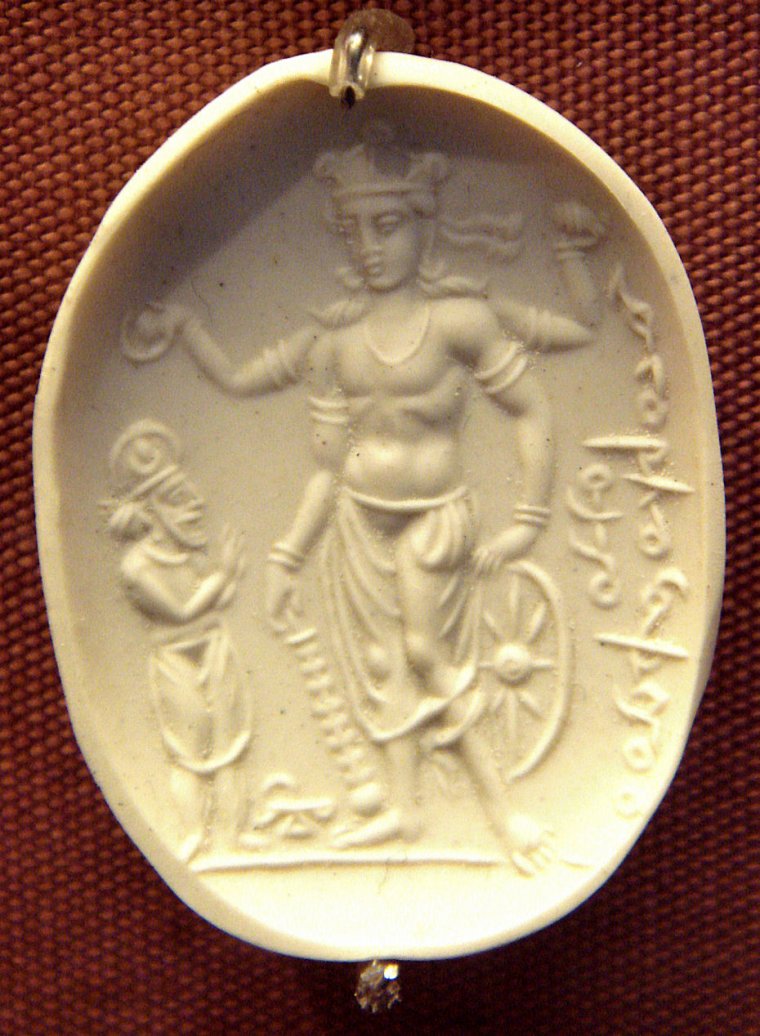
Vishnu blessing a worshiper (4th-6th century CE).
I. The Eternal Sleeper: The Cosmic Origin
In the beginning, before the concept of "beginning" existed, there was only the Kshira Sagara, the Ocean of Milk. Within this infinite, primordial sea, Vishnu reclines upon the coils of the thousand-headed serpent, Adishesha (or Ananta Shesha), who represents the remains of previous universes and the infinity of time.
Vishnu is often depicted with skin the color of a dark storm cloud (Meghavarnam), representing the all-encompassing nature of the sky and the sea. From his navel grows a lotus flower, and upon that lotus sits Brahma, the Creator.
While Brahma creates and Shiva eventually destroys, it is Vishnu’s dream that provides the reality in which we live. When Vishnu wakes, a universe is born; when he sleeps, it returns to his essence.
In his four hands, he holds four symbolic objects:
The Panchajanya (Conch): The sound of the "Om," the vibration from which all creation springs.
The Sudarshana Chakra (Discus): The weapon of time and the mind, capable of cutting through ignorance and evil.
The Kaumodaki (Mace): Representing mental and physical strength, and the power of knowledge.
The Padma (Lotus): Symbolizing purity, beauty, and the unfolding of the soul amidst the mud of the material world.
II. The Churning of the Ocean (Samudra Manthan)
One of the most pivotal legends involving Vishnu is the Samudra Manthan. The Devas (gods) had lost their strength due to a curse from the sage Durvasa. To regain their immortality, they needed the Amrita (nectar of life), which was hidden at the bottom of the Ocean of Milk.
Vishnu advised the Devas to form an alliance with their rivals, the Asuras (demons), to churn the ocean. They used Mount Mandara as a churning rod and the serpent Vasuki as a rope. However, as the churning began, the mountain started to sink into the soft bed of the ocean.
To save the mission, Vishnu took his second form, Kurma, the giant tortoise. He dived to the bottom of the ocean and supported the mountain on his back. As the ocean churned, many wonders emerged—the goddess Lakshmi (who became Vishnu’s consort), the physician Dhanvantari, and finally, the Amrita.
When the Asuras seized the nectar, Vishnu transformed himself into Mohini, an enchantress of incomparable beauty. Dazzled by her, the Asuras allowed her to distribute the nectar. With divine sleight of hand, Mohini ensured the Devas drank the nectar while the Asuras received nothing, thereby restoring the balance of the universe.
III. The Dashavatara: The Ten Descents
Vishnu’s primary role is to manifest on Earth whenever Dharma declines. These incarnations are known as the Dashavatara.
1. Matsya (The Fish)
At the end of the Satya Yuga, the first age, a great flood threatened to consume all life. Vishnu took the form of a tiny fish and appeared to King Manu while he was washing his hands in a river. The fish asked for protection, and as Manu cared for it, the fish grew larger and larger until it required the entire ocean.
The fish, Matsya, warned Manu of the coming deluge. He instructed Manu to build a massive ship and fill it with the seeds of all plants, pairs of all animals, and the Seven Sages (Saptarishis). When the rains came, Matsya—now a golden giant with a horn—towed the ship to safety using Vasuki as a rope, ensuring that life would continue in the next cycle.
2. Kurma (The Tortoise)
(As detailed in the Samudra Manthan, Kurma represents stability and the foundation upon which the quest for immortality is built.)
3. Varaha (The Boar)
The demon Hiranyaksha had dragged the Earth (the goddess Bhudevi) to the bottom of the cosmic ocean. Vishnu assumed the form of a massive wild boar, Varaha. He dived into the depths and fought the demon for a thousand years.
After slaying Hiranyaksha, Varaha lifted the Earth on his tusks and brought her back to her rightful place in the heavens, comforting her and restoring her stability.
4. Narasimha (The Man-Lion)
Hiranyaksha’s brother, Hiranyakashipu, sought revenge. He performed intense penance and gained a boon from Brahma that made him almost invincible: he could not be killed by man or beast, inside or outside, during the day or at night, on the ground or in the air, nor by any weapon.
Arrogant in his power, he demanded the world worship him. However, his own son, Prahlad, remained a devoted follower of Vishnu. Enraged, the King tried to kill his son multiple times, but Vishnu protected him. Finally, the King pointed to a stone pillar and asked, "Is your god in here?"
The pillar shattered, and Vishnu emerged as Narasimha—with the body of a man and the head of a lion (neither man nor beast). He placed the King on his lap (neither ground nor air), at the threshold of the palace (neither inside nor outside), at twilight (neither day nor night), and tore him apart with his claws (no weapon). This avatar represents the divine protection of the devotee.
5. Vamana (The Dwarf)
The benevolent but ambitious Asura King Bali had conquered the three worlds, ousting the Devas. To restore balance without killing the virtuous Bali, Vishnu appeared as a small Brahmin boy, Vamana.
He asked Bali for a simple gift: as much land as he could cover in three steps. Bali’s guru warned him, but the King, proud of his generosity, agreed. Suddenly, Vamana grew to a cosmic size. With his first step, he covered the Earth.
With his second, he covered the heavens. Having nowhere else to step, Bali realized the boy was Vishnu and offered his own head for the third step. Pleased by Bali’s humility, Vishnu pushed him to the underworld (Patala) to rule there and granted him immortality.
6. Parashurama (The Warrior with an Axe)
In the Treta Yuga, the warrior caste (Kshatriyas) became corrupt and began oppressing the people and the sages. Vishnu was born as Parashurama, the son of the sage Jamadagni. Armed with a celestial axe given to him by Shiva, he purged the world of tyrannical kings twenty-one times, teaching the lesson that power without righteousness is a curse.
7. Rama (The Prince of Ayodhya)
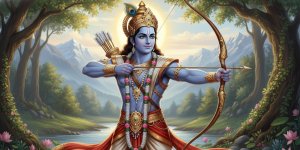
Rama is the Maryada Purushottama, the "Ideal Man." His story, the Ramayana, is the bedrock of Indian morality. To defeat the ten-headed demon Ravana, Vishnu took birth as the eldest son of King Dasharatha.
Rama’s life was one of sacrifice. He accepted a fourteen-year exile to the forest to uphold his father’s honor. When Ravana kidnapped his wife, Sita, Rama led an army of vanaras (monkeys) to Lanka. Rama’s victory was not just a military one; it was the victory of Dharma over Adharma. He established "Ram Rajya," a kingdom of perfect justice and peace.
8. Krishna (The Divine Statesman)
Krishna is perhaps the most beloved incarnation. Born in a prison to Devaki and Vasudeva, he was smuggled across a stormy river to be raised by cowherds in Gokul. His life moved from the playful "makkhan chor" (butter thief) of his youth to the profound philosopher of the Mahabharata.
As the charioteer for the warrior Arjuna during the Great War of Kurukshetra, Krishna delivered the Bhagavad Gita. He taught that one must perform their duty (Karma) without attachment to the results. Krishna represents the divine as a friend, a lover, a teacher, and a master strategist.
9. The Buddha / Balarama
Depending on the tradition, the ninth avatar is either Balarama (Krishna’s brother) or Gautama Buddha. When the Buddha is included, it signifies Vishnu’s role in teaching compassion, non-violence (Ahimsa), and the path to enlightenment through the rejection of excessive ritualism.
10. Kalki (The Future)
Kalki is the avatar yet to come. It is said that at the end of the Kali Yuga (the current age of darkness and ignorance), when virtue has vanished and the world is engulfed in chaos, Vishnu will appear on a white horse, wielding a flaming sword. He will cleanse the world of filth and herald the return of a new Satya Yuga, restarting the cycle of time.
IV. The Legend of Lakshmi and Vishnu
One cannot tell the legend of Vishnu without his consort, Lakshmi, the goddess of wealth and prosperity. Their relationship is the ultimate archetype of divine partnership. Lakshmi is the Shakti (energy) that allows Vishnu’s preservative power to function.
Whenever Vishnu takes an avatar, Lakshmi accompanies him in a corresponding form:
When he was Rama, she was Sita.
When he was Krishna, she was Rukmini (and in some traditions, Radha).
When he was Vamana, she appeared as a lotus.
Their union represents the balance between material abundance and spiritual preservation. It is said that Lakshmi dwells in Vishnu's chest (Srivatsa), signifying that wealth and prosperity are always held close to the heart of the Preserver.
V. The Legend of the Tulsi Plant
A beautiful and tragic legend explains why the Tulsi (Holy Basil) plant is sacred to Vishnu. There was a woman named Brinda who was the wife of the demon Jalandhara. Brinda’s unwavering chastity and devotion to her husband made Jalandhara invincible. He began to terrorize the heavens.
To defeat him, Vishnu took the form of Jalandhara and appeared before Brinda. Thinking he was her husband, she greeted him, and in that moment of "betrayal," her husband’s protection was broken, and Shiva was able to slay him.
When Brinda realized the deception, she cursed Vishnu to turn into a stone (the Shaligram stone found in the Gandaki River). However, moved by her devotion, Vishnu blessed her, saying she would be reborn as the Tulsi plant. He declared that he would never accept an offering unless it was accompanied by a Tulsi leaf. Thus, in every Hindu household, the Tulsi is nurtured as a living manifestation of the divine.
VI. The Philosophy of Preservation
The legend of Vishnu is ultimately a philosophical statement about the nature of existence. Unlike Shiva, who represents the beauty of the void and the end of things, Vishnu represents the beauty of the process.
He is the god of the "middle." Life is not just birth and death; it is the long, complicated, often painful journey in between. Vishnu is the deity who cares about the details of that journey. He is the god of social order, of kingship, of family duty, and of the complex ethics required to live in a world that is rarely black and white.
His blue skin is the color of the infinite—the sky that covers everyone and the ocean that supports all life. His multiple arms signify his ability to reach into every corner of the universe to uphold those who are falling.
As the ages (Yugas) turn, the legends of Vishnu remind the devotee that no matter how dark the world becomes, there is a preservative force at work. Whether as a tiny fish, a ferocious man-lion, or a humble prince, Vishnu’s "descents" (Avatars) prove that the divine is not distant.
The legend ends where it begins: with Vishnu reclining on the serpent of time, drifting in a yogic sleep (Yoga Nidra). Our entire history, our wars, our triumphs, and our very existence are but a moment in his dream.
And yet, the legend promises that if a single devotee calls out in genuine need—as Prahlad did, or as the elephant Gajendra did when caught by a crocodile—the Lord of the Universe will wake, mount his eagle Garuda, and fly across the cosmos to save them.
In the heart of the follower, Vishnu is the eternal reassurance that while change is inevitable and destruction is certain, preservation—the act of holding things together with love and Dharma—is the highest calling of the soul.
YOU MAY ALSO LIKE