| / Stories, Legends, Myths |
The Legend of Brahma
The story of Lord Brahma is not a single narrative but a vast tapestry of cosmic origins, psychological metaphors, and divine drama. To understand Brahma is to understand the Hindu concept of time, the nature of the mind, and the eternal cycle of the universe.
In the Hindu Trinity (Trimurti), Brahma is the Creator, Vishnu is the Preserver, and Shiva is the Destroyer. While Vishnu and Shiva are worshipped in millions of temples worldwide, Brahma is a deity of the mind and the past, often left out of ritual worship due to ancient curses and philosophical shifts.
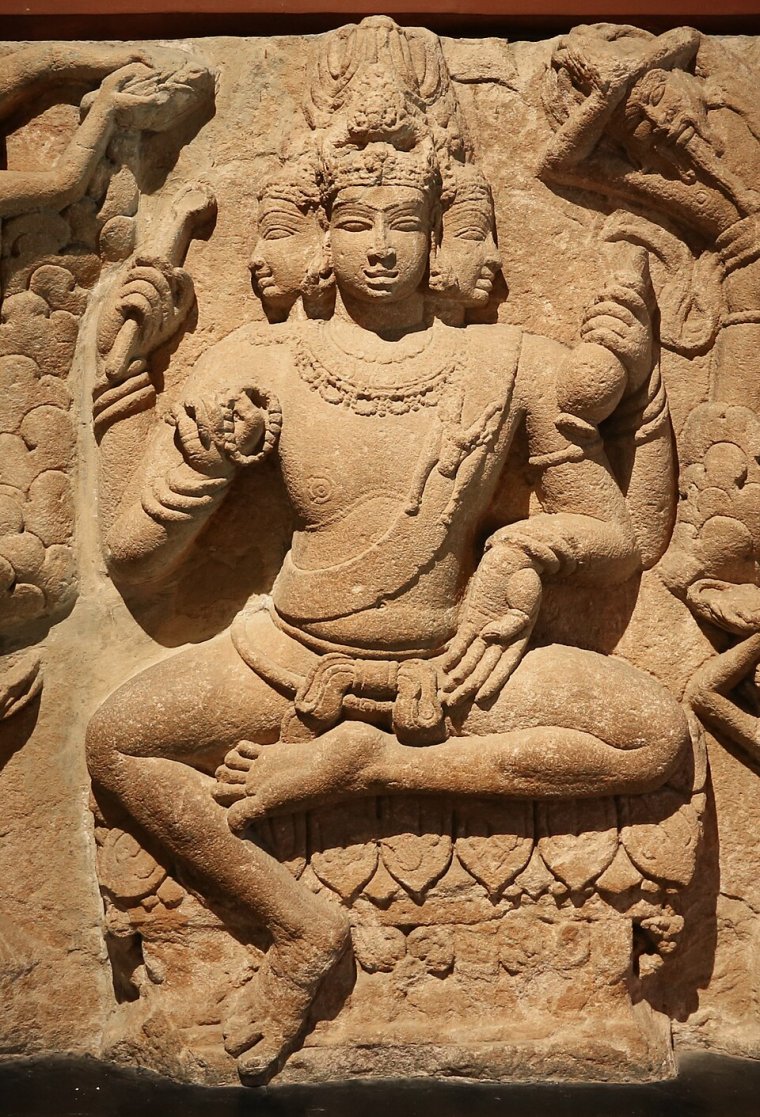
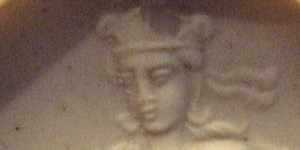
Brahma (Sculptures in the Chhatrapati Shivaji Maharaj Vastu Sangrahalaya)/Wikipedia
I. The Void and the Primordial Birth
Before the universe began, there was neither "is" nor "is not." There was no sky, no earth, no time, and no death. There was only the Brahman—the impersonal, infinite, and unchanging reality. Within this infinite consciousness, a desire arose: "Eko’ham Bahusyam" (I am one; let me become many).
There are two primary traditions regarding how Brahma emerged from this desire.
The Hiranyagarbha (The Golden Egg)
The oldest Vedic texts describe the universe as a dark, fluid void. In this cosmic ocean, a seed was sown. This seed grew into a magnificent golden egg, known as the Hiranyagarbha. For a divine year, the egg floated in the darkness. Inside, the energy of the Brahman condensed into the form of Brahma.
When the time was right, Brahma broke the egg into two halves. The upper half became the Heavens (Akasha), and the lower half became the Earth (Prithvi). From the center, the atmosphere and the directions were formed. Brahma emerged as the Lord of all things that were to be.
The Lotus from the Navel
In the Puranic tradition, specifically the Vaishnava texts, the story begins with Lord Vishnu. During the great dissolution of the previous universe (Pralaya), Vishnu lay sleeping on the coils of the serpent Ananta-Shesha, floating on the Milk Ocean.
As Vishnu dreamt of the new cycle of creation, a lotus flower grew from his navel. The stem of this lotus was the axis of the world. Within the blooming petals sat Brahma. Upon waking, Brahma looked around and saw only darkness. He was confused. He wondered: "Who am I? Where did I come from? What is my purpose?"
He climbed down the lotus stalk for a thousand years, trying to find its root, but he could not find the end. Finally, he heard a divine voice whisper two syllables: "Ta-Pa" (meditate).
Brahma returned to his lotus seat and meditated for another thousand years. In that deep silence, the knowledge of the Vedas was revealed to him. He realized his purpose was to act as the secondary creator, the architect who would take the raw energy of the Supreme and fashion it into the world.
II. The Architecture of Existence
Brahma did not create the world out of nothing; he shaped it using the materials provided by the Divine. His first creations were not physical beings but mental ones.
He first created the Manasaputras (Mind-born sons). These were great sages like Atri, Angiras, Marichi, and Bhrigu. He commanded them to go forth and populate the universe.
However, these sages were so spiritually advanced that they had no interest in worldly things. They preferred to sit in meditation, seeking liberation.
Frustrated, Brahma realized he needed to create beings with desires, emotions, and physical forms. To guide the moral and social order, he created the Prajapatis (Lords of Progeny) and the first man, Swayambhuva Manu, and the first woman, Shatarupa.
III. The Legend of the Five Heads and Shatarupa
One of the most profound and controversial stories involving Brahma explains his physical form. To assist in creation, Brahma split his own being to create a female half, often called Shatarupa (She of a Hundred Forms) or Saraswati (the Goddess of Knowledge).
Shatarupa was the most beautiful being in the universe, as she was the embodiment of all creative potential. Brahma, as the Creator, looked upon his creation and was instantly captivated. This was the birth of Kama (desire) in the universe.
Shatarupa, embarrassed by Brahma's intense gaze, moved to his right side to avoid him. Immediately, a second head sprouted on Brahma’s right. She moved to his left, and a third head appeared. She moved behind him, and a fourth head grew. Finally, she leaped into the sky, and a fifth head grew on top of the others, staring upward.
This story is a metaphor for the mind. The "Creator" (the intellect) becomes obsessed with the "Creation" (the material world). When the mind is consumed by its own creations, it loses its sense of divinity and becomes trapped in the cycle of attachment. This obsession would lead to Brahma's downfall.
IV. The Pillar of Fire and the Great Lie
The most famous legend regarding Brahma’s decline concerns his rivalry with Lord Vishnu. One day, the two deities were arguing about who was the supreme ruler of the cosmos. Brahma claimed status as the Creator, while Vishnu claimed status as the Sustainer.
As their argument intensified, a massive pillar of light—the Jyotirlinga—suddenly appeared between them. It had no beginning and no end. It pierced the heavens and reached deep into the underworld. A voice from the void challenged them: "He who finds the end of this pillar is the greatest."
Vishnu took the form of Varaha (a giant boar) and dug deep into the earth for thousands of years to find the base. Brahma took the form of Hamsa (a swan) and flew into the highest heavens to find the summit.
After an eternity, Vishnu returned. He admitted truthfully, "I could not find the end. This pillar is infinite."
Brahma, however, was unwilling to admit defeat. As he was flying upward, he encountered a Ketaki flower falling from the sky. Brahma asked the flower, "Where did you come from?" The flower replied that it had been falling from the top of the pillar for ages.
Brahma struck a deal with the flower. He returned to Vishnu and lied: "I have reached the top! And here is this Ketaki flower from the summit to prove it." The flower, fearing Brahma, bore false witness and agreed with the lie.
Suddenly, the pillar of fire split open, and Lord Shiva emerged in his fiercest form. Shiva was outraged. He praised Vishnu for his honesty but turned to Brahma with divine wrath. He declared that Brahma had succumbed to ego (Ahankara) and dishonesty.
Shiva then pronounced a curse: "Since you have lied to claim a greatness you do not possess, you shall never be worshipped by humanity. There shall be no temples built in your name, and no festivals celebrated for you." He also cursed the Ketaki flower, stating it would never be used in any holy ritual again.
To punish Brahma's arrogance further, Shiva took the form of Bhairava and used his fingernail to cut off Brahma’s fifth head—the head that had spoken the lie. This is why, in all modern depictions, Brahma is shown with only four heads.
V. The Curse of Saraswati and the Pushkar Legend
While the "Pillar of Fire" is the primary reason for his lack of worship, another legend takes place in the holy town of Pushkar in Rajasthan, home to the world’s most famous Brahma temple.
Brahma wished to perform a grand Yajna (fire sacrifice) for the benefit of the world. To perform the ritual, his consort, Saraswati, had to be present. However, Saraswati was taking a long time to prepare for the ceremony. The auspicious moment (Muhurta) was passing.
If the ritual was not performed at exactly the right time, the universe would suffer. In a moment of panic, Brahma asked the god Indra to find him a woman who could sit in the place of his wife. Indra found a local shepherd girl named Gayatri. Brahma married her on the spot so the ceremony could proceed.
When Saraswati finally arrived and saw another woman sitting in her place beside Brahma, she was consumed by fury. She saw it as a betrayal of her status. She cursed Brahma, saying, "You are the Creator, yet you have no patience and no respect for your partner. For this, you will never be worshipped anywhere on Earth except in this one place: Pushkar."
She also cursed the other gods who had facilitated the marriage: Vishnu was cursed to suffer the pains of human birth (leading to his avatars), and Shiva was cursed to be a wandering ascetic.
VI. The Battle with Madhu and Kaitabha
Despite his losses in status, Brahma remains the guardian of the Vedas (sacred knowledge). A famous legend tells of a time when this knowledge was almost lost.
During one of the periods of cosmic sleep, two demons named Madhu and Kaitabha were born from the earwax of Lord Vishnu. These demons were incredibly powerful and sought to destroy Brahma. They stole the Vedas from Brahma's hands and hid them deep in the primeval ocean.
Without the Vedas, Brahma was powerless to begin the next cycle of creation. He was like a builder who had lost his blueprints. Brahma began to sing a beautiful hymn to the Great Goddess, Yoga-Nidra, the power of divine sleep. He begged her to wake Vishnu so that the demons could be defeated.
Vishnu awoke and fought the demons for five thousand years. Eventually, with the help of the Goddess's illusions, the demons were tricked and slain. Vishnu recovered the Vedas and returned them to Brahma, who was then able to restore the world's wisdom.
VII. The Symbolism of Brahma’s Form
The Four Heads: These represent the four Vedas (Rig, Yajur, Sama, and Atharva). They also represent the four Yugas (epochs of time) and the four directions. Because Brahma is the God of Knowledge, he sees in all directions at once.
The Four Arms: These represent the four aspects of human personality: the mind (Manas), the intellect (Buddhi), the ego (Ahankara), and the consciousness (Chitta).
The Rosary (Akshamala): Symbolizing the cyclical nature of time.
The Water Pot (Kamandalu): Containing the water of creation, representing the elements.
The Vedas: Representing divine knowledge.
The Scepter or Lotus: Representing authority and purity.
The White Beard: Brahma is the "Grandfather." His beard symbolizes the vastness of his experience and the fact that creation is an ancient, ongoing process.
The Swan (Hamsa): His Vahana (vehicle). The swan is a sacred bird in Hindu lore because it possesses the "Neera-Ksheera Viveka"—the ability to separate milk from a mixture of milk and water. This symbolizes the power of Discrimination (Viveka). Brahma teaches that to create a good life, one must be able to distinguish between the eternal spirit and the temporary material world.
VIII. Brahma’s Time (The Cosmic Scale)
Perhaps the most awe-inspiring part of Brahma’s legend is the scale of his life. In Hindu cosmology, time is not linear; it is cyclical and unimaginably vast.
One "Day of Brahma" is called a Kalpa. A Kalpa consists of 1,000 Maha Yugas. One Maha Yuga (which includes the Satya, Treta, Dvapara, and Kali Yugas) lasts 4.32 million years. Therefore, one day for Brahma is 4.32 billion years.
When Brahma wakes up in the morning, he creates the universe. During his day, life flourishes, civilizations rise and fall, and the gods perform their dramas.
When Brahma goes to sleep at night, a partial dissolution (Pratisanchara) occurs. The earth and the lower heavens are consumed by fire and water, and all souls enter a dreamless sleep within Vishnu.
Brahma lives for 100 "Brahma Years." 360 of his days and nights make one year. His total lifespan is 311 trillion, 40 billion years.
At the end of his 100 years, Brahma himself dissolves back into the Brahman. The entire universe, including the stars and the gods, disappears. There is a period of total darkness for another 100 Brahma years.
Then, a new Brahma is born from a new lotus, and the cycle begins again.
According to Hindu tradition, the current Brahma is about 51 years old—we are in the first day of the 51st year of his life.
IX. The Philosophical Meaning of Brahma
Why did the worship of the Creator fade while the Preserver (Vishnu) and Destroyer (Shiva) thrived? This is a question that historians and theologians have debated for centuries.
The Completed Task: Philosophically, Brahma represents the past. The creation is already done. We live in the present (the realm of Vishnu, who maintains our lives) and we fear or welcome the future/transformation (the realm of Shiva). Once a house is built, the architect is thanked, but the inhabitants spend their time with the one who maintains the house or the one who will eventually renovate it.
The Nature of the Mind: Brahma represents the human intellect (Buddhi). The intellect is responsible for "creating" our reality, but the intellect is also prone to ego, pride, and attachment (as shown in the story of Shatarupa and the lie). Hindu philosophy suggests that the intellect must be transcended to reach the soul. Therefore, Brahma is respected as a grandfather figure, but the focus of devotion is directed toward the heart (Vishnu) or the transcendental spirit (Shiva).
The Feminine Power: Brahma is often portrayed as being unable to create without Saraswati. While Brahma provides the "structure" of the world, Saraswati provides the "meaning"—speech, music, art, and science. Without knowledge (Saraswati), the creator is just an engineer without a soul.
X. The Many Brahmas
In the Bhagavata Purana, there is a beautiful story that humbles the concept of Brahma. One day, the Brahma of our universe went to visit Krishna in Dwaraka. He felt quite proud of himself, being the creator of such a vast world.
When he arrived, Krishna’s guard asked, "Which Brahma are you?"
Our Brahma was confused. "What do you mean? I am the four-headed Brahma, the creator of the universe!"
Krishna smiled and summoned all the other Brahmas from other universes. Suddenly, the room was filled with Brahmas. Some had ten heads, some had a hundred, some had a thousand, and some had a million heads, representing universes much larger and more complex than our own. Our four-headed Brahma looked like a tiny child among giants.
His ego vanished instantly. He realized that he was just one small part of an infinite, breathing multiverse, and that even a "Creator" is but a servant to the supreme consciousness.
Conclusion
The legend of Brahma is a story of the rise of consciousness. He is the first-born, the Svayambhu (self-manifested). He represents the brilliance of the mind, the vastness of time, and the complexity of the physical world.
Yet, his stories also serve as a cautionary tale about the dangers of the ego. Through his loss of his fifth head and his lack of temples, he teaches that even the most powerful being in the universe can fall if they lose their grip on Truth (Satya).
He remains in the background of Hindu thought—the quiet grandfather who wrote the laws of the universe, who carries the Vedas in his hands, and who waits for the end of his long, 311-trillion-year life so he can return to the infinite peace of the Brahman.
To think of Brahma is to think of the very beginning of the "I," and the long journey of the soul through the days and nights of cosmic time.
YOU MAY ALSO LIKE