| / Terms, Glossaries, Dictionaries |
Hindu Deities
Hinduism is often misunderstood as strictly polytheistic (worshipping many distinct gods). In reality, it is more accurately described as monistic or pantheistic.
Most Hindus believe in one Supreme Cosmic Spirit or Ultimate Reality called Brahman, which is formless, infinite, and eternal. Because the human mind struggles to comprehend the infinite, Brahman manifests in thousands of different forms, which are the various deities.
To understand Hindu deities, it is easiest to break them down into major categories:
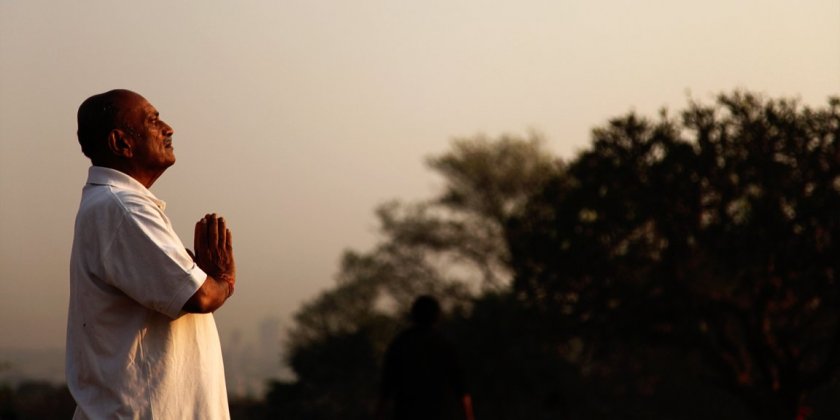
Namaste! Photo: Vinoth Chandar (Chennai, India)/Wikipedia
The Trimurti (The Hindu Trinity)
These three male deities represent the cosmic functions of creation, maintenance, and destruction.
Brahma (The Creator): He is responsible for creating the universe and all living beings. He is typically depicted with four faces (representing the four Vedas, the holy texts) and four arms. Interestingly, despite his important role, he is rarely worshipped in daily Hindu practice today. (Note: Do not confuse Brahma the god with Brahman the supreme spirit).
Vishnu (The Preserver): He maintains and protects the universe. Whenever evil threatens the balance of the world, Vishnu incarnates on Earth to restore order. He is depicted with blue skin, holding a conch shell, a discus (chakra), a lotus, and a mace.
Shiva (The Destroyer / Transformer): He destroys the universe at the end of a cosmic cycle so it can be recreated. He is also the lord of meditation, yoga, and the arts. He is depicted as an ascetic with a third eye, a blue neck, a trident, and a snake around his neck.
The Tridevi (The Divine Feminine)
In Hinduism, the male gods cannot act without their female counterparts, who represent Shakti (divine cosmic energy/power).
Saraswati: The consort of Brahma. She is the goddess of knowledge, wisdom, music, and the arts. She is usually depicted wearing white and playing a stringed instrument called a veena.
Lakshmi: The consort of Vishnu. She is the goddess of wealth, fortune, purity, and prosperity (both material and spiritual). She is often depicted sitting on a lotus flower, showering gold coins.
Parvati: The consort of Shiva. She is the goddess of love, fertility, and devotion. She is the gentle aspect of the Divine Mother.
The Fierce Forms of the Divine Mother
Parvati/Shakti also takes on fierce, warrior-like forms to defeat evil that the male gods cannot defeat.
Durga: A warrior goddess who rides a lion or tiger. She has many arms, each holding a weapon gifted by the other gods. She was created to slay the indestructible buffalo-demon Mahishasura.
Kali: The most fearsome form of the goddess. She represents time, change, and the destruction of the ego. She is depicted with dark skin, a protruding tongue, a garland of human skulls, and a skirt of severed arms. Despite her frightening appearance, she is fiercely loving toward her devotees.
The Avatars of Vishnu
When Vishnu comes to Earth, he takes on the form of an Avatar (incarnation). Traditionally, there are ten major avatars (the Dashavatara), but two are worshipped universally as supreme deities in their own right:
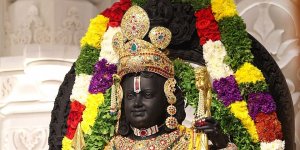
Rama: The hero of the epic Ramayana. He represents the ideal man, king, and husband. He is the embodiment of dharma (duty, righteousness).
Krishna: The central figure of the epic Mahabharata and the speaker of the Bhagavad Gita. He is worshipped as a divine statesman, a mischievous child, a romantic lover, and the supreme teacher of the universe.
The ten incarnations are traditionally listed as follows:
Matsya (The Fish)
Vishnu appeared as a giant fish during the Satya Yuga (the first age) to save the first man, Manu, and the holy Vedas from a great cosmic flood. This story bears a striking resemblance to the story of Noah’s Ark.
Kurma (The Tortoise)
When the gods and demons were churning the Ocean of Milk to obtain the nectar of immortality (Amrita), the mountain they were using as a stirring rod began to sink. Vishnu incarnated as a giant tortoise to support the mountain on his back.
Varaha (The Boar)
A demon named Hiranyaksha dragged the Earth (the goddess Bhudevi) to the bottom of the cosmic ocean. Vishnu took the form of a boar, dove into the depths, fought the demon for a thousand years, and eventually lifted the Earth back to the surface on his tusks.
Narasimha (The Man-Lion)
The demon king Hiranyakashipu had a boon that he could not be killed by man or beast, indoors or outdoors, at day or at night. To protect the king's pious son, Prahlada, Vishnu appeared as Narasimha—with the body of a man and the head of a lion.
He killed the demon at twilight, on a threshold (neither in nor out), using his claws (neither man-made weapon nor animal tooth), thus bypassing the boon's protections.
Vamana (The Dwarf)
The benevolent but prideful demon king Bali had taken control of the three worlds (heaven, earth, and the underworld). Vishnu appeared as a tiny dwarf priest. He asked Bali for as much land as he could cover in three steps. Bali agreed, and Vamana grew to a giant size; with two steps he covered the earth and the heavens.
For the third step, Bali humbly offered his own head, and Vamana pushed him into the underworld, granting him immortality for his humility.
Parashurama (The Warrior with an Axe)
In this form, Vishnu appeared as a Brahmin (priest) who took up arms to end the tyranny of the Kshatriya (warrior) caste, who had become arrogant and began abusing their power. He represents the restoration of social order through force.
Rama (The Ideal Man/King)
The hero of the epic Ramayana. Rama represents the "Perfect Man" (Maryada Purushottama). He is worshipped for his adherence to duty, honor, and virtue. His most famous feat was defeating the ten-headed demon king Ravana to rescue his wife, Sita.
Krishna (The Divine Teacher)
Krishna is perhaps the most widely worshipped of all avatars. He is a central figure in the Mahabharata and delivered the Bhagavad Gita on the battlefield. He represents divine love, joy, and the philosophy of selfless action. Unlike other avatars, Krishna is often worshipped as the Supreme Being himself in many traditions.
Buddha (The Enlightened One)
Most modern lists of the Dashavatara include Gautama Buddha, the founder of Buddhism. He is seen as an incarnation of Vishnu who taught non-violence (ahimsa) and the path to enlightenment.
In some regional traditions (particularly in South India) or older texts, Balarama (the elder brother of Krishna) is listed as the 9th avatar instead of Buddha.
Kalki (The Future Avatar)
Kalki is the only avatar who has not yet appeared. It is prophesied that he will appear at the end of the Kali Yuga (our current age of darkness and spiritual decay). He is described as a warrior riding a white horse with a blazing sword, who will cleanse the world of evil and usher in a new Golden Age (Satya Yuga).
The Evolutionary Connection
Many scholars and devotees point out that the sequence of the Dashavatara mirrors the biological evolution of life on Earth:
Matsya: Life in water (Fish).
Kurma: Amphibian (Tortoise).
Varaha: Land animal (Boar).
Narasimha: Transition from animal to human (Man-lion).
Vamana: Small/early human (Dwarf).
Parashurama: Tribal/early human with tools (Axe-wielder).
Rama: The civilized man (King/Law-abider).
Krishna: The advanced social/intellectual man (Philosopher/Statesman).
Buddha: The spiritually enlightened man.
Kalki: The future/final transformation.
Other Massively Popular Deities
Ganesha: The elephant-headed son of Shiva and Parvati. He is the Remover of Obstacles and the god of new beginnings. In Hinduism, prayers are almost always offered to Ganesha before any other deity or before starting a new venture.
Hanuman: A vanara (monkey) deity and the ultimate devotee of Lord Rama. He represents immense physical strength, courage, loyalty, and selfless devotion.
Kartikeya (Murugan): The brother of Ganesha and the Hindu god of war. He is vastly popular in South India and among the Tamil diaspora.
The Vedic Deities (Gods of Nature)
In the most ancient Hindu texts (the Vedas), the prominent gods were tied to the elements and nature. While they are not the primary focus of modern temple worship, they are still invoked during fire rituals and weddings.
Indra: King of heaven and god of rain, storms, and lightning.
Agni: The god of fire. He acts as the messenger between humanity and the gods.
Surya: The Sun god.
Vayu: The god of wind.
How Hindus Worship
Because there are so many deities, a common practice in Hinduism is the concept of the Ishta Devata (cherished divinity).
A Hindu might respect all the gods, but they will choose one specific deity (often based on family tradition or personal connection) to worship daily as their personal link to the Supreme Brahman.
In Hinduism, the Dashavatara (Sanskrit: dasha = ten, avatara = descent/incarnation) refers to the ten primary incarnations of Vishnu, the Preserver.
According to Hindu theology, Vishnu descends to Earth in different forms whenever the world is in chaos, to destroy evil and restore Dharma (cosmic order and righteousness).
YOU MAY ALSO LIKE