| / Stories, Legends, Myths |
The Life Story of Sariputta
Sāriputta (Pāli: Sāriputta; Sanskrit: Śāriputra) is one of the most important figures in the Theravāda tradition and is regarded as the Buddha’s "Chief Disciple" (alongside Moggallana). He was often referred to as the Dhammasenapati, or the "General of the Dhamma."
He was renowned for his profound wisdom (paññā), his mastery of the Abhidhamma (Buddhist philosophy), and his extreme humility.
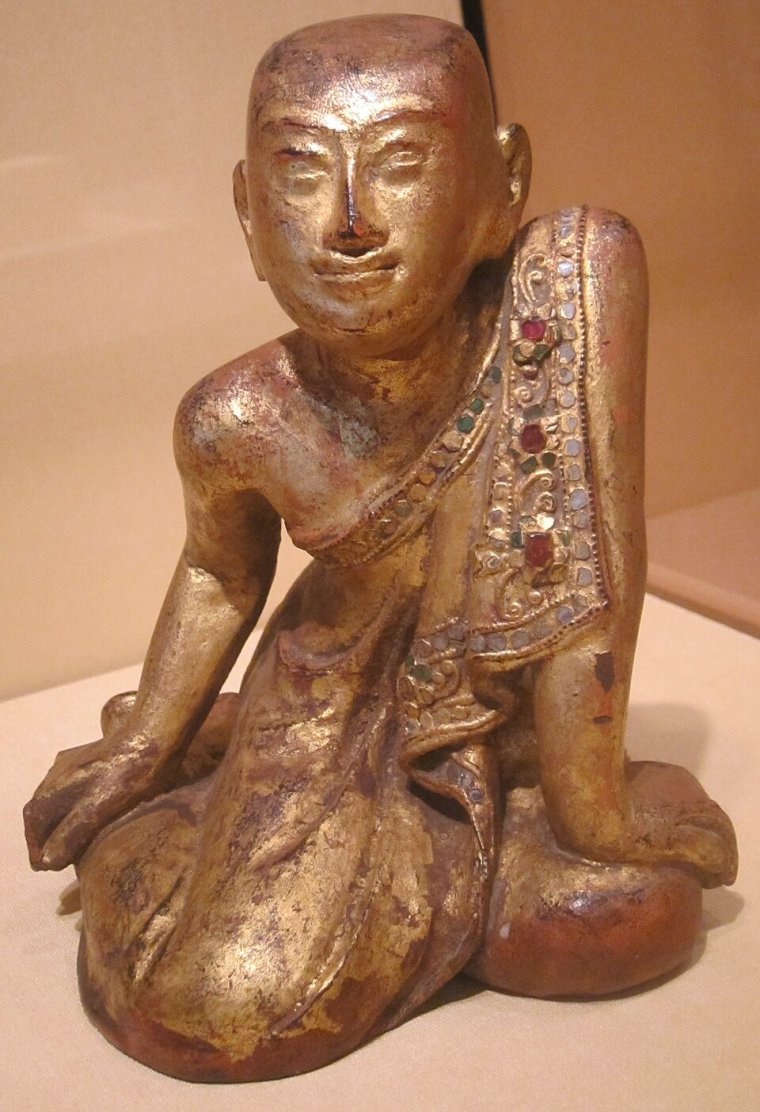
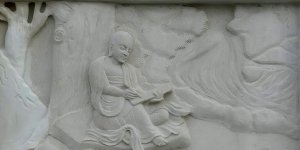
Sariputta. Myanmar, 19th century.
Early Life
Sariputta was born into a wealthy Brahmin family in a village near Rajgir (modern-day Bihar, India). His birth name was Upatissa. The name "Sāriputta" means "son of Sārī," referring to his mother.
He had a lifelong best friend named Kolita (who would later become Moggallana). The two were said to be inseparable.
Despite their wealth and high social status, both Upatissa and Kolita felt a deep sense of spiritual dissatisfaction.
Legend says that while watching a popular festival, they were struck by the realization that within a hundred years, everyone in the crowd would be dead. This realization of impermanence led them to renounce their worldly lives and become wandering ascetics.
Initially, they studied under a famous teacher named Sanjaya Belatthiputta. They mastered his teachings quickly but felt that his philosophy didn't lead to the "Deathless" (Enlightenment). They made a pact: whoever found the "Truth" first would immediately tell the other.
The Meeting with Assaji
The turning point in Sariputta’s life came when he met Assaji, one of the Buddha’s first five disciples. Sariputta was struck by Assaji’s serene and composed appearance as he walked for alms.
Sariputta asked Assaji who his teacher was and what he taught. Assaji modestly replied that he was a newcomer, but he recited a single verse that summarized the Buddha's teaching:
"Of those things that arise from a cause,
the Tathāgata has explained the cause,
and also their cessation.
Such is the teaching of the Great Ascetic."
Upon hearing these words, Sariputta immediately attained the first stage of enlightenment (Sotapanna or Stream-entry).
He immediately sought out Kolita and repeated the teaching. Kolita also attained stream-entry. Together they and many of their followers went to meet the Buddha and entered the monastic order.
After ordination, Kolita (later Mahā Moggallāna) attained arahantship within a short time.
Sāriputta attained full enlightenment about two weeks later while listening to a discourse given by the Buddha. The tradition portrays him as a disciple whose realization matured through careful contemplation and penetrating wisdom.
The "General of the Dhamma"
While Moggallana became famous for his psychic powers, Sariputta became the foremost in Wisdom.
The Buddha often said that Sariputta was like a mother who gives birth to a child (bringing people to the first stage of enlightenment), while Moggallana was like a wet nurse who rears the child (helping them toward higher stages).
Tradition credits Sariputta with the systematization of the Abhidhamma Pitaka (the philosophical and psychological analysis of the teachings). It is said the Buddha taught these deep insights to Sariputta, who then organized them for the Sangha.
On several occasions, the Buddha would give a brief teaching and then ask Sariputta to explain it in detail to the monks. The Buddha once stated that Sariputta was the only person who could "turn the wheel of the Dhamma" just as the Buddha himself did.
Character Traits
Sariputta was celebrated for his humility and patience. Despite being the Chief Disciple, he was known for being incredibly approachable.
There is a story of a seven-year-old novice monk pointing out that Sariputta’s robe was dragging on the ground; instead of being offended, the "General of the Dhamma" knelt down, thanked the boy, and adjusted his robe.
Many discourses in the Pāli Canon are delivered by Sāriputta. He often takes teachings given briefly by the Buddha and expands them into detailed analyses.
The Canon repeatedly depicts him as humble despite his status, respectful even toward junior monks, calm and free from pride, a model teacher and mentor.
The Buddha frequently praised Sāriputta's wisdom and compared him to a capable general who helps a king govern a kingdom.
Final Days and Death (Parinirvana)
Sariputta passed away shortly before the Buddha. Realizing his life was coming to an end, he requested permission from the Buddha to return to his birthplace, Nalaka.
His final mission was to convert his mother, a staunch Brahmin who had spent her life resenting her son's choice to follow the Buddha. On his deathbed, Sariputta gave a final sermon that so moved his mother that she attained the first stage of enlightenment.
Sariputta died in the very room where he was born. After attaining final Nibbāna (Parinibbāna), his relics were brought to the Buddha by fellow monks. The Buddha reportedly praised him and reminded the community of his extraordinary qualities.
For many Theravāda practitioners, Sāriputta represents the possibility that rigorous investigation, careful reflection, and ethical conduct can culminate in awakening. His life demonstrates that wisdom is not merely intellectual knowledge but direct insight into the nature of reality.
Iconography
In Buddhist art and iconography, Sariputta is usually depicted standing on the right side of the Buddha (representing wisdom), while Moggallana stands on the left (representing power).
He remains a symbol of the intellectual depth of Buddhism and the possibility of combining vast intelligence with profound humility.
YOU MAY ALSO LIKE