| / Stories, Legends, Myths |
The Legend of Nagarjuna
The legend of Nagarjuna (c. 150–250 CE) is one of the most colorful and significant in Buddhist history. He is revered as the founder of the Madhyamaka (Middle Way) school of Mahayana Buddhism and is often referred to as the "Second Buddha."
The stories surrounding him blend historical fact with supernatural myth, emphasizing his roles as a philosopher, an alchemist, and a bridge between the human and spirit worlds.
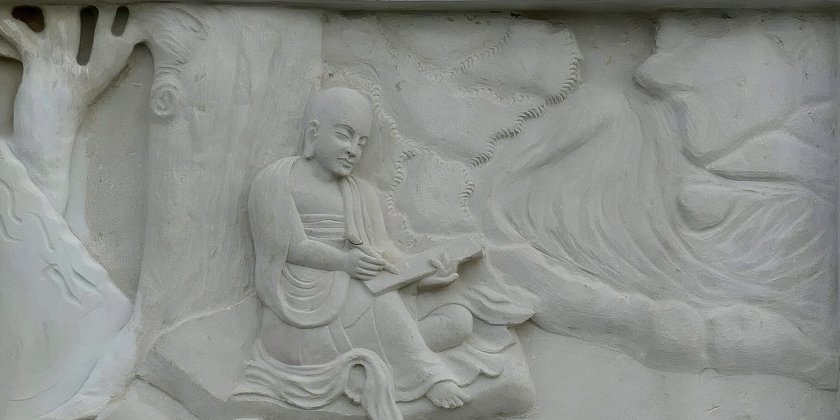
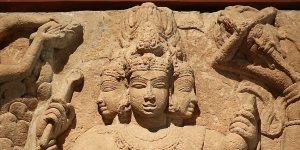
Nagarjuna composes the Madhyamika Texts, Buddhavanam Stupa Drum Reliefs, Telangana.
Birth and the Prophecy of Death
Legend says Nagarjuna was born to a Brahmin family in South India. At his birth, an astrologer predicted the boy would die at the age of seven. To prevent his parents from witnessing his death, they sent him to the great Buddhist university of Nalanda.
There, he met the master Saraha, who told him that he could escape death by reciting the mantra of the Buddha Amitayus (the Buddha of Infinite Life). Nagarjuna practiced so intensely that he cheated death and stayed at Nalanda, eventually becoming a monk and a great scholar.
The Journey to the Dragon Realm
The most famous legend explains how he got his name. It is said that while he was teaching, he noticed two students who emitted a natural fragrance of sandalwood. He discovered they were the sons of the Naga King (Nagas are serpent-like deities who live underwater and guard secret treasures).
The Nagas invited Nagarjuna to their underwater kingdom. There, they revealed that the Buddha had entrusted them with the Prajnaparamita Sutras (The Perfection of Wisdom Sutras), claiming that humanity was not yet ready to understand them when the Buddha was alive.
Nagarjuna studied these texts in the Naga realm for many years. When he returned to the human world, he brought these sutras with him, which became the foundation of Mahayana Buddhism. Because he was "helped by the Nagas" and his skills were compared to the archer "Arjuna," he was named Nagarjuna.
The Philosopher-Alchemist
In Indian and Tibetan traditions, Nagarjuna is also remembered as a master of Rasayana (alchemy). Legend says he was able to transform base metals into gold.
According to one story, there was a great famine, and the monks at Nalanda were starving. Nagarjuna used his alchemical skills to create gold, which he used to buy food for the entire monastic community for several years.
This side of the legend paints him not just as a logic-driven philosopher, but as a "Siddha" (an enlightened master with supernatural powers).
The Friendship with the King
Historically, Nagarjuna was a friend and advisor to a King of the Satavahana dynasty (likely Gautamiputra Satakarni).
He wrote a famous letter of advice to the King called the Suhrulekha (Letter to a Friend), which is still studied today as a guide for ethical leadership and lay Buddhist practice.
The Legend of His Death
The story of Nagarjuna’s death is a tragic tale of karmic inevitability. Because of his mastery over life-extending alchemy, Nagarjuna lived for hundreds of years. The King also lived an unnaturally long life because of his friendship with the sage.
Eventually, the Crown Prince grew impatient to inherit the throne. His mother told him, "The King will only die when Nagarjuna dies. Go and ask the sage for his head; he is so compassionate he will not refuse you."
The Prince went to Nagarjuna and made the request. Nagarjuna agreed to sacrifice himself. However, no metal sword could cut his neck—his spiritual power was too great.
Nagarjuna then explained that in a previous life, he had accidentally killed an insect while cutting Kusha grass. Because of that tiny karmic debt, the only thing that could kill him was a blade of Kusha grass.
The Prince took a blade of grass and easily decapitated the sage. Legend says that as he died, Nagarjuna’s blood turned into milk. It is also prophesied that his head and body will one day reunite when the future Buddha, Maitreya, appears in the world.
To this day, Nagarjuna remains the single most influential philosopher in Mahayana Buddhism, particularly in the Tibetan and Zen traditions.
YOU MAY ALSO LIKE