| / Stories, Legends, Myths |
The Life Story of Mahā Moggallāna
Mahā Moggallāna (Sanskrit: Maudgalyāyana) was one of the Buddha's two chief disciples, alongside Sāriputta. While Sāriputta was renowned for wisdom, Mahā Moggallāna was regarded as 'foremost in psychic powers' (iddhi).
If Sariputta was the "mother" of the Sangha (bringing people to the faith), Moggallana was the "wet nurse" (disciplining them and helping them progress further on the path).
The two are often portrayed as complementary figures: Sāriputta representing penetrating wisdom and Moggallāna representing extraordinary meditative mastery.
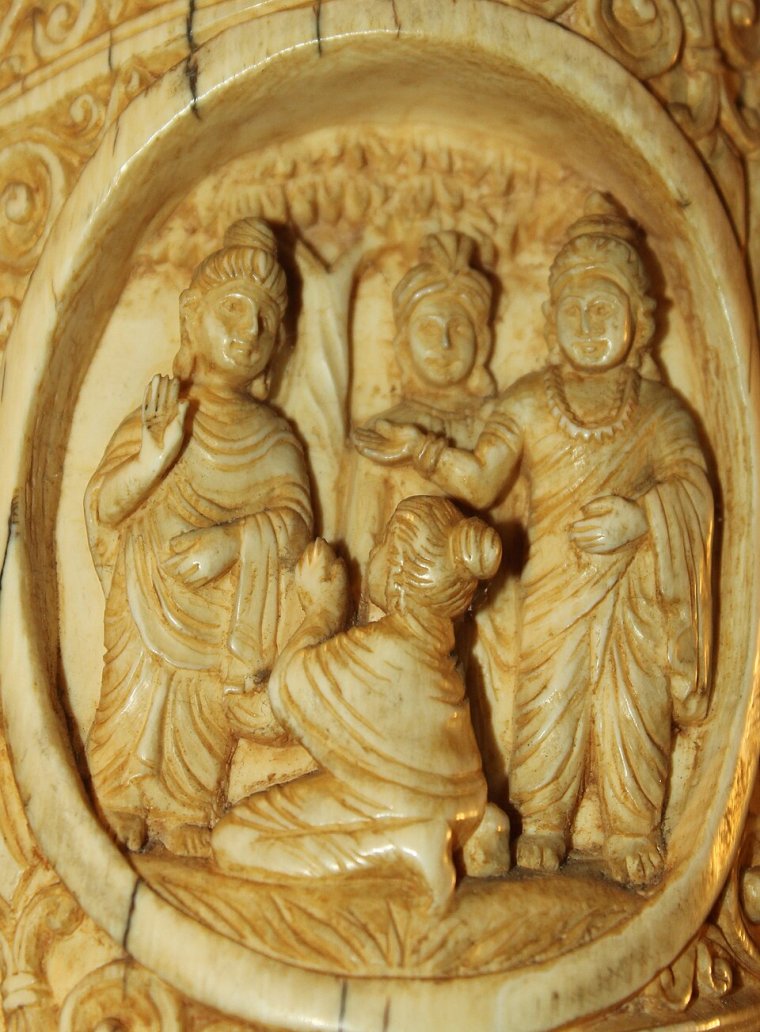
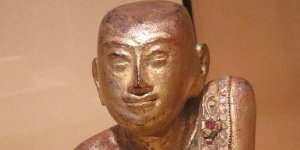
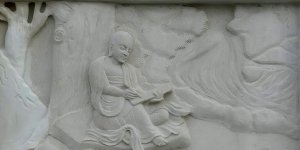
Sariputra and Maudgalyayana become the followers of Buddha. (craftsmen from the Delhi region, India)
Early Life and Renunciation
Moggallana was born into a prominent Brahmin family in the village of Kolita (near Rajgir). His birth name was Kolita. He was the inseparable best friend of Upatissa (Sariputta).
As mentioned in Sariputta's story, the two friends grew disillusioned with worldly pleasures while attending a festival and decided to seek enlightenment.
Like Sāriputta, Kolita became a disciple of Sañjaya Belaṭṭhiputta before eventually encountering the Buddha's teaching.
After Sariputta heard the Dhamma from the monk Assaji, he rushed to find Moggallana. Upon hearing the same verse, Moggallana also achieved the first stage of enlightenment (sotapanna) instantly.
Both men realized they had found the path they had been seeking. They approached the Buddha, entered the Saṅgha, and became monks.
Rapid Enlightenment and Master of Psychic Powers
Interestingly, Moggallana attained full Enlightenment (arahantship) within about a week of ordination—faster than Sariputta (who took two weeks).
During his meditation, Moggallana struggled with "sloth and torpor" (sleepiness).
The Buddha appeared to him in a vision and gave him specific techniques to overcome drowsiness (such as pulling his ears, splashing water on his face, or visualizing light). Following these instructions, Moggallana pushed through and attained the final goal.
Moggallana was renowned for his extraordinary supernatural abilities. The Canon repeatedly identifies Moggallāna as the disciple foremost in supernormal powers. However, the Buddha always emphasized that these powers were tools for teaching, not for show.
Stories describe abilities such as:
• Traveling through the air.
• Perceiving beings reborn according to their actions.
• Shaking celestial palaces to awaken complacent gods.
• Knowing the thoughts and spiritual levels of others.
• Hearing and seeing things across great distances or in other dimensions.
• He frequently visited the "heavens" to see the rewards of good deeds and the "hell realms" to see the results of bad karma. He would return to the human world and describe these scenes to people to encourage them to live ethically.
• Once, he tamed a fierce naga (serpent king) named Nandopananda who was blocking the sky, by transforming himself into an even larger dragon.
In Theravāda interpretation, these abilities are viewed as secondary to liberation. Moggallāna's greatness lay not in possessing powers, but in being fully enlightened.
Teacher and Protector of the Saṅgha
Moggallāna frequently used his abilities to assist the Buddhist community.
The Canon depicts him correcting monks who had become careless, helping protect the Saṅgha from harmful influences, teaching about karma through accounts of beings in various realms of existence and assisting the Buddha in guiding disciples.
Many discourses feature him reporting what he observed in heavenly or unfortunate realms, illustrating the consequences of wholesome and unwholesome actions.
While Sariputta was known for his gentle nature, Moggallana was the "enforcer" of the Sangha. He had a keen ability to spot monks who were becoming lazy or corrupt.
In one famous story, when a group of monks was being noisy and heedless in a monastery, Moggallana used his toe to shake the entire massive building, terrifying them into realizing the importance of mindfulness and the power of the Dhamma.
The friendship between Sāriputta and Moggallāna is one of the most celebrated relationships in Buddhist literature.
The Buddha compared them to a king's two chief ministers, the two wheels of a chariot, and the two foremost supports of the Saṅgha.
Although their strengths differed, the texts portray them as deeply respectful of one another.
Saving His Mother (The Ghost Festival)
One of the most famous legends regarding Moggallana involves his mother. Using his divine eye, he saw that his mother had been reborn as a "Hungry Ghost" (preta) due to her stinginess in her past life. She was skeletal and unable to eat.
Moggallana tried to give her food using his powers, but it turned into burning coals. He asked the Buddha for help. The Buddha instructed him to make offerings to the entire Sangha (the community of monks) at the end of the rainy season retreat. This merit was so great that it liberated his mother from the ghost realm.
This story is the origin of the Ullambana Festival (or the Ghost Festival), widely celebrated in East Asia as a day to honor ancestors.
The Martyrdom (Death)
Moggallāna's death is one of the most dramatic stories in the Theravāda tradition.
Moggallana’s death was tragic and violent. Because he was so successful at converting people to Buddhism by describing the realms of heaven and hell, rival religious groups grew jealous. They hired a band of assassins to kill him.
Twice, Moggallana sensed the assassins coming and used his powers to escape (once by flying into the sky and once by exiting through a keyhole).
The third time, he realized through his divine insight that his past karma had caught up with him. In a very distant past life, he had been tricked into killing his elderly parents.
Accepting his fate, he allowed the assassins to beat him until his bones were crushed. The assassins left him for dead.
However, through sheer mental power (jhana), he "knitted" his body back together one last time to fly to the Buddha, bid him a final farewell, and then passed away into Parinirvana.
The Pāli Canon itself says relatively little about the details, but the story became an important example in Theravāda tradition of the principle that even an arahant may still experience the results of past bodily karma, though no new karma is created.
If Sāriputta is often seen as the ideal of wisdom, Moggallāna is often seen as the ideal of spiritual power grounded in enlightenment. Together they represent two of the highest attainments possible for disciples of the Buddha.
In Buddhist temples, Moggallana is usually depicted on the left side of the Buddha. While Sariputta represents the intellectual side of the path, Moggallana represents the transformative and energetic side.
YOU MAY ALSO LIKE