| / News |
Ganesha Chaturthi 2026: Date, Rituals, Offerings, Significance and the Legend of Lord Ganesha
Millions of Hindus will welcome Lord Ganesha on Monday, September 14, 2026, marking the beginning of Ganesha Chaturthi, one of India's most vibrant and widely observed Hindu festivals. The festival celebrates Ganesha, the elephant-headed deity revered as the remover of obstacles, patron of wisdom and intelligence, and lord of auspicious beginnings.
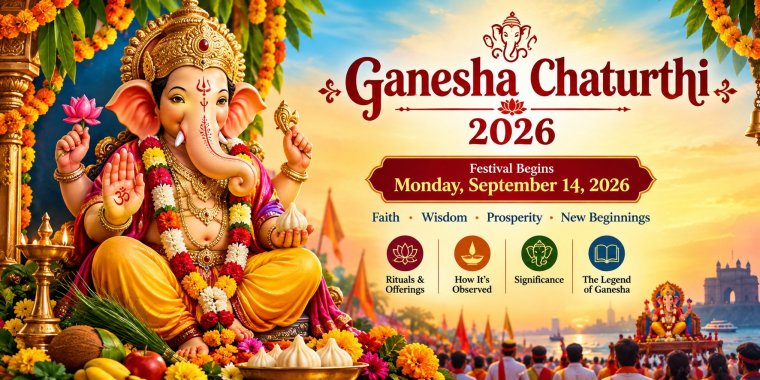
Ganesha Chaturthi 2026
Ganesha Chaturthi falls on the fourth day (Chaturthi) of the Shukla Paksha of the Hindu month of Bhadrapada. In 2026, the Chaturthi tithi runs from the morning of September 14 into September 15, with the festival observed on September 14.
At the end of the festival, a statue of Ganesha is immersed in water.
Preparations often begin days or weeks beforehand, with families and communities bringing home or installing specially made Ganesha murtis (statues or idols). In cities such as Mumbai and Pune, enormous temporary public pavilions, known as pandals, become centers of prayer and community celebrations.
The festival generally begins with the installation of the Ganesha idol, followed by prana pratishtha, a ritual invoking the divine presence in the image.
Devotees then perform prayers, offerings and aarti, fire-offering rituals, often accompanied by devotional music and the chanting of Ganesha's names.
Traditional worship may include a series of ritual offerings known as Shodashopachara Puja, along with fasting, recitation of prayers and daily worship throughout the festival.
At the end of the celebration comes visarjan, or immersion. The idol is carried in a procession, accompanied by singing, music and chants, before being immersed in water.
The ritual symbolizes Ganesha's return to his divine abode and the impermanence of the physical world.
Among the most familiar offerings to Ganesha are: modak — a sweet dumpling traditionally regarded as one of Ganesha's favorite foods, laddus and other sweets, durva grass — a sacred grass especially associated with Ganesha worship, red flowers, particularly those traditionally used in Ganesha puja. coconut and fruits, dakshina, or a monetary offering, according to family tradition.
Devotees may also chant mantras such as “Om Gan Ganapataye Namah”, perform aarti, and read or listen to stories associated with Ganesha.
Traditions differ considerably between regions and families, so there is no single universal form of Ganesha Chaturthi worship. The emphasis is generally on devotion, prayer, gratitude and seeking Ganesha's blessings.
The legend of Ganesha
Ganesha occupies a special place in Hindu religious tradition as the Vighnaharta, or remover of obstacles. He is also associated with wisdom, learning, prosperity and auspicious beginnings. Consequently, Ganesha is traditionally invoked before many important undertakings, ceremonies and religious rituals.
For devotees, Ganesha Chaturthi is therefore more than a celebration of a deity's birth. It represents a prayer for wisdom to overcome difficulties, discernment in making decisions and success in new endeavors.
The festival also has an important social dimension. Public celebrations bring neighborhoods and communities together for worship, cultural performances, music, food and charitable activities.
In Maharashtra especially, the modern public form of Ganeshotsav became prominent during the late 19th century. The freedom fighter Bal Gangadhar Tilak helped transform what had largely been a household celebration into a major public festival, using it as a means of encouraging community solidarity during British rule.
One of the best-known stories about Ganesha's origin appears in Hindu mythology in several variations.
According to the popular version, Goddess Parvati created Ganesha from the material of her body and instructed him to guard the entrance while she bathed. When Lord Shiva returned and attempted to enter, Ganesha—who did not recognize him—refused to let him pass.
A confrontation followed, and Shiva severed Ganesha's head.
Parvati was devastated and demanded that Ganesha be restored. Shiva agreed and instructed his attendants to bring the head of the first suitable living being they encountered. They returned with the head of an elephant, which Shiva placed on Ganesha's body, bringing him back to life.
Shiva then blessed Ganesha and granted him a position of great honor among the gods. This story is commonly associated with Ganesha's elephant head and with his status as a deity who should be honored at the beginning of auspicious activities.
Another celebrated story explains Ganesha's wisdom. When Shiva and Parvati asked Ganesha and his brother Kartikeya to race around the world, Kartikeya immediately set off on his vehicle. Ganesha instead walked around his parents and explained that, to him, his parents represented the entire universe. His intelligence and devotion won him the contest.
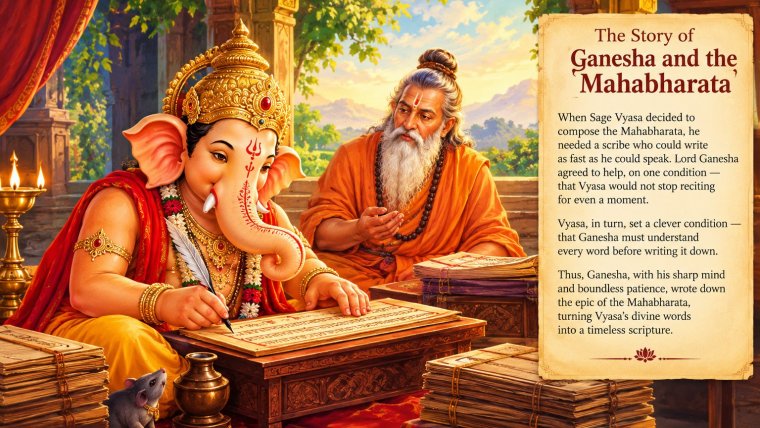
According to a well-known Hindu tradition, Sage Vyasa sought a scribe capable of recording the vast epic he was composing, the Mahabharata. He approached Lord Ganesha, who agreed to write it down on the condition that Vyasa recite the poem continuously without pausing.
Vyasa accepted, but added his own condition: Ganesha must understand every verse fully before writing it. This arrangement ensured that Vyasa could occasionally pause to compose the more complex passages while Ganesha reflected on their meaning.
As the narration began, Ganesha wrote with extraordinary speed, recording Vyasa's verses as the sage recited them. Tradition says that when his writing instrument broke during the intense work, Ganesha broke off one of his own tusks and continued writing with it rather than allowing the transcription to stop.
This is one of the stories traditionally associated with Ganesha's single tusk, or Ekadanta, and symbolizes his determination and willingness to sacrifice for the pursuit of knowledge.
Through their extraordinary collaboration, Vyasa's spoken poetry was transformed into a written epic encompassing stories of kings, heroes, gods, moral dilemmas, war and dharma.
The legend presents Ganesha not simply as a scribe, but as a symbol of wisdom, concentration, perseverance and the power of knowledge. It also highlights the importance of understanding before acting: Ganesha's agreement to comprehend each verse before writing reflects the idea that true learning requires both attentive listening and thoughtful understanding.
From celebration to farewell
The final day, Ananta Chaturdashi, brings an emotional conclusion to the festivities. After days of worship, devotees carry the Ganesha idol in a procession for visarjan, immersion into water. The immersion represents a profound Hindu theme: all physical forms are temporary, while the divine is eternal.
The familiar farewell chant—“Ganpati Bappa Morya!”—captures both celebration and devotion as worshippers bid farewell to Ganesha with the hope of welcoming him again the following year.
For millions of devotees, Ganesha Chaturthi 2026 will thus combine ancient mythology, household prayer, community celebration and a reminder that wisdom and faith can help overcome life's obstacles.
YOU MAY ALSO LIKE