| / News |
Bhutan Prepares for a Remarkable Run of Buddhist Festivals from September 17 to 26
Thimphu, Bhutan, September 13, 2026 — Bhutan is preparing for one of the most concentrated periods of its autumn religious calendar, with four major Buddhist celebrations taking place in quick succession between September 17 and 26, 2026. From the sacred rituals of the Thimphu Drubchen to the colourful masked dances of Thimphu, Wangdue Phodrang and Gangtey, the ten-day period will offer an exceptional glimpse into the Himalayan kingdom’s living Buddhist traditions.
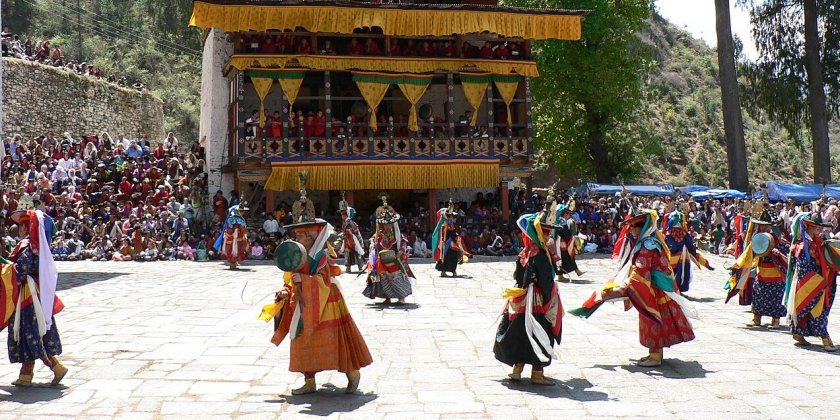
Bhutan Prepares for a Remarkable Run of Buddhist Festivals. Credit phote: Stephen Shephard/wikipedia.org
The sequence begins with the Thimphu Drubchen on September 17, followed by the Wangdue Tshechu from September 19 to 21, the Thimphu Tshechu from September 21 to 23, and finally the Gangtey Tshechu from September 24 to 26.
Bhutan’s Ministry of Home Affairs lists September 17 for the Thimphu Drubchoe and September 21–23 for the capital’s Tshechu, while 2026 festival calendars place Wangdue and Gangtey in the intervening and immediately following days.
Together, the celebrations create a nearly continuous journey through western Bhutan’s spiritual landscape, linking the capital Thimphu with historic Wangdue Phodrang and the high-altitude Phobjikha Valley.
Thimphu Drubchen opens the festival period
The first event, the Thimphu Drubchen on September 17, is considerably more ritual-focused than the large public Tshechus that follow.
Held at Tashichho Dzong, the fortress-monastery that dominates the northern end of Thimphu, the Drubchen is rooted in Bhutan’s tantric Buddhist traditions.
It includes prayers and sacred masked dances associated with protective deities and is traditionally understood as a ceremony seeking spiritual protection and well-being for the kingdom and its people.
Unlike the festive atmosphere of a Tshechu, the Drubchen has a particularly devotional character.
Monks, dancers and worshippers take part in rituals whose meaning extends well beyond spectacle, giving visitors an opportunity to see an important dimension of Bhutanese religious life.
The event also serves as a spiritual prelude to Thimphu’s larger Tshechu several days later.
Wangdue Phodrang takes centre stage
Attention then shifts eastward to Wangdue Phodrang, where the Wangdue Tshechu will run from September 19 to 21. The three-day festival is one of western Bhutan’s major district celebrations and revolves around sacred cham dances performed by monks and lay dancers.
Among its best-known performances is the Raksha Mangcham, a dramatic dance portraying judgment after death and the consequences of good and bad actions.
Like other Bhutanese Tshechus, the festival honours Guru Rinpoche, or Padmasambhava, the eighth-century Buddhist master whose teachings occupy a central place in Bhutanese Vajrayana Buddhism.
The festival also carries special historical resonance because of Wangdue Phodrang Dzong. The great fortress was devastated by fire in 2012 and subsequently reconstructed and reconsecrated, restoring one of the region’s most important religious and architectural landmarks.
For local communities, however, the Tshechu is not simply a performance. Families arrive dressed in their finest gho and kira, pray, meet relatives and neighbours and spend much of the day around the festival grounds. Religion and social life come together in a way characteristic of Bhutan’s Tshechu tradition.
Bhutan’s largest capital festival follows
The final day of the Wangdue celebration coincides with the opening of the Thimphu Tshechu on September 21, meaning festival-goers moving through western Bhutan will face an unusually rich choice of events on that day.
Running until September 23, Thimphu Tshechu is among Bhutan’s largest and most prominent annual religious gatherings.
The Thimphu district administration describes it as a major celebration of Guru Rinpoche featuring elaborate cham masked dances, Buddhist stories, moral teachings and communal worship.
Crowds gather around the Tashichho Dzong festival grounds, where brightly costumed monks and lay performers enact stories rooted in Buddhist teachings.
The dances are traditionally regarded not merely as entertainment but as religious acts capable of conveying blessings, teachings and protection.
For Bhutanese participants, the occasion is also intensely social. People travel to the capital, wear ceremonial clothing, share meals and reconnect with family and friends while attending the religious performances.
The 2026 dates of September 21–23 are also confirmed in the Royal Government of Bhutan’s holiday calendar.
Gangtey brings the celebrations to Phobjikha Valley
Barely a day after Thimphu Tshechu concludes, the festival season continues in one of Bhutan’s most atmospheric landscapes.
The Gangtey Tshechu will take place from September 24 to 26 at Gangtey Goenpa, overlooking the broad Phobjikha Valley in Wangdue Phodrang district.
The three-day festival features sacred masked dances associated with the Peling Buddhist tradition, along with folk songs and community celebrations.
Gangtey offers a markedly different setting from the busy capital. The monastery sits above a high glacial valley surrounded by forests and mountains, creating an intimate backdrop for ceremonies that draw residents from surrounding villages.
Local people traditionally attend wearing their finest clothing and jewellery, turning the monastery courtyard into a colourful gathering place.
The festival concludes with religious blessings, while 2026 festival information also lists the final-day display of a Thongdrel, a monumental sacred Buddhist image believed to confer blessings upon those who see it.
Phobjikha is also famous as the winter habitat of the endangered black-necked crane, although the cranes generally arrive later in the season.
Ten days showcasing Bhutan’s living Buddhist heritage
Taken together, the four celebrations create an unusual cultural corridor across western Bhutan.
Although often grouped together as “festivals,” they are not identical: the Thimphu Drubchen is primarily a ritual observance, while the three Tshechus combine religious ceremonies with larger public and community celebrations.
What connects them is Bhutan’s Vajrayana Buddhist tradition and the continuing importance of monasteries, dzongs, ritual dances and communal gatherings in everyday cultural life.
For international visitors, the September sequence also provides a rare opportunity to see several expressions of Bhutanese Buddhism during a single journey: the solemn rituals of the capital’s Drubchen, the historic setting of Wangdue, the scale and colour of Thimphu Tshechu and the more intimate monastic atmosphere of Gangtey.
The schedule is particularly striking in 2026: Thimphu Drubchen on September 17; Wangdue Tshechu on September 19–21; Thimphu Tshechu on September 21–23; and Gangtey Tshechu on September 24–26.
For ten days in September, western Bhutan will therefore become a moving stage for prayer, masked dance, sacred music and centuries-old ritual — a reminder that the kingdom’s celebrated festivals remain, above all, acts of living faith rather than performances created for visitors.
YOU MAY ALSO LIKE