| / News |
Holi Festival 2026: Celebrations Across India
Holi is one of the most important and joyful festivals in India. It is known as the Festival of Colors and celebrates the arrival of spring, the end of winter, and the victory of good over evil. People of all ages participate with great enthusiasm.
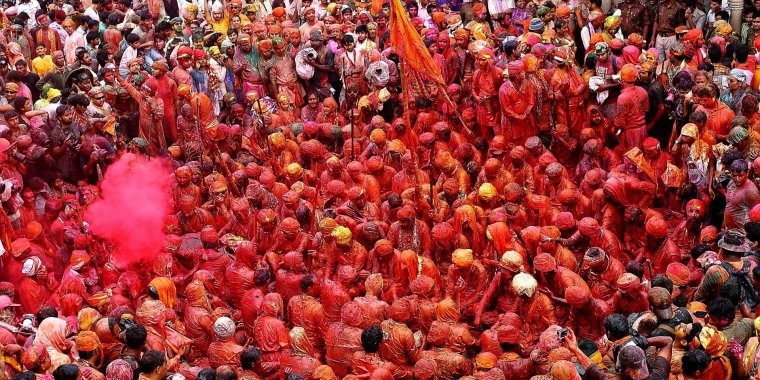
Lathmar Holi Photo: Narender9 / Wikimedia Commons
Holi is celebrated in March, on the full moon day (Purnima) of the Hindu month of Phalguna. The festival usually lasts for two days.
In 2026, it is celebrated on March 3rd and March 4th.
The first evening is called Holika Dahan. On this night, people gather to light a large bonfire. Families and communities come together to pray, sing, and perform rituals around the fire. The bonfire symbolizes the burning away of evil and negative energy.
The second day is known as Rangwali Holi (the day of colors). On this day, people throw colored powders (called gulal) and splash colored water on each other.
Streets are filled with music, dancing, laughter, and celebration. Friends and families visit one another, share sweets such as gujiya, and enjoy festive drinks like thandai. It is a time to forgive past misunderstandings and strengthen relationships.
The main legend associated with Holi is the story of Prahlada, his father Hiranyakashipu, and his aunt Holika.
According to Hindu mythology, Hiranyakashipu was a powerful demon king who wanted everyone to worship him as a god. However, his son Prahlada was a devoted follower of Lord Vishnu and refused to worship his father.
Enraged by this, Hiranyakashipu tried many times to punish and kill Prahlada, but he survived each attempt due to his strong faith.
Finally, Hiranyakashipu asked his sister Holika for help. Holika had a magical cloak that made her immune to fire. She tricked Prahlada into sitting with her in a burning fire, believing she would survive while he would perish.
However, due to divine protection, Prahlada remained unharmed, and Holika was burned instead. This event symbolizes the triumph of good over evil, and the bonfire of Holika Dahan represents this victory.
In many parts of India, Holi is also linked to stories of Lord Krishna playfully throwing colors on Radha and the other gopis, which is believed to be the origin of the tradition of playing with colors.
Holi is celebrated in almost every part of India — from small villages to large metropolitan cities — each with its own local traditions and style.
Mathura is believed to be the birthplace of Lord Krishna. Holi here is deeply connected to Krishna’s life and is celebrated with great devotion and enthusiasm. The celebrations last for several days with temple rituals, processions, music, and colors.
Vrindavan, where Krishna is said to have spent his childhood, hosts famous Holi celebrations in temples such as Banke Bihari Temple. Devotees and visitors from around the world gather to celebrate with flowers and colors.
Barsana is known for its unique Lathmar Holi, where women playfully hit men with sticks (lathis) as part of a traditional reenactment of Krishna’s playful teasing of Radha and her friends.
In Jaipur, Holi is celebrated with royal-style events, traditional music, elephant festivals (in some years), and cultural performances. The Pink City becomes very colorful during this time.
India’s capital, Delhi, celebrates Holi with large public events, music festivals, and private gatherings. Many communities organize Holi parties with DJs, dancing, and food.
Udaipur celebrates Holi with royal traditions, especially at the City Palace, where a grand Holika Dahan ceremony takes place.
In the spiritual city of Varanasi, Holi is celebrated with devotional songs, rituals along the Ganges River, and colorful street celebrations.
Although Holi started in India, it is now celebrated in countries like Nepal, the United States, the UK, Canada, and Australia. Many non-Indians also participate in “Festival of Colors” events inspired by Holi.
Overall, Holi is not only a religious festival but also a celebration of joy, unity, forgiveness, and new beginnings.
YOU MAY ALSO LIKE