| / News |
Over 3 million devotees participated in the Mandala Pooja pilgrimage at the Sabarimala temple in Kerala, India, of the Lord Ayyappa
The Mandala pilgrimage at the Sabarimala temple in Kerala, India, dedicated to Lord Ayyappa, took place from 17 November 2025 to 27 December 2025. According to the Travancore Devaswom Board (TDB), the temple was visited by over 3 million pilgrims and the revenue exceeded ₹332.77 crore (US$36.7 million), generated through kanikka (offerings), sale of appam (pancakes made from fermented rice batter and coconut milk) and aravana prasadam (a rich, traditional sweet made with rice, jaggery, ghee, and dried coconut), room rent and auction proceeds.
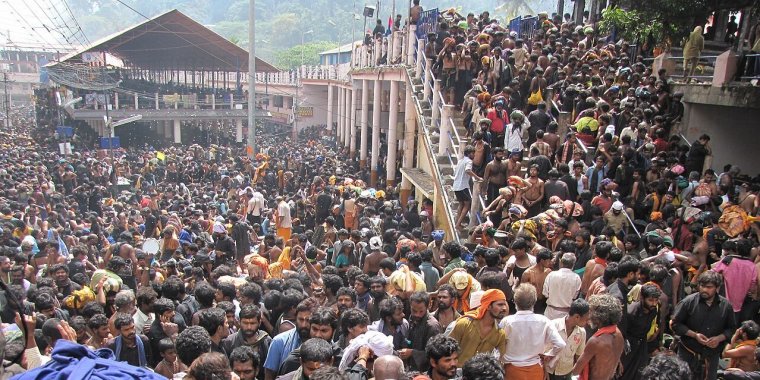
Sabarimala pilgrimage. Photo: Avsnarayan/Wikipedia
Ayyappa or Ayyappan, also known as Dharma Sastha and Manikandan, is the Hindu deity of truth and justice, usually depicted as a young warrior riding a tiger and holding a bow and arrow, or as a yogi wearing a little bell on his neck (in Sanskrit, mani means bell and kanda means neck).
According to Hindu mythology, he was the son of two male gods, Shiva and Vishnu (the latter taking a female form called Mohini, or "delusion personified").
The stories of Mohini and Shiva are popular in South Indian texts. There are several, somewhat similar, versions of the events leading up to the birth of Dharma Sastha / Ayyappan, described in texts such as the Bhagavata Purana, Tripurarahasya, Brahmanda Purana, Kanda Purana, Agni Purana, Shiva Purana, Linga Purana and so on. Some of them identify Ayyappa with Hanuman.
Vishnu took the enchanting form of Mohini to kill a demon named Bhasmasura who had the power to turn anyone to ashes if he laid his hand on their head.
Bhasmasura is so taken by Mohini that he asks her to marry him. Mohini agrees, but only on the condition that Bhasmasura follows her, move for move, in a dance. In the course of the dance, she places her hand on her head. Bhasmasura mimics the action, and in turn, reduces himself to ashes.
Later, Shiva and his wife Parvati go to Vishnu's home. Shiva asks Vishnu to take on the Mohini form again so he can see the actual transformation for himself. Vishnu smiles, again meditates on the Goddess and transforms himself into Mohini. Mesmerized by her looks, Shiva has union with her, resulting in the birth of Ayyappa.
One of the legends notes that Ayyappa is born of Vishnu's thigh as Mohini does not have a real womb. Afterwards Mohini disappears, while Shiva returns home with Parvati.
Part of this article is accessible only to subscribers.
Ayyappan is a warrior deity and is revered for his ascetic devotion to Dharma, the ethical and right way of living. According to legends, at the age of 12, he confronted and defeated the demoness Mahishi, the sister of Bhasmasura, and returned home riding a tiger.
The Sabarimala Temple is dedicated to the God Dharma Sastha or Ayyappan and is situated atop the Sabarimala hill in Kerala, India, 1260m above mean sea level. The temple is surrounded by 18 hills in the Periyar Tiger Reserve.
It is one of the largest annual pilgrimage sites in the world, with an estimate of 10 to 15 million devotees visiting every year.
Pilgrims planning to visit Sabarimala often begin preparations weeks in advance. They lead a simpler life, while remaining celibate, eating vegetarian diet or partially fasting, without drinking any alcoholic beverages and wearing a black or blue dress.
The pilgrims refrain from any form of social or economic discrimination, treating each other as equals. They call each other by the name swami. The pilgrims bath in the Pamba river and embark on a trek to the top of the hill, barefoot, carrying an irumudi (a bag with two compartments containing offerings to the god) on the head.
As the deity is believed to be celibate, the temple practices used to prohibit women in their fertile age (between the ages of 10 and 50 years) from entering the shrine. This restriction was lifted by the Supreme Court of India in 2019 after a case was filed by five Hindi-speaking North Indian women advocates from Delhi.
According to local legends, Ayyappa learned and became an expert in Kalaripayattu, an Indian martial art that originated in modern-day Kerala in the 3rd century BC.
The temples and traditions of Ayyappan inspired Hindu yogi warriors who protected the trade routes in South India from criminals and helped restore Dharmic trading practices.
YOU MAY ALSO LIKE