| / News |
Seven Geshe nuns from Menri Monastery took the Tummo test
On January 31, 2026, seven Geshe nuns (a Tibetan academic title for religious studies) from the Bön Menri Monastery in Himachal Pradesh, India, took the Tummo (Tibetan Practice of Mystical Heat) test, which involves drying as many pieces of cotton cloth soaked in ice-cold water as possible during a frosty winter night, solely through body heat.
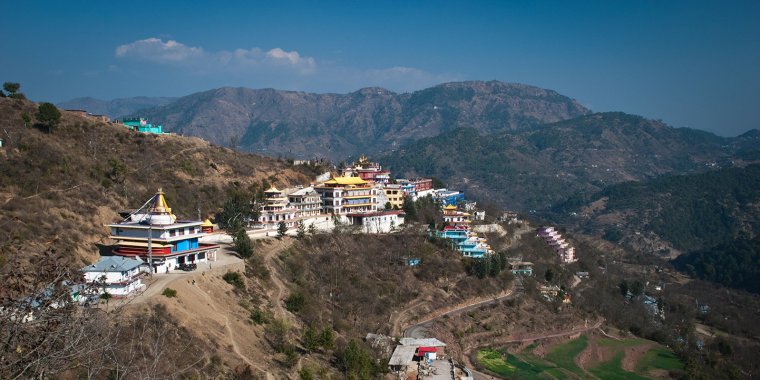
Menri Monastery, India (Feb 2016) Photo: Unpurrceivable/Wikipedia (CC BY-SA 4.0)
This traditional Tummo test is known as chure ("chu ras"), literally "wet cotton cloth".
Before the test, the seven nuns practiced for 100 days according to the instructions of Shardza Tashi Gyaltsen, the "Burning Mass of the Fire of Wisdom" which includes sets of traditional movements called trulkhor ("khrul 'khor") in Tibetan and yantra in Sanskrit.
The special method used in the Bön tradition here is to sew the cotton cloth that must be dried into a sack. In Buddhist traditions the cotton cloth is not in sack form but must have certain dimensions.
Geshe or geshema is a Tibetan religious academic degree for monks and nuns. The degree is mainly emphasized by the Gelug lineage, but is also awarded in the Sakya and Bön traditions. The geshema degree is awarded to nuns.
Geshe courses typically include the study of Abhidharma texts (Abhidharma Samuccaya by Asanga and Abhidharma Kośa by Vasubandhu), Prajñā Pāramitā (Abhisamayālaṃkāra by Maitreya, Bodhisattvacaryāvatāra by Śāntideva), Madhyamaka (Mūlamadhyamakakārikā by Nāgārjuna, Catuḥśataka by Āryadeva, Madhyamakāvatāra by Candrakīrti and Madhyamakālaṃkāra by Śāntarakṣita), Pramāṇa (Pramāṇavarttika by Dharmakīrti and Pramāṇasamuccaya by Dignāga), and Vinaya (Vinaya-mūla-sūtra by Pandita Gunaprabha).
The curriculum for the geshe degree is an adaptation of the subjects studied at the famous Indian Buddhist monastic university at Nālandā.
Menri Monastery ("medicine mountain") is the name of a Bon monastery in Tibet, that was later refounded in India.
The first Menri monastery was founded in 1072 as Yéru Wensakha Monastery, on the slopes of Mount Shari Phowa in Topgyel, Tsang, Tibet. It was destroyed by a flood in 1386.
The name Menri derives from the therapeutic herbs and springs on that mountain. Menri has become the main Bon monastery in the Tibetan cultural region. The abbot of Menri is recognized as the spiritual leader of Bon.
The second Menri monastery was founded in 1405 by Nyammé Shérap Gyeltsen.
In 1967, Menri was refounded for the third time, at Dolanji in Himachal Pradesh, India, by Lungtok Tenpai Nyima and Lopön Tenzin Namdak. This monastery recreated the geshe training program and is home to over two hundred monks.
YOU MAY ALSO LIKE