| / Terms, Glossaries, Dictionaries |
Vesak
Vesak, often referred to as "Buddha Day," is the most significant and holiest festival in the Buddhist calendar.
While various Buddhist traditions celebrate holidays throughout the year, Vesak is unique because it commemorates a "Triple Blessing"—the birth, the enlightenment, and the passing (Parinirvana) of Siddhartha Gautama, the Buddha.
To millions of Buddhists worldwide, Vesak is not just a day of celebration but a day of profound reflection, merit-making, and the renewal of one's commitment to the path of compassion and wisdom.
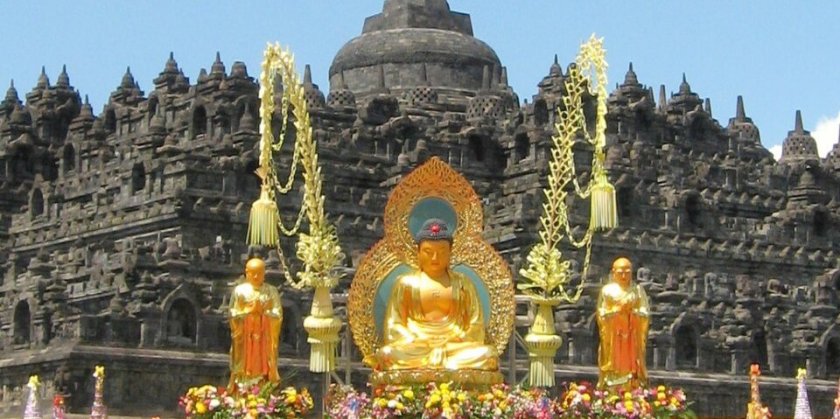
Borobudur on Vesak Day. Photo: pwbaker/wikipedia/flickr
The Full Moon of May
Vesak takes its name from the Sanskrit month Vaishakha (Pali: Vesakha). The timing is based on the lunar calendar, falling on the full moon day of the fourth lunar month. In the Gregorian calendar, this almost always falls in May.
The full moon is significant in Buddhism because many of the pivotal moments in the Buddha’s life occurred under the light of a full moon. It is believed that the lunar energy heightens spiritual practice and reflection.
The Three-Fold Significance
What makes Vesak extraordinary is the belief (primarily in the Theravada tradition of Sri Lanka and Southeast Asia) that all three major milestones of the Buddha’s life happened on the same day of the year:
The Birth: Prince Siddhartha was born in the Lumbini Grove (modern-day Nepal) over 2,500 years ago on the full moon of May.
The Enlightenment: After six years of searching, Siddhartha attained supreme enlightenment under the Bodhi tree in Bodh Gaya, India, on the full moon of May.
The Passing (Parinirvana): At the age of 80, the Buddha passed away in Kushinagar, India, also on the full moon of May.
How Vesak is Observed
The atmosphere of Vesak is distinct from many other religious festivals. It is characterized by a "quiet joy." There are no loud fireworks or rowdy parties; instead, the focus is on peace, internal reflection, and acts of kindness.
Devotional Practices
On the morning of Vesak, Buddhists gather at temples before dawn. They dress in simple white clothing (a symbol of purity) and participate in:
Hoisting the Buddhist Flag: A five-colored flag representing the colors of the Buddha’s aura.
Chanting and Meditation: Monks and laypeople chant ancient Pali scriptures and engage in group meditation to calm the mind.
Listening to Dhamma Talks: Monks deliver sermons on the Buddha's life and how to apply his teachings to modern challenges.
Bathing the Buddha
Is a very popular ritual, especially in Mahayana traditions (like those in China, Korea, and Vietnam).
A small statue of the infant Siddhartha—with one hand pointing to the sky and one to the earth—is placed in a basin of water decorated with flowers. Devotees pour water over the statue.
This symbolizes the cleansing of one’s own "inner dust" (greed, hatred, and delusion) and commemorates the legend that heavenly beings poured perfumed water over the Buddha at his birth.
Making Merit (Dana)
Vesak is a day of extreme generosity. It is believed that any good deed performed on Vesak earns "merit" many times over.
Charity: People distribute free food, drinks, and clothes to the poor and the elderly.
Vegetarianism: Many Buddhists abstain from eating meat on Vesak as a gesture of "Ahimsa" (non-violence) toward all living beings.
Life Release: In some cultures, birds, insects, or fish are purchased and released into the wild. This symbolises the Buddha’s teaching on the liberation of all beings from suffering.
The Symbolism of Light
As the sun sets on Vesak, the most beautiful part of the festival begins: the lighting of lamps. Temples and homes are decorated with thousands of small oil lamps or colorful paper lanterns.
This light symbolizes the Buddha’s enlightenment—the "Light of Wisdom" that dispels the "Darkness of Ignorance."
In countries like Thailand and Indonesia, thousands of monks and laypeople walk clockwise around a stupa or temple three times, holding a candle, three incense sticks, and a lotus bud.
While the core meaning is the same, Vesak looks different depending on the country:
Sri Lanka: The streets are filled with Vesak Koodu (massive, intricate bamboo lanterns) and Pandols—giant, electrically lit displays that tell stories from the Buddha’s past lives (Jataka tales).
South Korea: The "Lotus Lantern Festival" (Yeon Deung Hoe) features a massive parade through Seoul with giant floats shaped like dragons and lotus flowers.
Indonesia: Thousands of people gather at Borobudur, the world’s largest Buddhist temple. At the climax of the night, "sky lanterns" are released into the air, carrying prayers for world peace.
Japan: Known as Hanamatsuri (Flower Festival), it is celebrated on April 8th and focuses specifically on the Buddha’s birth, with shrines decorated with cherry blossoms.
Universal Recognition
In 1999, the United Nations officially recognized Vesak Day to acknowledge the contribution that Buddhism—one of the oldest religions in the world—has made for over two and a half millennia and continues to make to the spirituality of humanity.
It is now observed annually at the UN headquarters and offices worldwide.
Vesak is a reminder of the Buddha’s core message: that every human being has the potential to be awakened. It is a day to practice Metta (loving-kindness) not just toward friends and family, but toward all living creatures.
As the lanterns flicker in the night, the message of Vesak remains clear: "Be a light unto yourself."
YOU MAY ALSO LIKE