
| / Tipiṭaka / Tipiṭaka (English) |
Introduction
Aṅguttara Nikāya, or The Incremental Suttas Collection, is the fourth collection of Suttas from the Sutta Piṭaka (The Basket of Suttas) of the Pāli Tipiṭaka (The Canon of Theravada Buddhism, litt. The Three Baskets).
The Sutta Piṭaka comprises five Nikāyas or Collections of suttas:
• Dīghanikāya, The Long Suttas Collection;
• Majjhima Nikāya, The Middle-Length Suttas Collection;
• Saṁyuttanikāya, The Related Suttas Collection;
• Aṅguttaranikāya, The Incremental Suttas Collection;
• and the Khuddakanikāya, The Miscellaneous Collection, that comprises 19 distinct works, including the Dhammapada, Udāna, Jātaka, Milindapañha etc.
The Pāli Suttas Through The Ages: The Theravada Buddhist Councils
According to tradition, the suttas in the Sutta Piṭaka (or, more likely, most of the suttas in the first four Nikāyas, and some of the suttas in the Khuddakanikāya) were chanted by Ananda in the presence of about 500 bhikkhus, three months after the Parinibbana of the Buddha.
These suttas are generally thought to represent the actual words of the Buddha, in the language he spoke, a Middle Indo-Aryan language now known as Pāli.
The event, known as the First Buddhist Council, also included the chanting of the Vinaya Piṭaka (The Basket of Discipline) by another bhikkhu, Upali.
For about five centuries after the Parinibbana of the Buddha in 544 BCE (or 483 BCE, according to the dating of some European scholars), the suttas have been transmitted orally.
During this period, a few suttas have been added to the already existing collections; entire new works have been added to the Miscellaneous Collection (Khuddakanikāya), such as the Milindapañhapāḷi (The Questions of The King Milinda, -- identified with The Greek King Menander of Bactria, who reigned from about 155 BCE to about 130 BCE); a third Piṭaka was added, The Abhidhammapiṭaka, or The Basket of Higher Teachings; and two other Buddhist Councils have been held, The Second and The Third Buddhist Council, to resolve disagreements over the doctrine and the code of discipline.
After the Third Buddhist Council, the Pāli Tipiṭaka was carried, in oral form, from Northern India to Sri Lanka by buddhist monks sent by King Ashoka. According to the Sri Lankan Chronicle Mahavamsa, they arrived in Sri Lanka during the reign of Devanampiya Tissa of Anuradhapura (307–267 BCE).
In 29 BCE, in Sri Lanka took place the Fourth Buddhist (Theravada) Council, and The Pāli Tipiṭaka was written down on palm leaves.
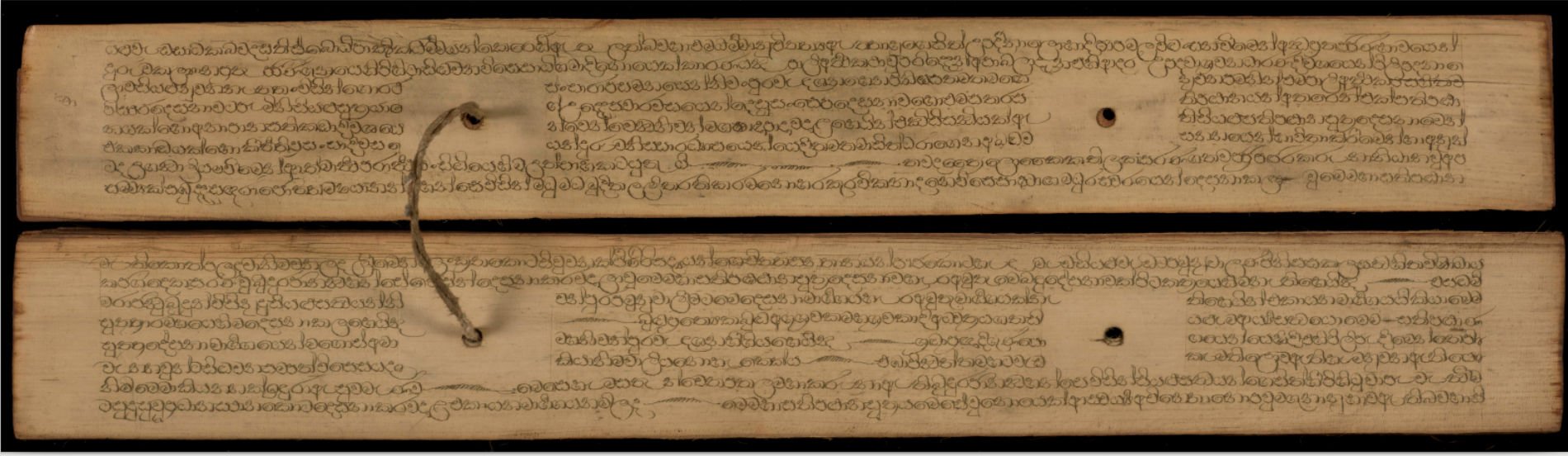
Sinhalese palm leaf manuscript of the Mahāsatipaṭṭhānasutta, from the collection of T.W. Rhys Davids. Photo: The University of Manchester Library
In 1871 AD, in the reign of King Mindon of Burma, the Fifth Buddhist council took place in Mandalay, in present-day Myanmar. Over five months, 2,400 burmese monks recited all the teachings of the Buddha according to the Theravada Pali Canon.
King Mindon had already commissioned the inscribing of the entire Pāli Tipitaka, in Myanmar script, on both sides of 729 marble slabs.
Each stone slab is 1.07 metres wide, 1.53 metres tall and 13 centimetres thick, and they are housed in miniature pagodas in the grounds of the Kuthodaw Pagoda at the foot of Mandalay Hill in Myanmar (Burma).
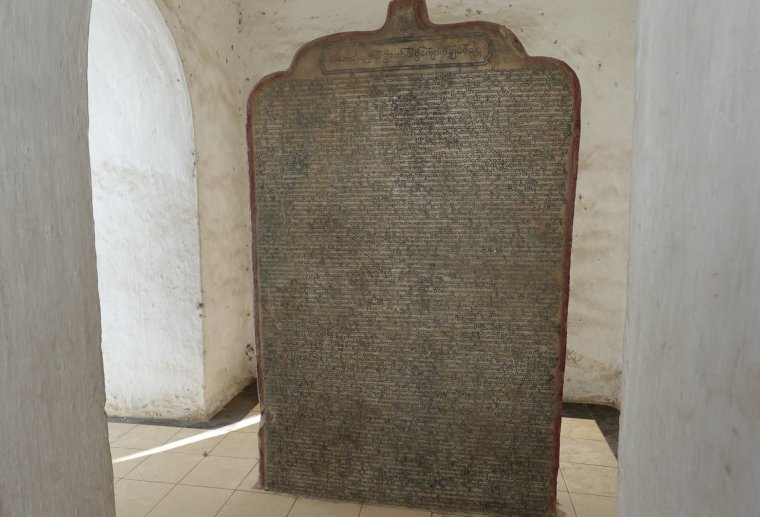
One of the 729 marble slabs with the text of the Pāli Tipitaka in Myanmar script, at the Kuthodaw Pagoda. Photo: Richard Mortel / Wikipedia.
Began in 1860 and completed in 1868, the marble Pāli Tipitaka is the world's largest book that stands to this day.
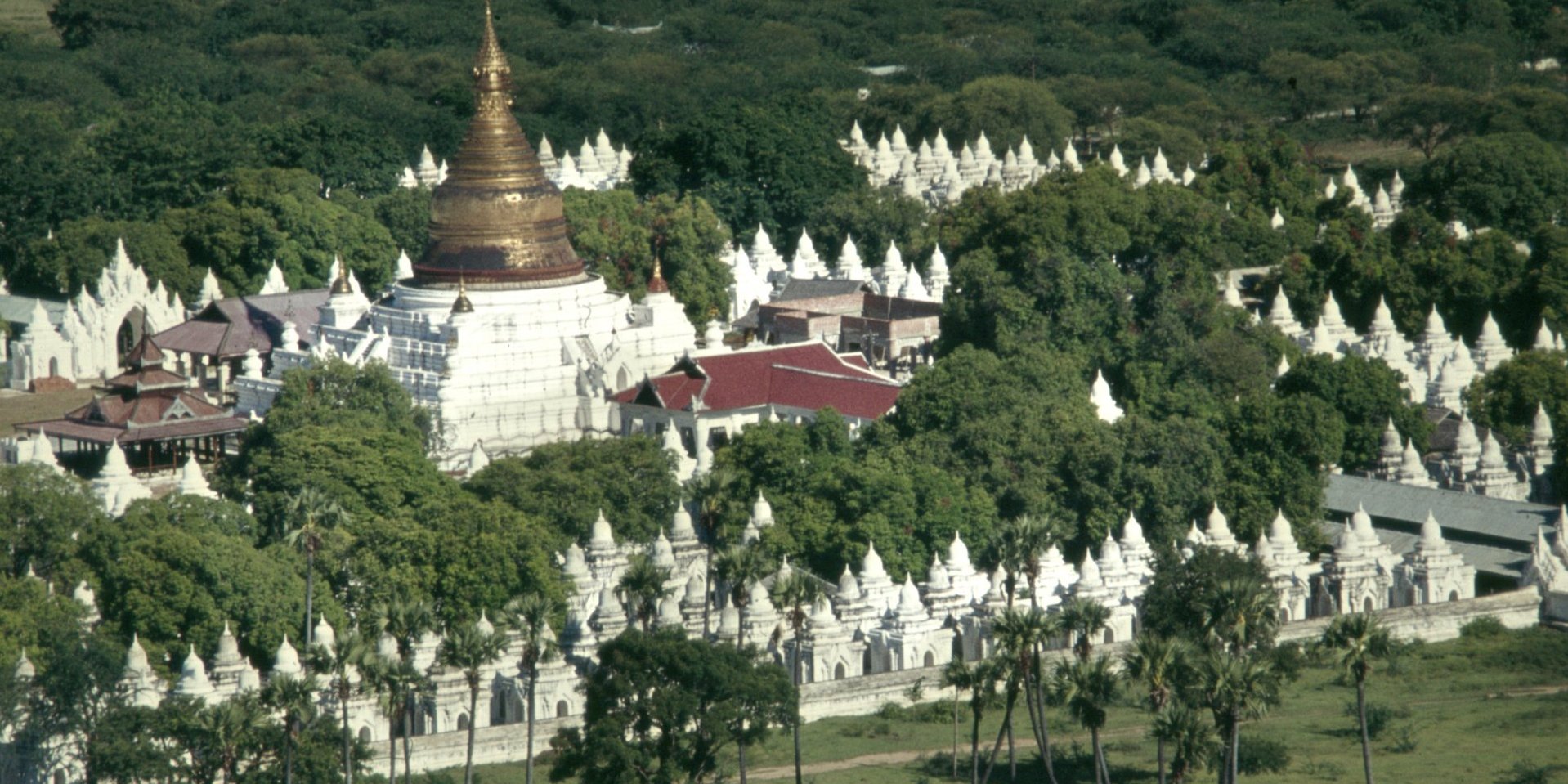
The Pāli Tipitaka inscribed on stone slabs, in Myanmar script, is the largest book in the world. Each stone slab is housed in a miniature pagoda. Photo: Gerd Eichmann / Wikipedia.
This project seems to have brought good luck to King Mindon. In 1866 two of Mindon's sons attempted a palace coup. The brother of the king was murdered during the revolt, but Mindon escaped alive and the coup was crushed. While Mindon was escaping the palace, he ran into a would-be assassin, who lost his nerve and grovelled in front of the king. Mindon commanded him to carry him from the palace, which he promptly did.
The Sixth Buddhist Council And The Chattha Sangayana Edition
Between 1954 and 1956, a Sixth Buddhist Council (Chaṭṭha Saṅgāyana) took place in Yangon, Burma.
The council was attended by 2,500 Theravadan Elders who came from eight different countries, (Myanmar, Cambodia, India, Laos, Nepal, Sri Lanka, Thailand and Vietnam).
A temple in Japan also sent delegates. Two Western monks attended, too: the German-born, Sri-Lanka-residing Ven. Nyanatiloka and Ven. Nyanaponika.
The Council lasted from Vesak (17 May) 1954 to Vesak (24 May) 1956, its completion coinciding with the 2500th anniversary of the Gautama Buddha's Parinibbāna according to traditional Theravada dating.
Over the two-year period, the monks from different countries recited from their existing redaction of the Pāli Canon and the associated post-canonical literature.
As a result, the Council synthesized a new redaction of the Pali texts, a critical edition with notes showing the differences between the texts preserved in each Theravada country.
This critical edition was then transcribed into several native scripts and is known as The Chaṭṭha Saṅgāyana edition.
The Vipassana Research Institute founded by S. N. Goenka in Igatpuri, Maharashtra, India, digitized The Chattha Sangayana edition (the Burmese script version), and converted it into Devanagari and other scripts.
The Chaṭṭha Saṅgāyana Tipiṭaka in 14 scripts (including Devanagari, Sinhala, Thai, Myanmar and IAST Transliteration in Latin script) has been available online on The Titi Tudorancea Bulletin in the Library section since 2019.
The Mahāsaṅgīti Tipiṭaka Edition
Revising the 1958 Sixth Council Edition with other editions to remove all printing and editorial errors, a charitable organisation from Thailand, the Dhamma Society Fund, founded in 1997 by M.L. Maniratana Bunnag (1923–2000), Lady-in-Waiting to Her Majesty Queen Sirikit of Thailand, has published a Roman-script edition in 40 volumes called "The Mahāsaṅgīti Tipiṭaka Buddhavasse 2500 Edition", or in short "The World Tipiṭaka Edition".
Comparing by random sampling two suttas from The Chaṭṭha Saṅgāyana Tipiṭaka against the corresponding two suttas from The Mahāsaṅgīti Tipiṭaka, we found them to be nearly identical.
Only the following minor differences were found:
- The Mahāsaṅgīti Edition uses the letter "ṁ" wherever The Chaṭṭha Saṅgāyana has an "ṃ" (and where The Pali Text Society edition has a letter not present in the IAST transliteration, "ɱ"). The IAST transliteration of the corresponding character from The Mahāsaṅgīti Edition in Devanagari script is actually "ṁ" too. In the Pāli, the corresponding sound is pronounced as "ng". Both character choices for that sound have advantages and disadvantages: while "ṁ" allows direct representation in Devanagari script, "ṃ" suggests a different pronounciation compared to "ṁ" from Sanskrit.
- Only one letter of one word was actually different, an "u" in one edition, versus an "ū" in the other ("abhibhuto" in The Mahāsaṅgīti Edition vs. "abhibhūto" in The Chaṭṭha Saṅgāyana Edition).
- The breaking of the text into paragraphs sometimes differs.
- There were two occurences of the apostrophe being placed one character to the left in one edition, versus the other (for example, "mūlan’ti" in The Mahāsaṅgīti Edition vs. "mūla’nti" in The Chaṭṭha Saṅgāyana Edition).
- The title of the suttas in The Mahāsaṅgīti Edition has the final "ṃ" removed (for example, Mūlapariyāyasutta in The Mahāsaṅgīti Edition vs. Mūlapariyāyasuttaṃ in The Chaṭṭha Saṅgāyana Edition).
This Bilingual Pāli-English Edition of The Suttas
Despite minor differences between different editions, the Pāli text, handed down through 2.5 millenia and traditionally considered to include the original words of The Buddha, in the ancient Indo-Aryan language he spoke, is the authoritative text of the Aṅguttara Nikāya.
The Pāli text of this bilingual edition of the Majjhima Nikāya is based on The Mahāsaṅgīti Tipiṭaka.
The English translation, provided here as an aid to understanding the original Pāli text, is based on the translation made by Bhikkhu Sujato, with about 17.300 lines corrected in the main four Nikāyas, to use what we consider to be preferable English renderings of some of the Pāli terms.
Bhikkhu Sujato (born Anthony Best), is an Australian Theravada Buddhist monk ordained into the Thai forest lineage of Ajahn Chah. Before being ordained, Anthony Best was a musician with the Australian band "Martha's Vineyard".
Bhikkhu Sujato made this translation between 2016–2018 while he was staying in Qimei, Taiwan, and dedicated it to the public domain via a Creative Commons Zero (CC0) license.
As the terms of the Creative Commons Zero license allow making changes to the text, in this edition we have applied a number of terminology changes, described below, to Bhikkhu Sujato's original translation.
As in the English language there is no word with the exact meaning of the Pāli term "bhikkhu", "Nibbana", "jhāna", etc. and lately they have started to spread in the West as such, in such cases, we preferred to use the Pāli word "as is".
1. Pāli word: Aṅguttara Nikāya
Original translation: Numbered Discourses
Revised translation: The Incremental Suttas Collection
Note: Nikāya means collection or category. In this case, it is a collection of similar suttas. Aṅguttara means incremental (greater by one).
2. Pāli word: bhikkhu
Original translation: mendicant
Revised translation: bhikkhu
3. Pāli word: Nibbana
Original translation: extinguishment
Revised translation: Nibbana
4. Pāli word: jhāna
Original translation: absorption
Revised translation: jhāna
5. Pāli word: āvuso
Original translation: reverend
Revised translation: friend
6. Pāli word: Uposatha
Original translation: sabbath
Revised translation: Uposatha (day)
7. Pāli word: savitakkaṁ savicāraṁ
Original translation: while placing the mind and keeping it connected
Revised translation: while thougths are being born and sustained analysis is going on
8. Pāli word: avitakkaṁ avicāraṁ
Original translation: without placing the mind and keeping it connected
Revised translation: without thougths being born and without sustained analysis going on
9. Pāli word: pīti
Original translation: rapture
Revised translation: (mental) joy
10. Pāli word: sukha
Original translation: bliss
Revised translation: (bodily) pleasure
11. Pāli word: kāyasaṅkhāraṁ
Original translation: the physical process
Revised translation: the habitual functioning patterns of the body
12. Pāli word: cittasaṅkhāra
Original translation: mental processes
Revised translation: the habitual functioning patterns of the mind
13. Pāli word: vacīsaṅkhāra
Original translation: verbal processes
Revised translation: the habitual functioning patterns of the speech
14. Pāli word: saṅkhāra
Original translation: choices
Revised translation: functioning patterns
15. Pāli word: parimukhaṁ
Original translation: in front of him/them
Revised translation: around the opening (of the nostrils) -- when related to mindfulness on breathing
Note: Mukhaṁ means "face", "mouth" or "opening" and pari means "around". When praticing mindfulness on breathing some people may also feel the breath on the upper lip.
16. Pāli word: paṭisaṁvedī
Original translation: experiencing
Revised translation: feeling deeply
Note: In the context of meditation practice, feeling deeply suggests a heightened level of sensitivity and awareness, allowing one to fully experience a particular sensation or state of mind.
17. Pāli word: ānupassī
Original translation: observing
Revised translation: watching, again and again,
18. Pāli word: samādhi
Original translation: immersion
Revised translation: samādhi
19. Pāli word: sampajañña
Original translation: situational awareness
Revised translation: focused awareness
20. Pāli word: nimittā
Original translation: foundation
Revised translation: (meditation) object; cause
21. Pāli word: khattiya
Original translation: aristocrat
Revised translation: khattiya class person; khattiya
Note: The khattiya caste, or warriors' caste, was the caste from which the raja (king) was chosen.
YOU MAY ALSO LIKE

