| / Terms, Glossaries, Dictionaries |
Samskaras
In Indian religions (Hinduism, Buddhism and Jainism), Samskaras (or Sanskaras) have two main meanings: they are both rites of passage that mark the stages of life, and subconscious mental impressions that shape our character and habits.
Sacraments and Rites of Passage (Shodasha Samskaras)
In Hinduism, there are traditionally 16 main samskaras (known as Shodasha Samskaras) that purify and sanctify the life of the individual from conception to death.
Before birth
Garbhadhana: The ritual for a conscious conception.
Pumsavana: Prayers for the health of the fetus.
Simantonnayana: A ritual similar to a "baby shower", intended to bring joy to the mother during pregnancy.
Childhood
Jatakarma: The ceremony celebrating the birth.
Namakarana: The ritual of naming the child.
Annaprashana: The first meal of solid food (usually rice).
Chudakarana (Mundan): The first cutting of hair, symbolizing purification.
Education and Maturity
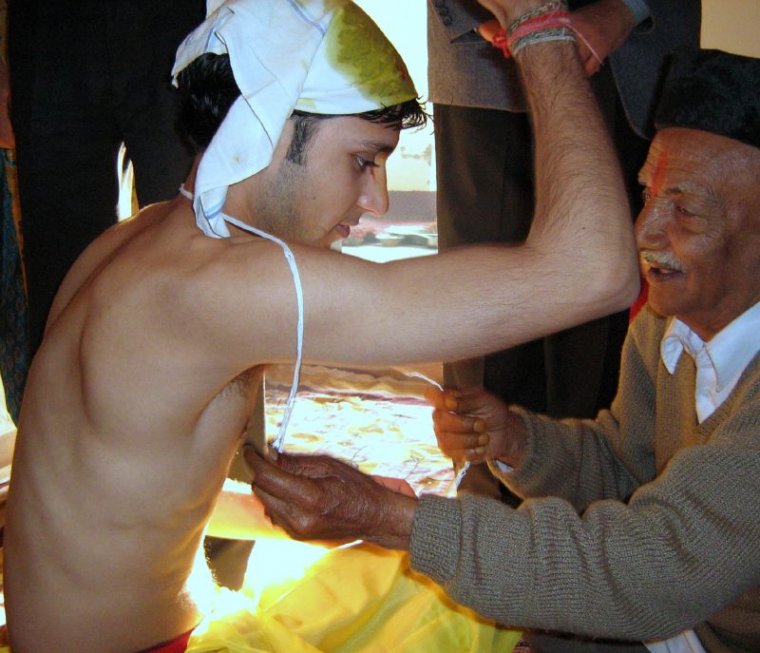
Upanayana is the initiation of a child, youth or adult into formal education process, particularly of ancient Sanskrit texts such as Vedas, Upanishads and Smritis. The wearing of thread, from left shoulder side flowing down towards the right is part of the ceremony. Photo: Vinodbahal, Shimla, India/Wikipedia
Upanayana: The sacred thread ritual, marking the beginning of spiritual education.
Vidyarambha: The beginning of learning the alphabet and basic knowledge.
Vivaha: Sacred marriage, considered one of the most important samskaras.
End of life
Antyeshti: The last rites and cremation, which mark the return of the body to the five elements.
Psychological concept (mental impressions)
Samskaras (Sanskrit: saṁskāra) are deep mental impressions, psychological imprints, or conditioning patterns formed by past thoughts, actions, and experiences. The concept comes primarily from Indian philosophical traditions such as Hinduism, Buddhism, and Jainism.
Philosophically, samskaras are the subconscious imprints left by every thought, action, or intention.
These impressions act as channels in the mind. The more we repeat an action, the deeper the channel becomes, turning into a habit or personality trait.
Samskaras are considered the basis of the theory of karma. They are the seeds that, when activated by circumstances, determine our automatic reactions and shape our future destiny.
Yoga and meditation practices aim to bring these subconscious impressions to the conscious level, allowing us to replace negative samskaras (which lead to suffering) with positive ones (which lead to clarity and peace).
In spiritual psychology
• Every thought, emotion, or action leaves a subtle imprint in the mind.
• These imprints shape habits, tendencies, preferences, fears, and reactions.
• Over time, repeated patterns become strong behavioral conditioning.
For example:
Repeated anger → forms an anger samskara.
Repeated compassion → forms a compassion samskara.
Trauma → forms fear-based samskaras.
These impressions influence future behavior—often unconsciously.
In traditions like Yoga (especially in the Yoga Sutras), samskaras are said to reside in the subconscious and drive karma and rebirth.
Samskaras in other religions
Buddhism: For Samskaras in Buddhism see Saṅkhāra in Buddhism
Jainism: Recognizes rituals similar to Hindu ones, but with their own theological meanings, related to the liberation of the soul from karmic residues.
Sikhism: Although it does not use the entire set of 16, it recognizes essential rituals such as Naam Karan (naming) and Anand Karaj (marriage).
YOU MAY ALSO LIKE