
Hindu Festivals in India
India is a land of incredible diversity, and this is vividly reflected in its festivals. Hindu festivals are generally tied to the lunisolar Hindu calendar, meaning their exact dates on the Gregorian calendar change from year to year.
They celebrate agricultural harvests, seasonal changes, and stories from Hindu mythology—including epics like the Ramayana and the Mahabharata.
Because there are hundreds of festivals, the best way to understand them is by grouping them into major nationwide celebrations, deity-specific festivals, harvest festivals, and celebrations of family bonds.
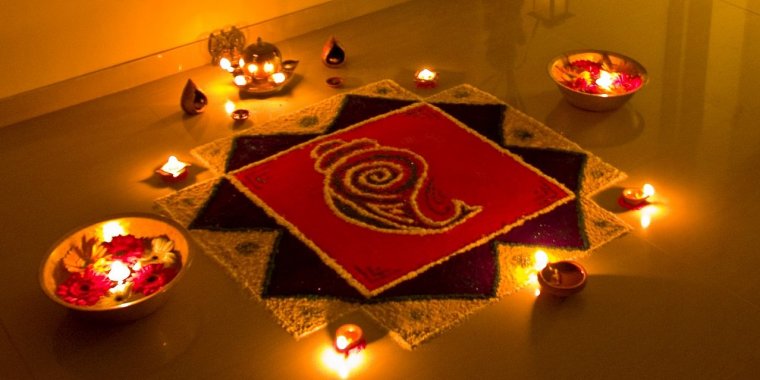
The Rangoli of Lights. Photo: Subharnab Majumdar/ Wikipedia
Here is a guide to the major Hindu festivals in India:
The "Big Three" Pan-Indian Festivals
These are the most widely celebrated festivals across the subcontinent, though the specific customs and regional names vary wildly.
Diwali (Deepavali) - The Festival of Lights: Usually October/November
It signifies the spiritual victory of light over darkness, good over evil, and knowledge over ignorance.
In North India, it celebrates Lord Rama’s return to his kingdom of Ayodhya after 14 years of exile and defeating the demon king Ravana. In South India, it often commemorates Lord Krishna's victory over the demon Narakasura.
People clean their homes, decorate with oil lamps (diyas) and colorful rangoli (floor art), burst firecrackers, share sweets, and pray to Lakshmi, the Goddess of Wealth.
Holi - The Festival of Colors: Usually March (marking the arrival of spring).
A joyous celebration of spring, love, and new life. It is famous for people throwing colored powder (gulal) and water at each other in the streets.
It commemorates the burning of the demoness Holika, who tried to kill her devout nephew Prahlad, symbolizing the triumph of true devotion. It is also deeply associated with the divine love of Lord Krishna and Radha.
Navratri, Dussehra, and Durga Puja: Usually September/October
A massive nine-night (Navratri) and ten-day (Dussehra) festival celebrating the Divine Feminine and the victory of good over evil.
In North/West India (Navratri/Dussehra): People fast and perform traditional dances like Garba and Dandiya. On the 10th day (Dussehra), massive effigies of the demon Ravana are burned to celebrate Lord Rama's victory.
In East India (Durga Puja): Huge, elaborate public pavilions (pandals) are built housing beautiful clay idols of Goddess Durga slaying the buffalo-demon Mahishasura. On the last day, the idols are immersed in rivers.
Festivals Celebrating Specific Deities
Many festivals mark the birth or a major cosmic event associated with a specific god or goddess.
Krishna Janmashtami: Usually August/September
Celebrates the birth of Lord Krishna (the divine charioteer and guide from the Mahabharata).
Devotees fast until midnight (the time of his birth), sing devotional songs, and rock cradles containing infant Krishna idols. In Maharashtra, the Dahi Handi event involves human pyramids breaking pots of curd hung high in the streets, mimicking Krishna's childhood mischief of stealing butter.
Ganesh Chaturthi: Usually August/September
Celebrates the birth of Ganesha, the elephant-headed god of wisdom, prosperity, and the remover of obstacles.
Extremely popular in the state of Maharashtra. Clay idols of Ganesha are brought into homes and public pandals for 10 days of worship, music, and feasting, ending with grand, loud processions to immerse the idols in water bodies (Visarjan).
Maha Shivaratri - The Great Night of Shiva: Usually February/March
It marks the night Lord Shiva performed the heavenly dance of creation, preservation, and destruction (the Tandava), and also marks his marriage to Goddess Parvati.
A solemn, spiritual festival. Devotees stay awake all night chanting prayers, fasting, and offering milk, water, and bael leaves to the Shiva Lingam.
Rama Navami: Usually March/April
Celebrates the birth of Lord Rama (the seventh avatar of Vishnu and hero of the Ramayana).
Marked by reading the Ramayana, singing bhajans (hymns), and chariot processions.
Harvest and Seasonal Festivals
Because India has a deep agrarian history, the cycles of the sun and the harvesting of crops are deeply sacred.
Makar Sankranti / Pongal / Lohri / Bihu: Mid-January (One of the few Hindu festivals determined by the solar cycle rather than lunar, falling on Jan 13/14/15).
Marks the transition of the sun into the zodiac sign of Capricorn (Makara) and the end of the winter solstice.
It is celebrated differently across India:
Makar Sankranti (North/West India): Famous for massive kite-flying festivals and eating sesame-jaggery sweets.
Pongal (Tamil Nadu): A four-day harvest festival where newly harvested rice is boiled in milk and jaggery.
Lohri (Punjab/North India): Celebrated with bonfires, singing, and dancing to mark the winter harvest.
Magh Bihu (Assam): Features feasts and bonfires.
Onam: Usually August/September
The biggest festival in the southern state of Kerala. It is a harvest festival that also celebrates the annual homecoming of the legendary, benevolent demon-king Mahabali.
Features intricate flower carpets (Pookkalam), grand vegetarian feasts served on banana leaves (Sadya), and thrilling snake-boat races.
Vasant Panchami: Usually late January/February
Marks the preliminary preparations for spring. It is dedicated to Saraswati, the Goddess of Knowledge, Music, and Art.
People wear yellow (symbolizing the blooming mustard fields), and children are often taught to write their first words on this day.
Festivals Celebrating Relationships
Raksha Bandhan: Usually August
Celebrates the bond of protection and love between brothers and sisters.
Sisters tie a sacred, decorative thread (Rakhi) around their brothers' wrists, praying for their long life. In return, brothers give gifts and vow to protect their sisters.
Karwa Chauth: Usually October/November
Primarily observed in North India. Married women undertake a strict fast from sunrise to moonrise for the safety, longevity, and prosperity of their husbands.
Women dress in beautiful bridal colors, apply henna, and break their fast only after seeing the moon through a sieve and then looking at their husbands.
Because the Hindu calendar uses a system of 'tithis' (lunar days), festivals can sometimes span two days on the Western Gregorian calendar, and the exact date depends heavily on the phases of the moon.
