| / Buddhism |
Buddhist Festivals
Buddhist festivals, much like Hindu ones, are predominantly tied to the lunar calendar, meaning their dates shift each year on the Gregorian calendar.
However, because Buddhism spread across vastly different cultures—forming three major branches: Theravada (South/Southeast Asia), Mahayana (East Asia), and Vajrayana (Tibet/Himalayas)—the festivals vary significantly depending on the region.
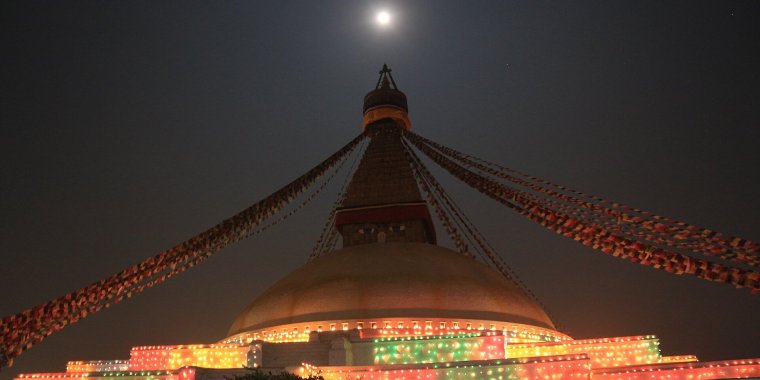
Bouddhanath Stupa. Photo: Bijaya2043/Wikipedia
Vesak (Buddha Purnima or Buddha Day).
This is the most important festival in Buddhism. While traditions vary, this festival is recognized in almost every Buddhist culture worldwide. Usually May (on the day of the first full moon).
For most traditions (especially Theravada), it commemorates three major events in the life of Siddhartha Gautama that all occurred on the same lunar date: his Birth, his Enlightenment (Nirvana), and his Passing Away (Parinirvana).
Devotees visit temples early in the morning, chant sutras, and make offerings of flowers, candles, and incense. Many practice vegetarianism on this day.
In East Asia, a common ritual is "Bathing the Buddha," where fragrant water is poured over a small statue of the infant Buddha.
In countries like Sri Lanka and Indonesia, massive, colorful paper lanterns are lit to symbolize the light of enlightenment.
Major Theravada Festivals (South & Southeast Asia)
These festivals are heavily observed in countries like Sri Lanka, Thailand, Myanmar, Cambodia, and Laos, focusing heavily on the Buddha's historical life and the monastic community.
Asalha Puja (Dharma Day): Usually July (full moon day).
It commemorates the Buddha’s very first teaching after his enlightenment, delivered at the Deer Park in Sarnath, India. This sermon, known as "Setting the Wheel of Dhamma in Motion," introduced the Four Noble Truths.
Monks give sermons, and laypeople visit temples to listen to the teachings, meditate, and make offerings. It also marks the beginning of the Vassa (Rains Retreat).
Vassa (The Rains Retreat) and Kathina: Vassa runs from July to October (during the monsoon season). Kathina occurs in October/November at its conclusion.
Vassa is a three-month period where monks remain inside their temples for intensive meditation, a tradition dating back to the Buddha's time to prevent monks from trampling crops during the monsoon.
At the end of Vassa, the Kathina festival takes place. It is a joyful time for laypeople to express gratitude to the monks by offering them new robes and basic supplies. It is the largest alms-giving ceremony of the Buddhist year.
Magha Puja (Sangha Day): Usually February or March (full moon day).
Celebrates a historic gathering where 1,250 enlightened disciples (arahants) spontaneously came to see the Buddha without being summoned.
The Buddha delivered the Ovadapatimokkha, laying down the core principles of Buddhism: cease doing evil, cultivate good, and purify the mind.
Characterized by large, beautiful candlelight processions (Wian Tian) where devotees walk clockwise around the main shrine of a temple three times, representing the Buddha, the Dharma, and the Sangha.
Major Mahayana Festivals (East Asia)
Celebrated predominantly in China, Japan, Korea, and Vietnam, these traditions sometimes split the events of Vesak into separate days and incorporate local cultural practices regarding ancestors.
Bodhi Day (Rohatsu in Japan): Usually December 8th (or the lunar equivalent in late Dec/Jan).
While Theravada Buddhists celebrate the Buddha's enlightenment during Vesak, Mahayana traditions dedicate this specific day to Siddhartha Gautama sitting under the Bodhi tree and attaining awakening.
It is observed quietly. Zen Buddhists, in particular, engage in an intense week-long meditation retreat (sesshin), staying awake the entire night before Bodhi Day to emulate the Buddha's final push toward enlightenment.
Parinirvana Day (Nirvana Day): Usually February 15th.
Commemorates the death of the historical Buddha and his attainment of final Nirvana (freedom from the cycle of rebirth).
A solemn day of reflection on the impermanence of life. Buddhists read passages from the Nirvana Sutra, meditate on death and mortality, and often prepare traditional foods or go on retreats.
Ullambana / Obon (The Ghost Festival): Usually August or September.
Deeply rooted in Mahayana texts, it is a time when the realms of heaven, hell, and the living are believed to open. It focuses on filial piety (respect for parents and ancestors) and relieving the suffering of deceased spirits (hungry ghosts).
In Japan (Obon), people return to ancestral family places, clean graves, and perform traditional dances (Bon Odori). Floating lanterns are placed on rivers to guide ancestral spirits back to the spiritual realm.
In Chinese traditions, food offerings and "ghost money" are burned to appease wandering spirits.
Major Vajrayana Festivals (Tibet, Bhutan, Nepal)
Tibetan Buddhism has a rich, highly ritualistic calendar tied to the Tibetan lunar cycle.
Losar (Tibetan New Year): Usually February or March.
A massive 15-day festival marking the start of the new year, blending Buddhist practice with pre-Buddhist Tibetan traditions.
The days leading up to Losar involve thoroughly cleaning homes to sweep away evil spirits from the old year. Monks perform spectacular Cham dances wearing elaborate masks to enact the victory of Buddhism over demonic forces.
Saga Dawa Duchen: Usually May or June.
This is the Tibetan equivalent of Vesak, celebrating the birth, enlightenment, and parinirvana of the Buddha. It is considered the most sacred month in the Tibetan calendar.
It is believed that the merit of any good deed (and the negative karma of any bad deed) is multiplied millions of times during this period. Devotees focus heavily on making prostrations, giving alms to the poor, circumambulating holy sites, and refraining from eating meat.
Lhabab Duchen: Usually October or November.
Celebrates the legend of the Buddha returning to earth from the Trāyastriṃśa heaven, where he had traveled for three months to teach the Dharma to his deceased mother, Queen Maya, to free her from Samsara.
Temples are newly painted, and ladders are sometimes drawn on rocks or temple walls to symbolize the Buddha's descent.
YOU MAY ALSO LIKE