| / Ashrams, Monasteries |
Phyang Monastery, Ladakh, India
Kagyu Tradition, 16th century, about 50 monks.
Phyang Monastery of Ladakh is about 17km West of the Leh town, at an elevation of 3590m, in the village of Fiang. It belongs to the Kagyu tradition, Drikung Lineage.
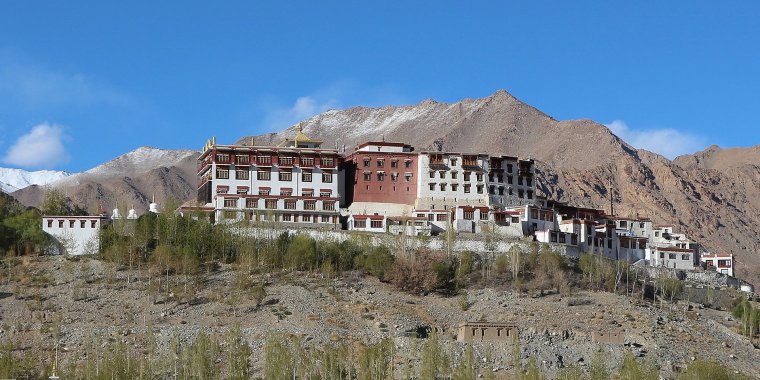
Phyang Monastery. Photo: Bernard Gagnon, Wikipedia.
Location
History
There are two versions regarding the establishment of Phyang Monastery.
According to one version “The site where the monastery now stands was once a part of the numerous monastic properties, offered during the time of Dharmaraja Jamyang Namgial to Chosje Damma Kunga. The hill of Phyang served as the venue of a monastery, known as Tashi Chozong, established in the year 1515.”
A monastic community was introduced to the monastery and with this started the first establishment of the Drikung teachings in Ladakh.
Another version states that Phyang monastery was established in the latter half of the 16th century by the ruler Tashi Namgyal.
There are several chronological difficulties in establishing events in Ladakh at this period and it is assumed that some names have been omitted from the Chronicle by mistake, or a deliberate attempt to eradicate some events which were thought to be better forgotten.
The monastery was the first one that introduced Jigten Sumgön’s1 teachings in Ladakh. The special protector of monastery is Achi Choki Dolma.2 The current reincarnation of Skyabje Toldan Rinpoche is the head lama of the monastery.
Features
The monastery has numerous sacred shrines, frescoes dating from the royal period, and a 900-year-old museum which has an extensive collection of idols including several fine Kashmiri bronzes, probably dating to the 14th century, thangkas, Chinese, Tibetan, and Mongolian firearms and other weapons.
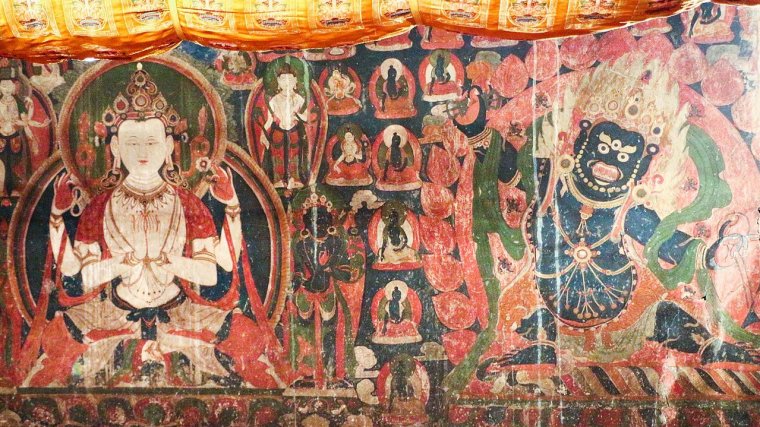
Fresco inside the monastery. Photo: Bernard Gagnon, Wikipedia.
Festivals
The Gang-Sngon Tsedup Festival is held annually from 17th day to 19th day of the first month of the Tibetan calendar. On the 2nd and 3rd day of the 6th month of the Tibetan calendar, Phyang serves as a venue for sacred dances.
Travel and Visiting
The best time to visit Phyang monastery is between May and September, when the weather is warm. Access to the area remains closed after November due to heavy snowfall.
Sources
• https://en.wikipedia.org
• http://www.buddhist-temples.com/buddhist-monastery/ladakh/phyang.html
Footnotes
1. Also known as Jigten Gönpo (1143–1217), the founder of the Drikung Kagyu lineage and main disciple of Phagmo Drupa Dorje Gyalpo (1110-1170), a disciple of Gampopa.
2. Achi Chökyi Drölma is the Dharma Protector (Dharmapāla) of the Drikung Kagyu school of Tibetan Buddhism. Achi Chokyi Drolma was the grandmother of Jigten Sumgön. She also appears as a protector in the Karma Kagyu refuge tree as Achi Chodron and is a dharmapāla and dakini in the life story of Tsasum Lingpa, a Nyingma tertön.
YOU MAY ALSO LIKE