| / Ashrams, Monasteries |
Taktsang Palphug Monastery, Bhutan
Nyingma, Kagyu Traditions, 15th century.
Paro Taktsang, also known as the Taktsang Palphug Monastery and the Tiger's Nest, is a sacred Vajrayana Himalayan Buddhist site, a spiritual and cultural icon of the kingdom of Bhutan, and a popular touristic attraction.
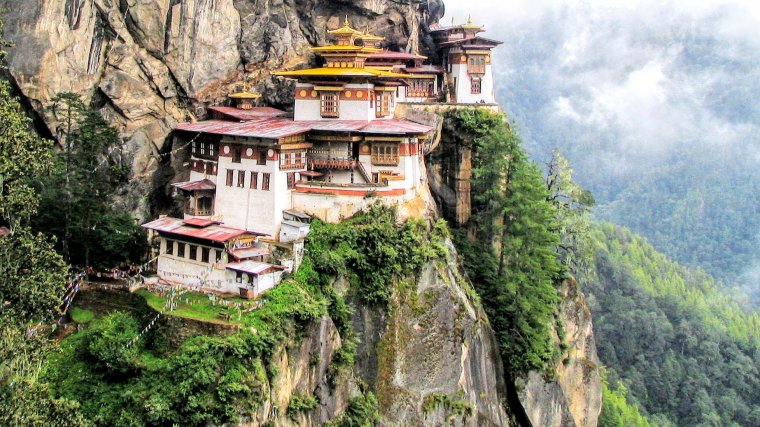
Paro Taktsang Monastery. Photo: Douglas J. McLaughlin, Wikipedia.
Location
Paro Taktsang is located 10 kilometers to the north of Paro town and hangs on a precarious cliff at 3120 meters altitude, about 900 meters above the Paro valley.
Though it looks formidable, the monastery complex has access from several directions, such as the northwest path through the forest, from the south along the path used by devotees, and from the north, over the rocky plateau, which is called the “Hundred Thousand Fairies.”
A mule track leading to it passes through pine forest that is colorfully festooned with moss and prayer flags.
On the approach path to the monastery, there is a Lakhang (village level monastery) and a temple of Urgyan Tsemo which, like the main monastery, is located on a rocky plateau with a precipitous projection of several hundred feet over the valley.
From this location, the monastery’s buildings are on the opposite ravine, which is known by the name “Copper-Colored Mountain Paradise of Padmasambhava”.
This is the view point for visitors and there is a cafeteria to provide refreshments. The trek beyond this point is very scenic with the sound of the water fall breaking the silence.
Along the trek route blue pine trees, prayer flags and kiosks selling paraphernalia for worship (such as prayer wheels, temple bells and skulls) are located. The route is scattered with several temples.
A large waterfall, which drops by 60 meters into a sacred pool, is forded over by a bridge. The track terminates at the main monastery. Guru Rinpoche's cave where he meditated is also seen. This cave is opened for public viewing only once a year.
History
Taktsang Senge Samdup cave is one of the thirteen taktsang, or "Tiger Lair", sacred caves in Tibet and Bhutan blessed by Indian Guru Padmasambhava and the seventh of the eight sacred places in Tibet and Bhutan he blessed for the practice of the Eight Classes of Herukas1.
Each of his eight main disciples attained realization in one of the places. Paro Taktsang is the place related to Jigten Chöto practice2, where Langchen Palseng (Langchen Palgyi Senge), attained realization.3
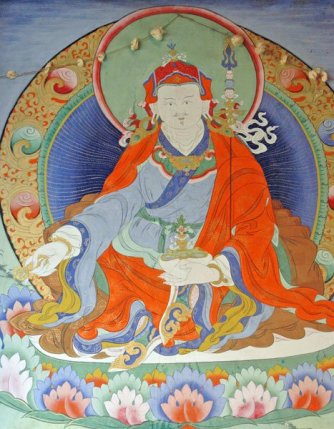
Wall painting at Paro Bridge, Bhutan, of Padmasambhava. Photo: Baldiri, WikipediaFrom the 11th century, many Tibetan saints and eminent figures came to Taktsang to meditate, including Milarepa (1040–1123)4, Pha Dampa Sangye (died 1117), the Tibetan yogini Machig Labdrön (1055–1145) and Thangton Gyelpo (1385–1464).
Between 12th and 17th centuries, many Lamas who came from Tibet established their monasteries in Bhutan.
The first sanctuary to be built in the area dates to the 14th century when Sonam Gyeltshen, a Nyingmapa lama of the Kathogpa branch came from Tibet.
The paintings he brought can still be faintly discerned on a rock above the principal building although there is no trace of the original one.
The Taktsang Ugyen Tsemo complex it is said to date back to 1408. Taktsang remained under the authority of the Kathogpa lamas for centuries until the mid-17th century.
A monastery complex was built in 1692 by Gyalse Tenzin Rabgye (1638-1696) around the Taktsang Senge Samdup cave. The plan to create an edifice at this site was originally that of the Shabdrung Rinpoche, Tenzin Rabgye‘s teacher.
On April 19, 1998, a fire broke out in the main building of the monastery complex, which contained valuable paintings, artifacts, and statues. The fire is believed to have been caused by electrical short-circuiting or flickering butter lamps lighting the hanging tapestries.
A monk died during the fire. The Government of Bhutan and the then King of Bhutan, Jigme Singye Wangchuck, oversaw the restoration of the damaged monastery and its contents in 2005.
Features
The monastery buildings consist of four main temples and residential shelters ideally designed by adapting to the rock (granite) ledges, the caves, and the rocky terrain. Out of the eight caves, four are comparatively easy to access.
The cave where Padmasambhava first entered is known as 'Tholu Phuk' and the original cave where he resided and meditated is known as the 'Pel Phuk'.
The main cave is entered through a narrow passage. It houses a dozen images of Bodhisattvas and of Chenrezig (Avalokitesvara). An adjoining small cell houses a sacred scripture scripted with gold dust and the crushed bone powder of a divine Lama.
All the buildings are interconnected through steps and stairways made in rocks. There are a few shaky wooden bridges along the paths and stairways also to cross over. The temple at the highest level has a frieze of Buddha.
Each building has a balcony, which provides views of the scenic Paro valley down below.
Another important place near the shrine is the Urgyan Tsemo, the “Peak of Urgyan” which has a small Mani Lakhang5.
The prayer wheel, turned by an old monk, resounds with chimes that are heard every day at 4 am.
Above the Urgyan is the holy cave temple known as “Phaphug Lakhang,” which is the main shrine of the Taktshang. It is also the residence of the Head Lama, Karma Thupden Chokyi Nyenci.
Festivals
Tshechu (literally "day ten") are annual religious Bhutanese festivals held in each district (dzongkhag) of Bhutan on the tenth day of a month of the lunar Tibetan calendar. The month depends on the place.
Tshechus are religious festivals of the Drukpa Lineage of the Kagyu school of Tibetan Buddhism.
At that time, large social gatherings take place, which perform the function of social bonding among people of remote and spread-out villages. Large markets also congregate at the fair locations, leading to brisk commerce.
Thimphu and Paro festivals are among the biggest in terms of participation and audience. They are related to traditions in other branches of Himalayan Buddhism, many of which have been banned in Tibet. In 2011, Paro Tshechu was performed March 15-19.
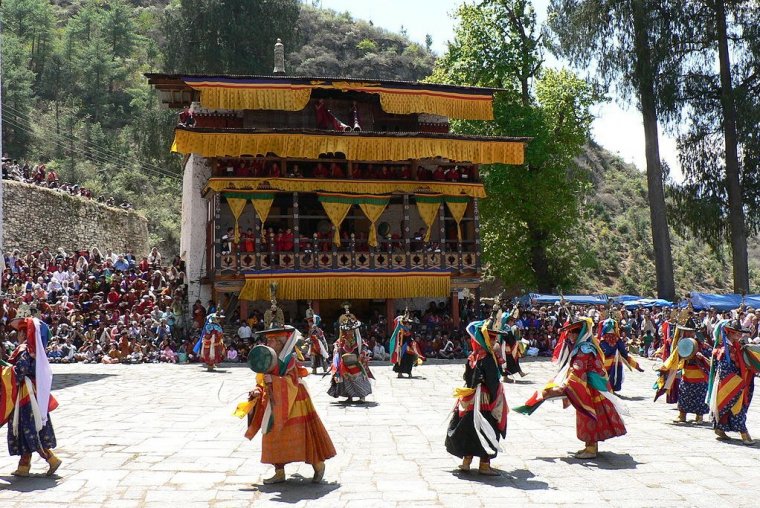
Dance of the Black Hats with Drums, Paro, April 2006. Photo: Stephen Shephard, Wikipedia.
The focal point of the tshechus are Cham dances. These costumed, masked dances typically are moral vignettes, or based on incidents from the life of Padmasambhava and other saints.
Typically, monks perform unmasked in certain group dances, including the Black Hat dance, while laymen perform masked, in largely different plays.
The monks are generally very precise in their movement, while some roles played by laymen involve considerable athleticism. Groups of women perform songs, with limited dance movements, in between the plays.
Most tshechus also feature the unfurling with intense religious fervor, early in the morning., of a large appliqué thangka typically depicting a seated Padmasambhava surrounded by holy beings, the mere viewing of which is said to cleanse the viewer of sin.
The thangka is raised before dawn and rolled down by morning.
Padmasambhava came to Tibet and Bhutan in the 8th century and 9th century. He used to convert opponents of Buddhism by performing rites, reciting mantras, and finally performing a dance of subjugation to conquer local spirits and gods. He visited Bhutan to aid the dying king Sindhu Raja.
Padmasambhava performed a series of such dances in the Bumthang Valley to restore the health of the king. The grateful king helped spread Buddhism in Bhutan.
Padmasambhava organized the first tshechu in Bumthang, where the eight manifestations of Padmasambhava were presented through eight forms of dances. These became the Cham dances depicting the glory of Padmasambhava.
Etiquette and Awareness
Those who wish to go on pilgrimage to Paro Taktsang and nearby sacred sites, should obtain a special permit from the Department of Culture, Ministry of Home & Cultural Affairs, Thimphu.
To maintain the sanctity of the place, ordinary tourists without a permit may not be allowed to go beyond Tsogyal Pangchung (meadow of Yeshe Tsogyal) before the Shelkarchu waterfall. At that place there is however an excellent view of Taktsang and a place to offer butter lamps.
Sources
• http://www.parotaktsang.org/
• https://en.wikipedia.org/wiki/Paro_Taktsang
• http://himalaya.socanth.cam.ac.uk/collections/journals/jbs/pdf/JBS_01_01_02.pdf
• https://www.holybooks.com/wp-content/uploads/The-Great-River-Of-Blessings.pdf
• http://rywiki.tsadra.org/index.php/Paro_Taktsang
Footnotes
1. Heruka: literally, 'blood drinker.' A wrathful deity, drinker of the blood of ego-clinging.
2. Jigten Chöto, or ‘worldly offerings and praises,’ relates to the worldly deities that govern the physical realms, the worldly entities that dwell in the physical realms, or “Protectors.“
3. Langchen Palgyi Senge was one of the eight chief disciples of Padmasambhava when the empowerment of the Assemblage of Sugatas (cycle of teachings connected to the Sadhana Section of Mahayoga) was conferred. He attained both the common and supreme accomplishments at Paro Taktsang.
4. The collection of Milarepa's songs compiled by Lhatsun Rinchen Namgyal (1473-1557) records that Milarepa visited Taktsang where he meditated for three months. Following his retreat he encountered four ascetics to whom he sang a song explaining the ten signs of his attainment.
5. Lhakhang (or Lakhang) are religious structures (temples) found throughout the Himalayas (Nepal, Bhutan) that house sacred objects, and in which religious activities take place. Lhakhang means “the house of gods”: enlightened beings such as the Buddha, his followers, and other deities.
YOU MAY ALSO LIKE