| / Ashrams, Monasteries |
Amarbayasgalant Monastery, Mongolia
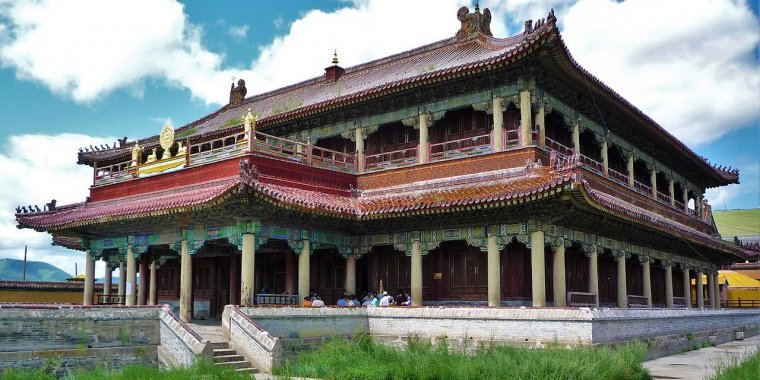
Amarbayasgalant Monastery, the main temple. 
Amarbayasgalant Monastery "Monastery of Tranquil Felicity", is one of the three largest Buddhist monastic centers in Mongolia.
The monastery complex is located in the Iven Valley near the Selenge River, at the foot of Mount Büren-Khaan in Baruunbüren sum (district) of Selenge Province in northern Mongolia. The nearest town is Erdenet which is about 60 km to the southwest.
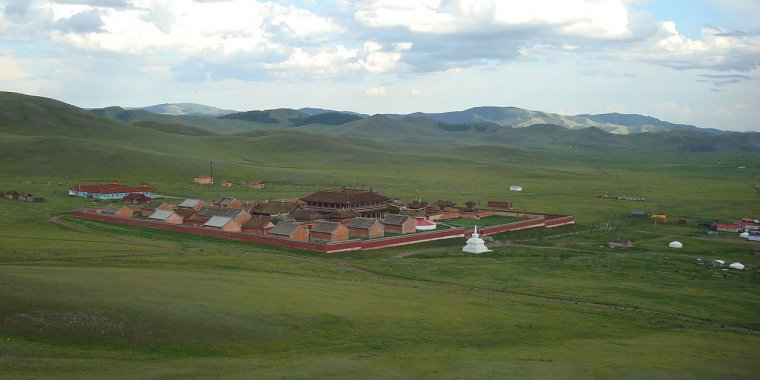
Amarbayasgalant Monastery.
The monastery was established and funded by order of Manchu Yongzheng Emperor (and completed under his successor the Qianlong Emperor) to serve as a final resting place for Zanabazar (1635–1723), the first Jebtsundamba Khutuktu, or spiritual head of Tibetan Buddhism for the Khalkha in Outer Mongolia and a spiritual mentor to both emperors' ancestor, the Kangxi Emperor.
Tradition holds that while searching for an appropriate site to build the monastery, the exploratory group came across two young boys, Amur and Bayasqulangtu, playing on the steppe. They were inspired to build the monastery on that very spot and to name it after the two children, Amur-Bayasqulangtu.
More likely, the location was chosen because it stood at the place where the lama's traveling Da Khuree (his mobile monastery and prime residence) was encamped at the moment of his death. Construction took place between 1727 and 1736 and Zanabazar's remains were transferred there in 1779.
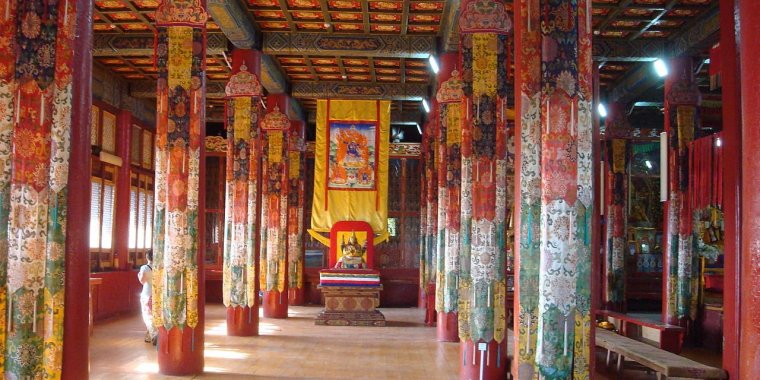
Amarbayasgalant Monastery, interior.
Amarbayasgalant monastery is dedicated to Zanabazar's main tutelary deity, Maitreya. Unlike Erdene Zuu Monastery, which is an ensemble of temple halls of different styles, Amarbayasgalant shows great stylistic unity. The overriding style is Chinese, with some Mongol and Tibetan influence.
The monastery resembles Yongzheng's own palace Yonghegong in Beijing (converted by his son the Qianlong Emperor into a Buddhist monastery).
Originally consisting of over 40 temples, the monastery was laid out in a symmetrical pattern, with the main buildings succeeding one another along a North-South axis, while the secondary buildings are laid out on parallel sides.
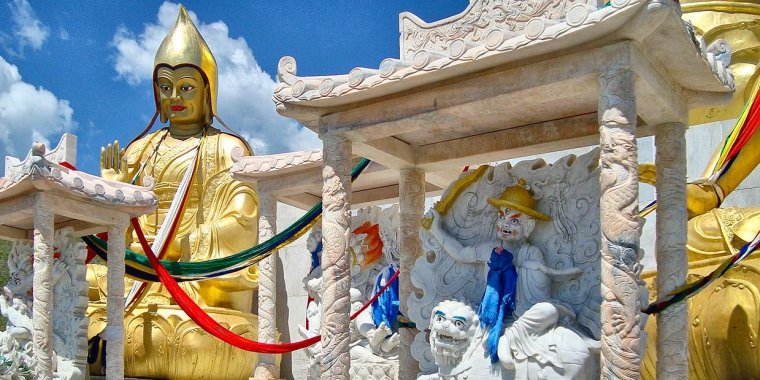
Amarbayasgalant Monastery.
The communists closed the monastery, killed several of the monks, and destroyed 10 of the temples in 1937. Luckily, 26 of the temples survived and have been partially restored through help from UNESCO and the Indian government.
Several new stupas and a large statue of Buddha have been added to the neighboring hills. As of 2012, about 60 monks live in the monastery.
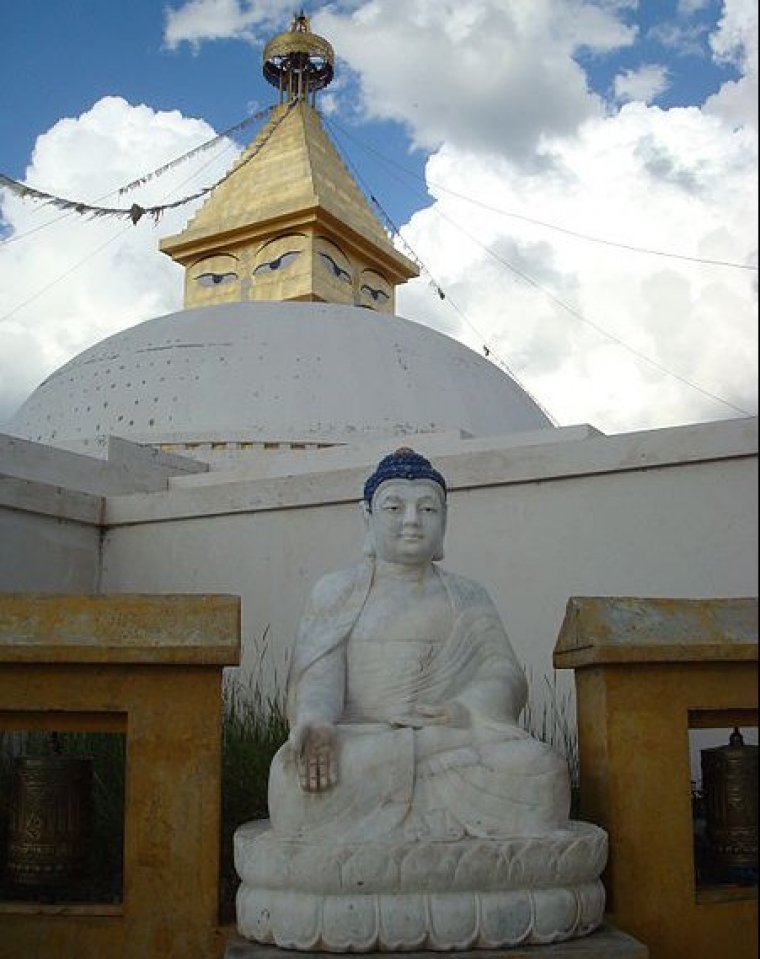
Stupa on a hill next to the monastery Amarbayasgalant.
Most of the monastery is free, except the main temple, which costs 5,000₮. (Wikipedia)
YOU MAY ALSO LIKE