| / Ashrams, Monasteries |
Lamayuru Monastery, Ladakh, India
Drikung Kagyu Lineage, 11th century, about 150 monks.
Lamayuru Monastery is affiliated with the Drikung Kagyu school of Buddhism and houses approximately 150 Buddhist monks. The monastery is made up of several shrines and has a very rich collection of thankas and magnificent wall paintings.
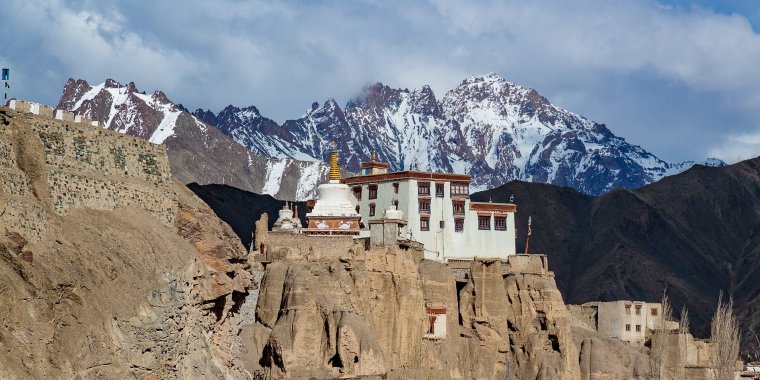
Lamayuru Monastery. Photo: Dmitry A. Mottl, Wikipedia.
Location
Lamayuru Monastery is situated on the Leh-Srinagar road, 125 km from Leh.
History
Originally, Lamayuru Monastery consisted of five buildings, out of which only the central one exists today.
A. H. Francke states that, "according to popular tradition," it was originally the foremost Bon monastery in Ladakh; its name means sauvastika1 and is a popular symbol in Bon for "eternity". Yungdrung2 is the name of the most popular school of Bon.
The legend says that Naropa, the 11th century Indian Buddhist scholar, sat in meditation for some time in one of the caves in Dukhang and he caused a crack in the hillside surrounding the lake.
The lake eventually drained, making way for the construction of a monastery. When the lake dried out, he found a dead snow lion, and on that spot the first temple of the area was constructed, known as the Singhe Ghang (Lion Mound).
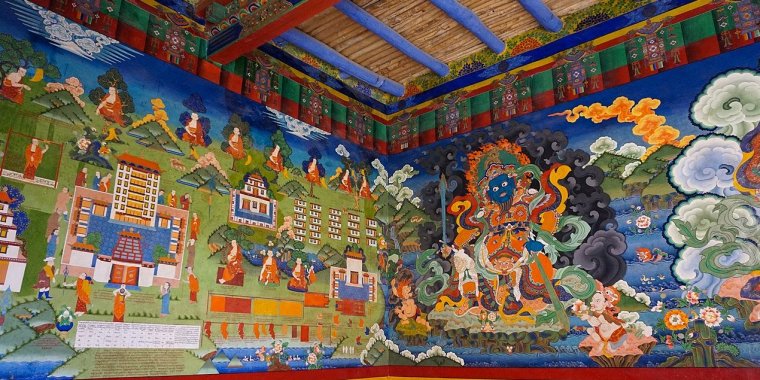
Murals in Lamayuru Monastery. Photo: Bernard Gagnon, Wikipedia.
Another legend has it that the building of Lamayuru Monastery was constructed according to the instructions of the King of Ladakh, under the direction of Rinchen Zangpo (958-1055 CE), the translator, and the monastery came under the administration of the Kadampa sect for 500 years.
During King Jamyang Namgyal’s rule in the sixteenth century, it was offered to Chosje Danma of the Drikung Kagyu School. The successive reincarnations of Skyabsje Toldan Rinpoche act as the chief skushoks (avatar) of the monastery. He has a dedicated festival in the fifth Tibetan month.
Features
The gompa consisted originally of five buildings, and some remains of the four corner buildings can still be seen. The oldest temple, the Sengesang, has a stucco of Vairocana seated on a lion throne.
The main temple has the cave of Naropa and contains three clay statues representing the three great masters: Naropa, Marpa and Milarepa. Naropa was the teacher of Marpa, who started Kagyu school in Tibet.
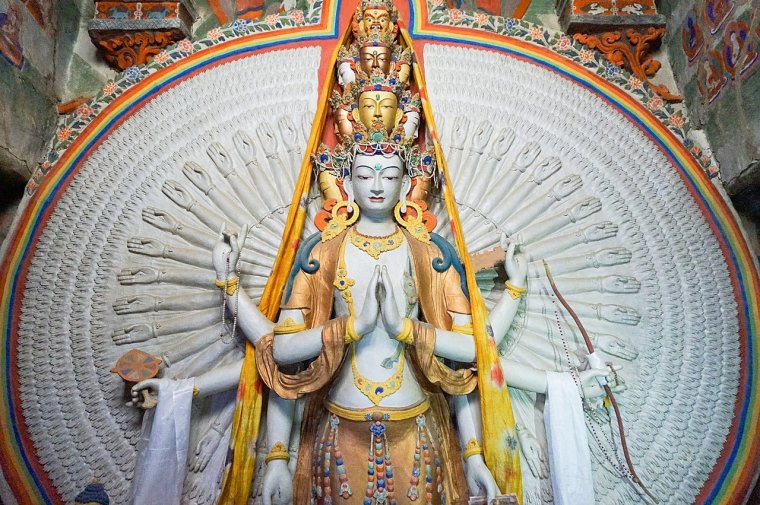
tatue of Avalokiteśvara in Chenrezi Lhakhang. Photo: Bernard Gagnon, Wikipedia.
Festivals
Lamayuru is host to two annual masked dance festivals in the second and fifth months of the Tibetan lunar calendar, when all the monks from these surrounding gonpas gather to pray.
Travel
The nearest airport to Lamayuru monastery is Leh, 125 Km away. Flights from Delhi to Leh are less than two hours, then It takes a couple of hours by car to reach the monastery.
Sources
• https://en.wikipedia.org/wiki/Lamayuru_Monastery
• http://www.buddhist-temples.com/buddhist-monastery/ladakh/lamayuru.html
• https://timesofindia.indiatimes.com
Footnotes
1. The svastika symbol, 卐 (right-facing or clockwise) or 卍 (left-facing, counterclockwise, or sauvastika), is an ancient religious icon in the cultures of Eurasia. It is used as a symbol of divinity and spirituality in Indian religions, including Hinduism, Buddhism and Jainism.
2. Yungdrung refers to the left-facing svastika (sauvastika), a symbol which occupies in Bon a similar place as the vajra in Tibetan Buddhism, symbolizing indestructibility and eternity.
YOU MAY ALSO LIKE