| / Ashrams, Monasteries |
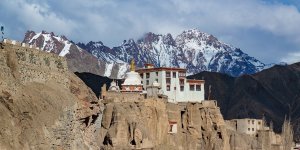
Likir Monastery, Ladakh, India
Gelug Tradition, 11th century, about 120 monks.
Likir Monastery, also known as Likir Gompa, is of the Gelugpa sect of Tibetan Buddhism. Likir means the Naga encircled. The monastery got its name as it is believed two serpent spirits, Nanda and Taksako guard it.
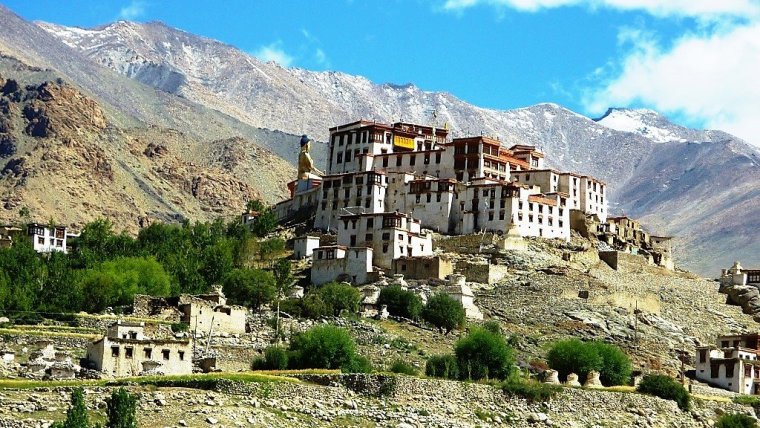
Likir Monastery, Ladakh, India. Photo: John Hill, Wikipedia.
Location
Located at 3700m elevation, approximately 52 kilometres west of Leh, the monastery is picturesquely situated on a little hill in the valley, in Likir village near the Indus River.
History
Lhachen Gyalpo, the fifth king of Ladakh, offered the site where the monastery now stands, to Lama Duwang Chosje. The Lama, a great meditator, blessed the site offered to him, after which the construction on the monastery was undertaken in 1065 CE.
Presumably, it originally belonged to the early Kadampa order of Tibetan Buddhism.
When the German tibetologist August Hermann Francke visited the monastery in 1909 he was shown a long inscription written in black ink on a wall which outlined the history of the monastery. Francke had it copied and interprets it as follows:
"King Lha-chen-rgyal-po founded the monastery in the 11th century. In the 15th century, Lama Lha-dbang-chos-rje (a famous pupil of Tsongkhapa) converted the lamas to the reformed doctrines of the Ge-lug-pa order, and thus founded the monastery afresh as a Ge-lug-pa establishment. Then it is stated that seven generations after Lha-chen-rgyal-po, King Lha-chen-dngos-grub (c. 1290-1320) arose, and that he introduced the custom of sending all the novices to Lhasa."
Likir Monastery is the seat of the Ngari Rinpoche, the present emanation of the younger brother of the Dalai Lama. Although he does not permanently reside here, he attends the more important pujas.
Features
The monastery currently has approximately 120 monks and a school with thirty students. The Central Institute of Buddhist Studies runs it and teaches in three languages, Hindi, Sanskrit and English.
Historical notes on a sign outside gompa reads:
"Lu.Khyil (water spirits circled) popularly known as “Likil” Gonpa gives its name to Nagas (water spirits) who once lived there. It is another important Ge.lug.pa monastery in Ladakh. Lachen Gyalpo, the fifth king of Ladakh is said to have offered to Lama Duwans Chosje, a great master of meditation, the land for building a monastery in 1065, This monastery joined the Gelugpa order in the 15th century.
The Du-Khang (Assembly Hall) contains Mar.ime.zat, Shakyamuni, and Maitreya (Buddhas of the past, present and future) an imposing statue of Tsong.Kha.pa and Kangyur & Tangyur. In Nyenes Khang are the life-like paintings of the Tung-Shah (the thirty-five confessional Buddhas and Nas.Tan.Chu.Tuk, sixteen arahats) The Gon Khang houses the statue of Se.Ta.Pa an imposing protective deity of the monastery and Yamantaka.
Likir Dos.mo.che, the annual festival of the monastery is held from 27th to the 29th of the 12th Tibetan month. By Courtesy of Tourism Deptt. Leh"
The monastery has two assembly halls, known as Dukhangs. They contain statues of Amitabha, three large statues of Buddha Sakyamuni, Maitreya and Tsong Khapa, founder of the yellow-hat sect.

Hanging prayer flags on the statue of Maitreya. Photo: John Hill, Wikipedia.The monastery is also a repository of old manuscripts, has a notable thangka collection and old costumes.
Sitting on the roof is a 23-metre high gilded statue of Maitreya Buddha, completed in 1999.
Bookcases stand at the statue sides, with the volumes of the Sumbum, describing the life and teachings of Tsong Khapa.
The left wall has paintings of the 35 Confessional Buddhas while the right wall has an image of Sakyamuni with two of his chiefs by his side.
A ladder leads to the Zinchun, which is the head lama's room containing mainly thangkas and images of lamas and the 21 manifestations of the White Tara, the consort of Avalokitesvara.
The Gonkhang was created in 1983 when the monastery underwent renovation and was completed a year later. The walls of the Gonkhang contain thangkas of the divinities.
Festivals
The Gompa serves as the venue of an annual event Dosmoche1, the assembly of votive offerings.
This event takes place from 27th day to 29th day of the 12th month of the Tibetan calendar. During Dosmoche, sacred dances are also performed at the monastery.
Travel and Visiting
By road, Likir Monastery can be reached via Manali-Leh route (473km), or via Srinagar-Leh route (434 km). The first route remains open only from July to September and the second route is open June to October. It takes 1.5 to 2 hour to reach Likir monastery from Leh by car.
Kushok Bakula Rimpochee airport in Leh is 7 km from the main city of Leh. Jet Airways provide flights Leh to Delhi regularly while Alliance Air provides connecting flights from Srinagar to Jammu and Leh to Delhi.
Sources
• https://en.wikipedia.org/wiki/Likir_Monastery
• http://www.buddhist-temples.com/buddhist-monastery/ladakh/likir.html
• https://www.lehladakhtourism.com/
Footnotes
1. Dosmoche is a festival celebrated in Leh, Likir and Diskit monasteries. It is the last festival of New Year Celebrations, while the other one is Losar. Dosmoche is also known as the "Festival of Scapegoat" and is one of Ladakh's most popular prayer festivals.
YOU MAY ALSO LIKE