| / Ashrams, Monasteries |
Thiksay Monastery, Ladakh, India
Gelug Tradition, 15th century, about 80 monks.
Location
Thiksay Gompa or Thiksey Monastery is a gompa (Tibetan-style monastery) affiliated with the Gelug sect of Tibetan Buddhism. It is located on top of a hill in Thiksey, approximately 19 kilometres east of Leh in Ladakh, India, at an altitude of 3,600 metres.
History
Thiksay Monastery it is noted for its resemblance to the Potala Palace in Lhasa, Tibet, being also known as “Mini Potala.” In central Ladakh, it is the largest gompa, a twelve-story complex housing many items of Buddhist art such as stupas, statues, thangkas, wall paintings and swords. There are two additional monasteries, a nunnery, and 12 temples that operate under Thiksey’s care.
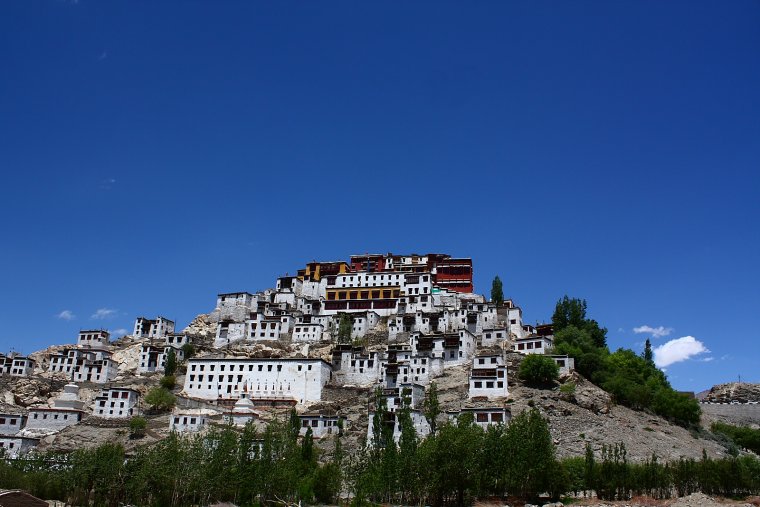
Thiksay Monastery, Ladakh, India. Photo: wikipedia.org
One of the main points of interest is the Maitreya Temple installed to commemorate the visit of the 14th Dalai Lama to this monastery in 1970; it contains a 15 metres (49 ft) high statue of Maitreya, the largest such statue in Ladakh, covering two stories of the building.
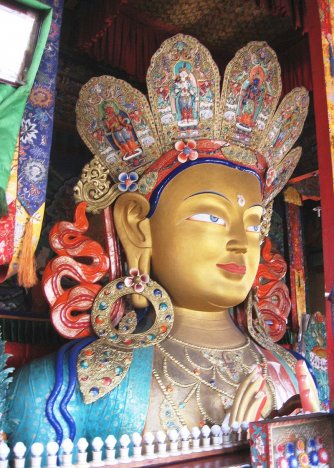
The statue of Maitreya Buddha at Thikse is two storeys tall. Photo: wikipedia.orgIn the early 15th century, Je Tsongkhapa, the founder of the Gelug School sent six of his disciples to remote regions of Tibet to spread the teachings of the new school.
Tsongkhapa gave Sherab Zangpo, one of his disciples, a small statue of Amitayus 1, containing bone powder and a drop of Tsongkhapa's own blood and directed him to meet the King of Ladakh with a message seeking his help in the propagation of Buddhism.
The King loved the gift of the statue and directed his minister to help Sherab Zangpo to establish a monastery of the Gelug order in Ladakh. As a result, in 1433, Zangpo founded a small village monastery called Lhakhang Serpo "Yellow Temple" in Stagmo, north of the Indus.
Despite his efforts, the lamas who embraced the Gelug order were initially few, although some of his disciples became eminent figures over the years.
In the mid-15th century, Palden Zangpo continued the monastic work started by his teacher, Sherab Zangpo. He decided to build a larger monastery here that was dictated by an unusual event that occurred while choosing a site.
Legends narrate that Tsongkhapa had predicted that his doctrine would prosper on the right bank of the Indus River. This prediction came true when the Thiksay Monastery was established.
This was followed by others such as Spituk Monastery and Likir Monastery, which are also situated on the right bank of the Indus.
Thiksay grew in prominence in Ladakh, second only to Hemis Monastery, administering ten other monasteries in the region, such as Diskit, Spituk, Likir and Stok. The monastery came to own or control 1,327 acres (537 ha) of land and some 25 villages became attached to the monastery.
Restoration of the old monasteries in Ladakh, including the Thiksay Monastery, is being carried out by the Archaeological Survey of India, at the request of the concerned Monastery administration.
Thiksay Gompa serves as the residence of approximately eighty monks and Thiksay Khenpo Rinpoche is the incumbent head of the monastery. He is the 9th reincarnation of Jangsem Sherab Zangpo, a contemporary disciple of Je Tsongkhapa, the founder of the Yellow Hat sect of Tibetan Buddhism.
Festivals
The annual festival held in the monastery precincts is known as the Gustor ritual, which is held from the 17th to 19th day of the ninth month of the Tibetan calendar (October–November). It is a traditional ceremony conducted in the monasteries of Gelukpa order of Tibetan Buddhism. Sacred dances such as the mask dance or Cham dance are performed as a part of this ritual.
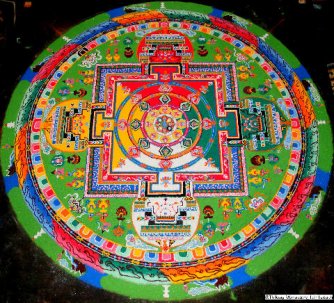
Sand Mandala by monks at Thiksay Monastery. Photo: thiksay.orgAnother special feature is the trade fair held at the base of the monastery, in which villagers from all over Ladakh assemble to barter and trade items and socialize. Sand mandalas are made for smaller festivals.
The morning prayers at 07:00, with synchronized chanting of sūtras at this monastery, attract many worshippers to observe the services.
Sand mandalas of Guyusamaja, Chakrasamvara, Vajravairava are made every year. They are made inside the Main Temple in the Fourth, Sixth and Eight months of the Tibetan calendar representing the abodes of these deities.
Mandalas are used as an aid to meditation, during which the monks visualize transforming themselves into the deities represented in the design. Once the initiation and meditation are complete, the mandala is destroyed illustrating the impermanence of all things.
Accommodation and Facilities
Visiting hours are form 6:00AM to 7:00Pm, except for a lunch break 1:00 - 1:30PM and tea break 4:00-4:15PM. The main prayer hall, Mahakala, Palden Lamo, Maytreya, Tara, Gold and Silver Stupa temples are available for visiting during these hours.
Multiple hotels are available in the area between Leh and Thiksay monastery.
Also, the monastery has guest rooms available with essential amenities. Visitors can meditate in the peaceful ambience, watch the monks and nuns go about their daily routine. The monastery has a well-stocked library that is available to visitors.
Etiquette and Awareness
• Inside the monastery visitors are requested to refrain from smoking, drinking alcohol, or carry any kind of weapon.
• Appropriate clothing is required.
• Video recording is only permitted upon purchasing a video ticket.
• Visitors are requested not to offer money, gifts, or other items to the monks. Donations are accepted at the monastery office.
• It is not permitted to stay over night in the private cells of the monks.
Altitude sickness, the mildest form being acute mountain sickness (AMS), is the harmful effect of high altitude, caused by rapid exposure to low amounts of oxygen at high elevation. People can respond to high altitude in different ways. Symptoms may include headaches, vomiting, tiredness, confusion, trouble sleeping, and dizziness.
Acute mountain sickness can progress to high altitude pulmonary edema (HAPE) with associated shortness of breath or high altitude cerebral edema (HACE) with associated confusion. Prevention is by gradually increasing elevation by no more than 300 meters (1,000 ft) per day.
Sources
• https://en.wikipedia.org/wiki/Thikse_Monastery
• http://www.thiksay.org
Footnotes
1. The saṃbhogakāya form of Amitābha.
YOU MAY ALSO LIKE