| / Ashrams, Monasteries |
Tsuklakhang Monastery, Sikkim, India
Nyingma Tradition, 19th Century.
Tsuklakhang Palace or Tsuklakhang Royal Chapel and Monastery is a Buddhist palatial monastery in Gangtok, Sikkim, India. It served as a location for coronation, marriages, and victory ceremonies for the Sikkimese royalty until the merger of Sikkim as a state of the Indian Union in 1975.
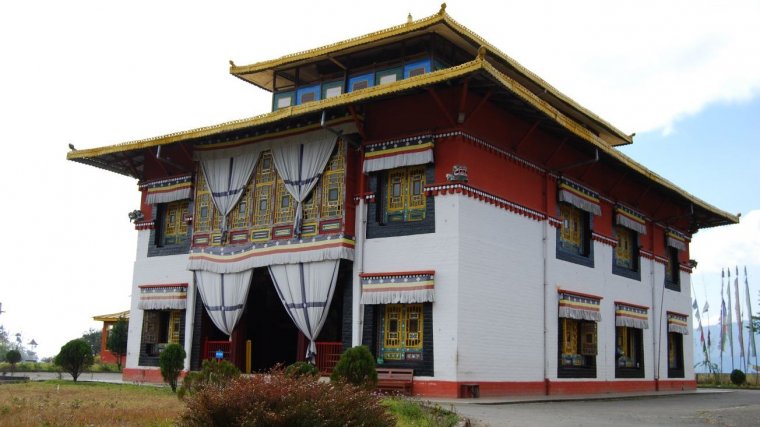
Tsuklakhang Main Temple, Gangtok, Sikkim. Photo: Xavier Rashid.
Location
History
This monastery was probably built in the year 1898 CE during the reign of 9th King Thutob Namgyal (1860-1914).
The last Chogyal of Sikkim, Wangchuk Tenzing Namgyal, before devoting himself to the life of monkhood, established the Tsuklakhang Trust dedicated to preservation of Tsuklakhang Monastery.
Features
The Royal Chapel of the Chogyals is the main venue for prayers with an assembly hall in the center and large depository of Buddhist scriptures and literature and contains altars which are ornate with Buddha, Bodhisattvas and Tantric deities.
The main temple of Tsuklakhang adheres to the precedence of the square form with a focus on the center, or axis mundi, symbolizing the ordered world. (James, Katharine Louise)
The main monastic grounds can be entered through a stone pathway from the palatial side of the grounds or through the official gates adorned with the emblem of a wheel and deer,1 then one must climb a final ascent to the monastery and its accompanying buildings.
Through its construction of floors, Tsuklakhang upholds traditional Buddhist concepts of hierarchy articulated by architectural tiers and height. Beside the main temple, Tsuklakhang has multiple religious buildings on the same grounds, which vary in function. (JKL)
Within the walls of the Tsuklakhang, a comprehensive restoration project begun in March 2011. The former German restorer and co-founder of the Tibet Heritage Fund, André Alexander (1965-2012), started the project with Parisian conservator Anca Nicolaescu and aid from Ladakh artists.
Tsuklakhang Monastery in Pictures
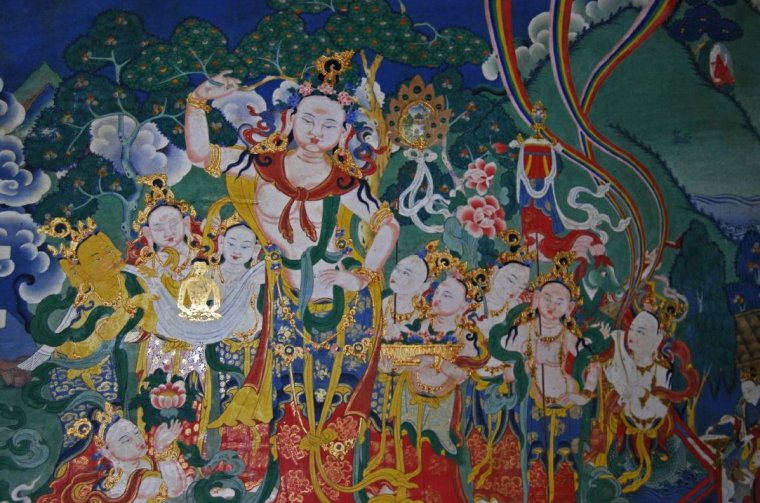
Birth of Buddha, First Floor of Tsuklakhang. Photo: Xavier Rashid.
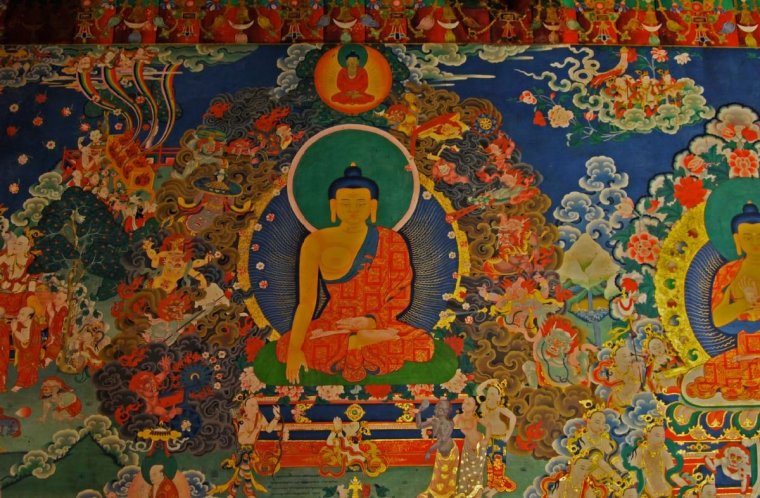
Buddha’s Enlightenment, First Floor of Tsuklakhang. Photo: Xavier Rashid.
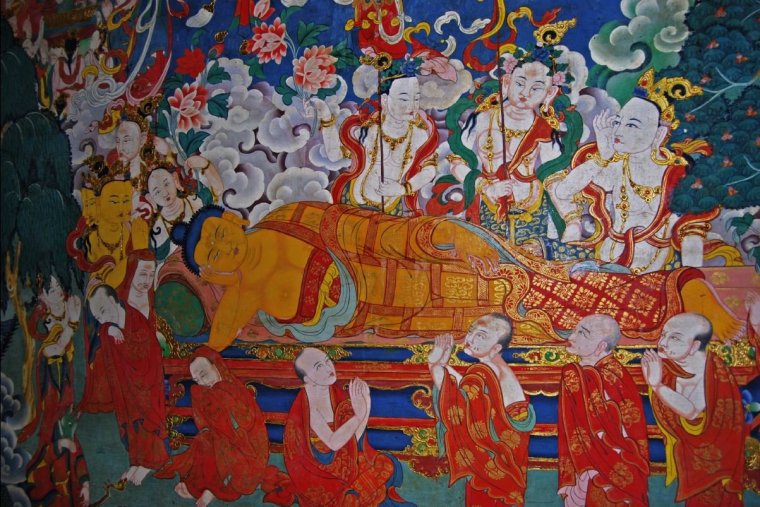
Parinirvāṇa of Buddha, First Floor of Tsuklakhang, Photo: Xavier Rashid.
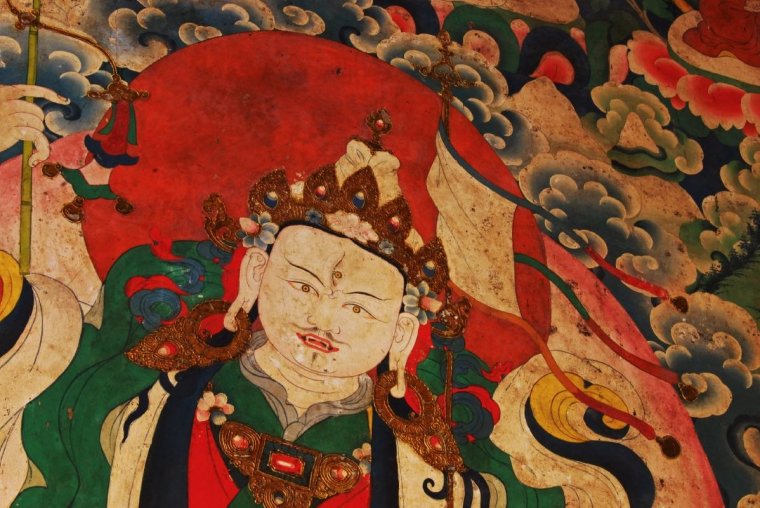
Guru Rinpoche, Ground Floor of Tsuklakhang. Photo: Xavier Rashid.
Festivals
• Saga Dawa celebrates Buddha’s birth, enlightenment, and passing into parinirvāṇa.
• Drukpa Tshezhi, the auspicious day when Lord Buddha gave his first sermon of the Four Noble Truth to his first five disciples at the Deer Park at Sarnath.2
• Guru Trungkar, birth anniversary of Padmasambhava
• Lhabab Duchen, Buddha's descent from the Trāyastriṃśa heaven down to earth.3
Previously, the famous winter festival Kagyad Chham and summer festival Pangtoed Chham were performed for worshipping the Guardian Deity of Mount Khangchendzonga known as Pang Lhabsol and functioned as a purification of the land and to expunge karmic actions of negative forces. However, after the abolition of Monarchy rule, the performance of Pangtoed Chham was discontinued.
Travel and Visiting
The monastery can be reached by a car from Gangtok, 124 km away.
Sources
• James, Katharine Louise (JKL), "The Royal Monastery of Tsuklakhang – A Buddhist Jewel" (2012). Syracuse
University Honors Program Capstone Projects. https://surface.syr.edu/honors_capstone/125
• http://www.sikkimeccl.gov.in/History/Monasteries/East/Tsuklakhang.aspx
• https://en.wikipedia.org/wiki/Tsuklakhang_Palace
Footnotes
1. Wheel of Dharma (Dharmachakra) is one of the Eight Auspicious Symbols of Buddhism. It is typically seen between two deer, symbolizing Buddha's first teachings at Deer Park in Sarnath. When Buddha gave this first sermon, legend says that two deer gathered around and listened.
2. Known as Asalha Puja or Dhamma Day in Theravada Tradition.
3. According to legend, the Buddha ascended the Trāyastriṃśa heaven temporarily at the age of 41, in order to give teachings to benefit the gods in that desire realm, and to repay the kindness of his mother by liberating her from Saṃsāra.
He was exhorted by his disciple and representative Maudgalyayana to return, and after a long debate and under a full moon agreed to return. He returned to earth a week later by a special triple ladder prepared by Viswakarma, the god of machines. This event is considered to be one of the eight great deeds of the Buddha.
On Lhabab Duchen, the effects of positive or negative actions are multiplied ten million times. It is part of Tibetan Buddhist tradition to engage in virtuous activities and prayer on this day.
YOU MAY ALSO LIKE