| / Buddhist Documentaries |
Sacred Places of The Buddhists (7)
The Sapta Parni Caves, India
A documentary film by BOGDAN-FLORIN PAUL
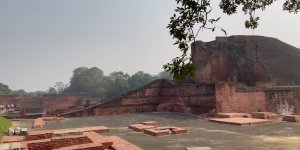
Sapta Parni, where the First Buddhist Council was held, is today a place of pilgrimage for Buddhists from all over the world.
It's a pleasant, peaceful place, with a beautiful view of the modern city at the base of the hill, Rajgir, Bihar, India.
After attaining Enlightenment under the Bodhi tree at Bodhi Gaya, the Buddha spent the next 45 years providing spiritual education and teachings to people of all social classes in the kingdoms of the northern Indian subcontinent.
The core of his teachings was the attainment of Liberation, with extremely precise details of the profound stages of meditation and samadhi, the achievement of which allows the meditator, through the power given by samadhi, to pierce the all-encompassing veil of illusion.
But, after the sudden death of his main disciples, Sariputra and Moggallana, whom he had intended to leave at the head of the order of bhikkhus that had formed around him, and after the Buddha's Parinirvana in 543 BCE, his teachings, of inestimable value to humanity, were threatened with being lost in the night of oblivion.
Under these circumstances, the senior monks of the Buddhist community decided to convene a gathering in which Ananda, the Buddha's personal assistant for the past 25 years, a Sakyan bhikkhu with an extraordinary memory, would recite the Buddha's dialogues and teachings that he had heard, to be rehearsed and preserved in the collective memory of all the monks present.
Upali, another Sakyan monk, would recite, for the same purpose, the Vinaya rules of discipline, and the circumstances in which the Buddha gave each rule.
The place chosen for this gathering would be on a hill near Rajagriha, in front of two caves called Saptaparni or Sattapanni, which would translate as the Caves of the Seven Leaves.
The gathering, which lasted several months and was attended by 500 bhikkhus, presided over by a senior monk named Mahakasyapa, would remain known in history as the First Buddhist Council.
The custom of joint rehearsal by Buddhist monks of the sutras and Vinaya rules is preserved and followed to this day.
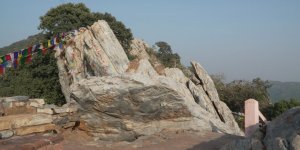
These rock walls above the Saptaparni caves were therefore witnesses to a crucial event in the spiritual history of humanity.
Watch this episode of the documentary film "Sacred Places of The Buddhists" to see what the Sapta Parni site looks like today and to learn more about the unique history of this place.
YOU MAY ALSO LIKE